
Every year, a retail brand makes the same expensive mistake.
A mid-size apparel company launches a new loyalty pass program and goes all-in on Apple Wallet. Pass enrollment among iPhone users rises quickly. Push notifications drive a clear increase in repeat visits. The CMO sends a celebratory Slack message.
Then the data team pulls the CRM report. In one composite example, more than 60% of the brand's highest lifetime-value customers in the U.S. Midwest are on Android. They never received a single push notification. They do not know the pass program exists.
This scenario is not hypothetical. It is a composite drawn from real patterns we see across pass issuers every quarter, and it points at the argument this piece makes: the Apple Wallet vs. Google Wallet question is strategic, not technical. The right answer depends on your audience.
This piece is for pass issuers, product managers, and marketing leads, not consumers comparing UI aesthetics. We evaluate these platforms on ROI, operational complexity, update reliability, and adoption behavior. At the end, you get a decision matrix you can use to score your own program.
The state of the platforms in 2026: market share is not the whole story
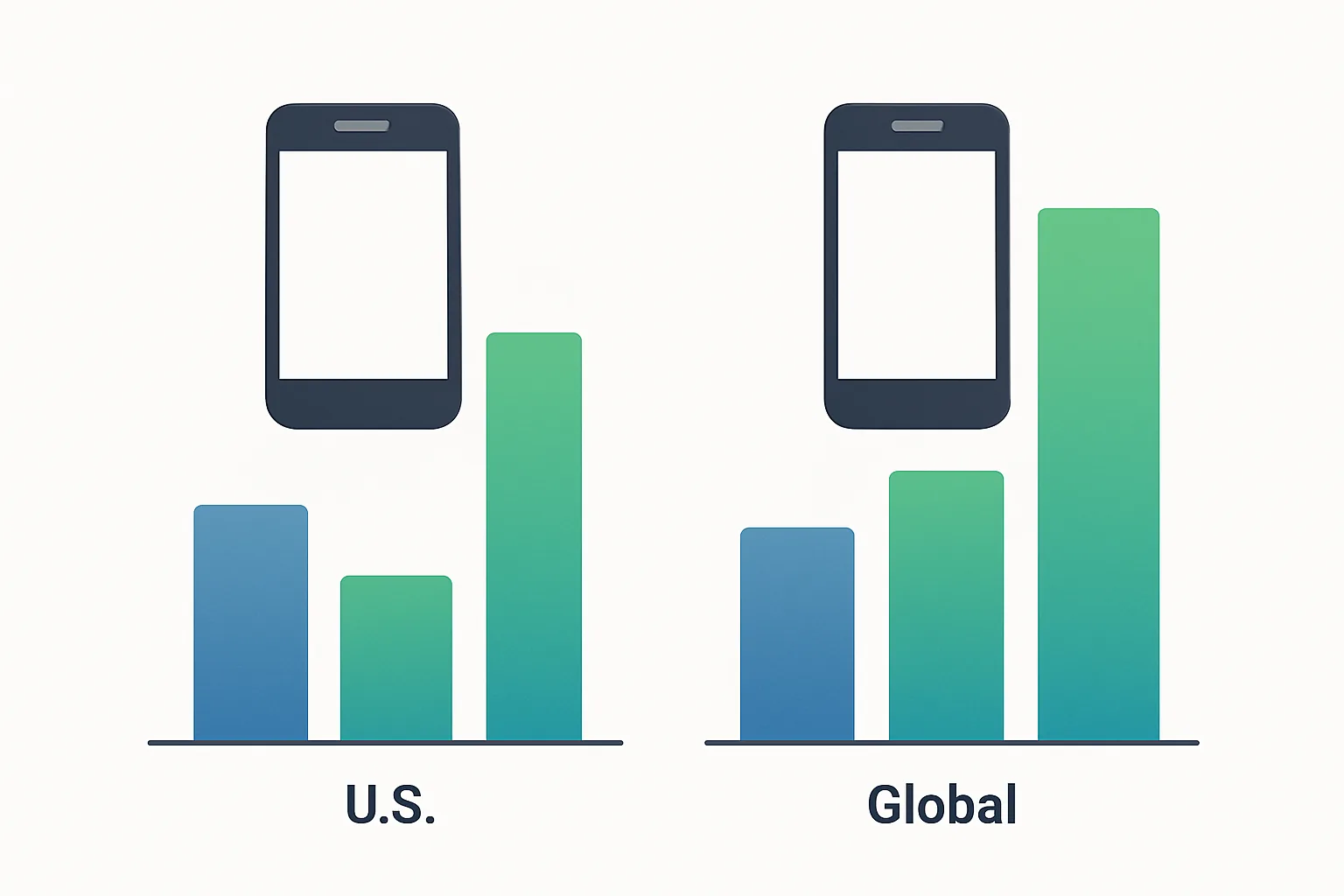
Start with the numbers everyone knows. In the U.S., iOS accounts for roughly 60-65% of the smartphone installed base. Globally, Android has roughly 70-75% of smartphones. These figures show up in every analyst deck. They are directionally accurate. They are also misleading if you are a pass issuer modeling wallet engagement.
Most issuers we speak with see higher Apple Wallet usage among iPhone customers than Google Wallet usage among Android customers. Apple Wallet ships pre-installed and is deeply integrated into iOS. There is no separate app to download and no account to configure. When someone adds a pass, it works.
Google Wallet usually requires more deliberate user action. On many Android devices, it is a separate app download. On others, it is bundled but not clearly surfaced. The gap between "owns an Android phone" and "actively uses Google Wallet" is wider than most issuers expect.
This distinction matters when you model conversion funnels. Think of it as "active pass users" versus "device owners." Apple's tight OS integration means higher passive enrollment. A user taps an "Add to Wallet" link and the pass can appear on the lock screen within seconds, if notification and location settings allow it.
Google Wallet often adds more friction, especially on devices from OEMs like Xiaomi or Oppo, where Google services may be de-prioritized in the default UI.
A few recent platform developments matter for issuers. Google has expanded its Wallet API capabilities compared with early Google Pay and WalletObjects. It added more pass types and notification options and signaled ongoing investment. Apple has evolved its pass ecosystem with order tracking features and new pass categories. Both platforms are investing. But feature parity does not equal reach.
Raw market share numbers do not answer the platform question. Vertical and demographic segmentation do.
Vertical by vertical: where each platform wins
Your industry influences which platform to prioritize, and in some cases it determines whether a single-platform launch is viable at all.
| Vertical | Skews toward | Why | Single-platform launch viable? |
|---|---|---|---|
| Premium retail | Apple Wallet | iOS over-indexes on higher-income, higher-spend shoppers in North America and Western Europe | Yes, iOS-first |
| Mass-market loyalty | Google Wallet | Value-conscious and emerging-market shoppers skew Android | Yes, Android-first |
| Travel and hospitality | Apple Wallet | Frequent business travellers in the U.S. and EU skew iPhone | Yes, iOS-first |
| Healthcare | Neither | Patients aged 45-75 split far more evenly than tech-early-adopter groups | No, dual platform required |
| Events and entertainment | Google Wallet | Younger and emerging-market audiences skew Android globally | Risky, dual platform advised |
Retail and loyalty. In North America and Western Europe, iOS skews toward higher-income, higher-spend demographics. If you are a premium retailer targeting affluent suburban shoppers, Apple Wallet gives you outsized reach into your core segment. If you run a mass-market loyalty program, especially one serving value-conscious consumers or emerging markets, Google Wallet becomes critical. Ignoring Android in these segments means ignoring your majority.
Travel and hospitality. Major airlines and hotel brands commonly support Apple Wallet for boarding passes and room keys. Many issuers report strong Apple Wallet adoption among frequent business travelers in the U.S. and EU. This group skews toward iPhone. Google Wallet is catching up, but the installed base advantage among high-frequency travelers is real.
Healthcare. Patient-facing passes like appointment reminders, insurance cards, and vaccination records often serve older demographics. This is a segment with a more balanced OS distribution than tech-early-adopter groups. A healthcare system targeting patients aged 45-75 in many U.S. metro areas will see a far more even iOS and Android mix than a student-focused program. Dual-platform support here is a requirement, not a nice-to-have.
Events and entertainment. Younger demographics drive ticketing, and younger demographics globally often skew Android. This is especially true in Latin America, Southeast Asia, and other emerging markets where Android dominates. If you issue event passes for music festivals, sports venues, or campus events, Google Wallet adoption matters more than U.S.-centric market share data suggests.
The pattern is clear. Your vertical shapes your audience OS distribution, and that distribution shapes your platform strategy.
Under the hood: pass updates, notifications, and barcode reliability
Platform choice is also about how reliably your passes behave once they are in a user's wallet. The engineering differences here matter.
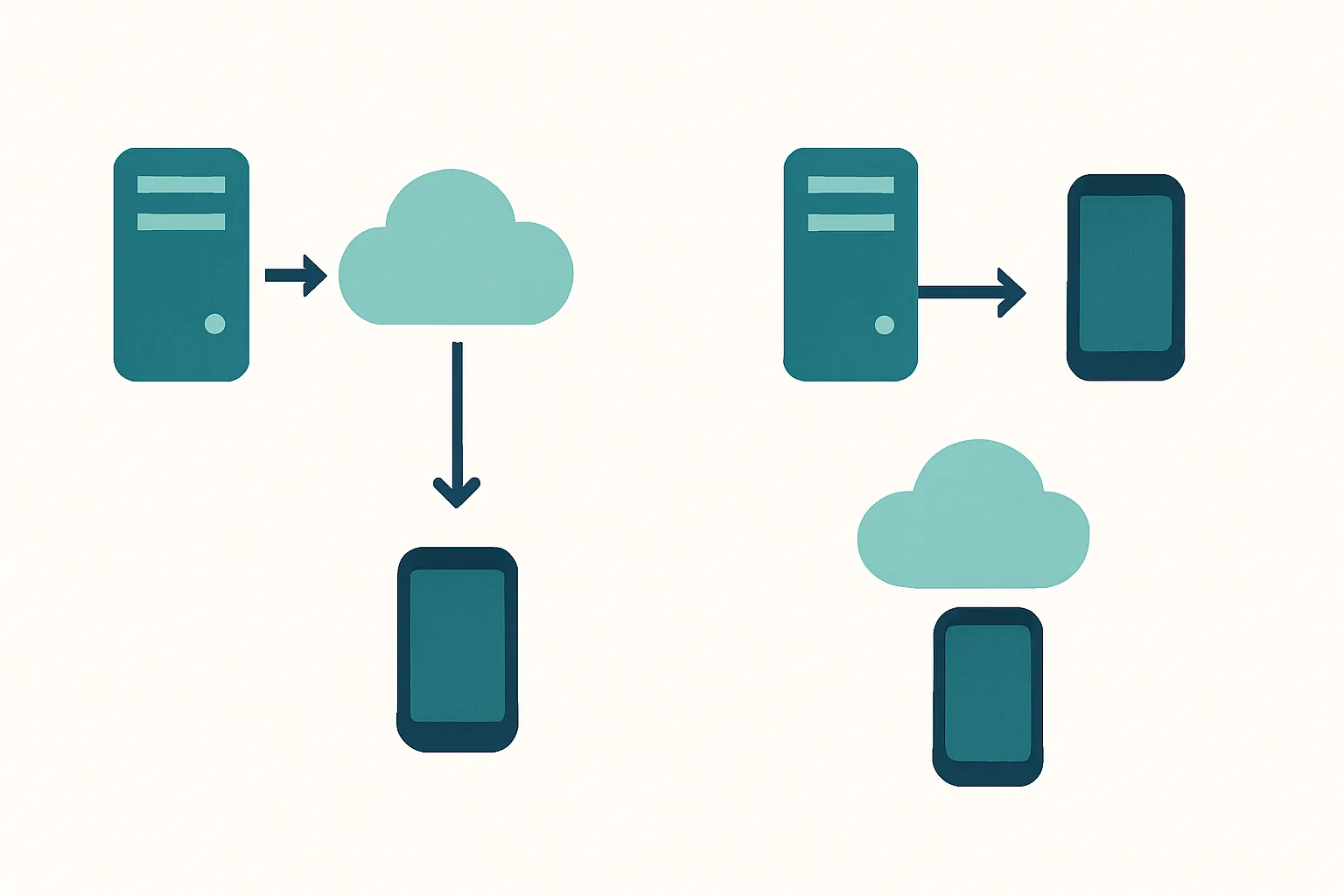
Pass update architecture. Apple Wallet uses a push-notification-triggered pull model. Your server sends a push through APNs (Apple Push Notification service). That tells the user's device to fetch the updated pass from your server. It is indirect but well defined, and Apple manages the delivery infrastructure.
Google Wallet uses a more direct server-side model through the Google Wallet API. You update the pass object on Google's servers, and the change then reaches the device. For some time-sensitive passes, such as gate changes, flash sale offers, or appointment updates, this model can in some cases offer slightly lower latency. Apple's model, in contrast, often gives more predictable behavior across the uniform iOS device fleet.
Notification mechanics. This is where fragmentation appears. Apple Wallet passes support time and location relevance. Passes can appear on the lock screen when users are near a set location or at a specific time, if users allow notifications and location access. Behavior is consistent at the OS level across iPhones running supported iOS versions. Users can still disable these features, but the baseline is predictable.
Google Wallet's notification support is more exposed to ecosystem variability. Android OEM skins such as Samsung One UI, Xiaomi MIUI, and OnePlus OxygenOS each handle background processes and notification delivery differently. Some kill background services aggressively to save battery. The result: wallet pass notifications may arrive late, arrive silently, or not arrive at all on certain devices. Many issuers underestimate this fragmentation until they are debugging delivery failures in production.
Barcode rendering. Apple Wallet renders barcodes using a consistent, native implementation across supported iOS versions and screen sizes. In practice, this produces crisp, high-contrast barcodes that scan reliably on properly configured devices.
Google Wallet's barcode rendering has historically shown more variability. Different screen sizes, display densities, and Android versions can affect the barcode. For POS scanning workflows in retail and transit, this variability can lead to longer transaction times and occasional scan failures.
Field-level updates. Both platforms support dynamic pass updates. Apple enforces a stricter change-set model. Certain field changes trigger a user-visible notification, and others update silently. Issuers need to understand this to avoid spamming users with irrelevant alerts, or making important updates that nobody notices.
Google's model is more flexible. It can also be less predictable in terms of what the user sees, depending on how you configure classes and instances.
Case study: how a mid-size retailer navigated the platform decision
Consider a composite case study drawn from patterns we have observed across multiple pass issuers. A U.S. apparel retailer with about 200 locations, a mix of suburban and urban stores, decides to replace its physical loyalty card with a digital wallet pass.
Phase 1: Apple Wallet. The team launches on Apple Wallet first. The reasoning is clear. Their customer base skews higher-income. Their development team has more iOS experience. Tooling similar to PassKit makes the initial build fast. In this composite example, within about 60 days they reach roughly one-third pass enrollment among iOS users. Geofenced notifications drive a low double-digit increase in store visits among passholders. Early results look strong.
The Android gap appears. Post-launch analytics tell a different story when viewed across all customers. Store visit data from POS transactions, not wallet data, shows that in this scenario nearly half of all store visits come from Android users. Pass adoption among this group is near zero. CRM data also shows these Android customers have lower digital engagement overall. They are exactly the segment a digital loyalty program should target.
Phase 2: Google Wallet. The team rolls out Google Wallet support, but does it carefully. They test notification delivery across Samsung Galaxy, Google Pixel, and OnePlus devices before launch. Where wallet notifications fail silently, a known issue on some OEM models with aggressive battery optimization, they add a fallback SMS message so the customer still gets the communication.
Outcome. In this composite scenario, moving from iOS-only to a dual-platform program produces a large increase in overall loyalty pass adoption. The lift is on the order of 50-60% compared to the iOS-only baseline. Notification testing is critical for Android. The phased approach works for this retailer, and the data shows a simple fact: an iOS-only program would have permanently excluded a large share of in-store customers from the most effective engagement channel available.
Launch both, or sequence them?
Should you launch on both platforms at once or roll out one at a time?
The case for simultaneous launch. You avoid splitting your customer base from day one. No segment feels like a second-class group. Your marketing is simpler. You can say "Add your pass now" instead of "Add your pass if you have the right phone." For healthcare and travel, where audience OS splits are often close to even, simultaneous launch is usually the only responsible choice.
The case for a phased rollout. An iOS-first rollout reduces initial engineering complexity. It allows your team to validate pass design, update logic, and support workflows on a more uniform platform before handling Android fragmentation. For teams with limited mobile wallet experience, this lower-risk path has value.
What adoption curves show. Many issuers see faster initial adoption for Apple Wallet passes, due to tighter OS integration and user familiarity. Google Wallet passes may show a slower ramp but can reach similar steady-state engagement over time, especially in Android-heavy verticals like events and mass-market retail.
A note on resources. Building passes for both platforms is not literally double the work if you use a unified pass management platform. You still need platform-specific QA, notification testing, and update logic validation. Engineering cost is manageable. Testing is where teams are often surprised.
Use this simple framework for your rollout decision. Launch simultaneously for healthcare, travel, and any program where your audience OS split is within 60/40 in either direction. Go iOS-first for premium retail targeting North American or EU demographics with clear iOS-skewing customer data. Go Android-first for emerging market programs or Gen Z-focused event and entertainment passes.
The decision matrix: a framework for product managers
Score your program across five dimensions.
| Dimension | Points to Apple Wallet | Points to Google Wallet | Points to dual-platform |
|---|---|---|---|
| Audience OS split | iOS above ~65% of your CRM records | Android above ~65% | Within roughly 60/40 either way |
| Geographic market | U.S., U.K., Western Europe, Japan | Latin America, Southeast Asia, Africa, India | Multi-region programs |
| Industry vertical | Premium retail, business travel | Events, mass-market retail | Healthcare, education, public sector |
| Time-sensitivity | Gate changes, flash offers, appointment reminders | Lower-urgency loyalty balances | Any program where a missed update costs money |
| Team capacity | Lean team, phased rollout | Lean team, phased rollout | Any team on a managed pass platform |
- Audience OS split. Pull actual data from your CRM, app analytics, or website device reports. Do not guess.
- Geographic market. U.S. and EU markets lean iOS. Latin America, Southeast Asia, Africa, and India lean heavily Android.
- Industry vertical. Match your vertical to the breakdown above. Premium retail and business travel favor iOS. Events, mass-market retail, and emerging markets favor Android.
- Pass use case time-sensitivity. If your passes require real-time updates, such as gate changes, flash offers, or appointment reminders, notification reliability should weigh heavily. Apple Wallet's consistency at the OS level gives it an edge for time-critical use cases, assuming users have not disabled relevant notifications.
- Team technical capacity. A lean team benefits from starting with one platform and then expanding. A team using a managed pass platform such as Passmint can justify simultaneous launch more easily because the API abstraction handles much of the platform-specific complexity.

A healthcare issuer in the U.S. serving mixed demographics, with appointment reminder passes and a lean dev team, scores as "dual-platform simultaneous, use a managed pass platform." A luxury fashion brand in Milan targeting affluent millennials fits an "iOS-first phased rollout" pattern.
Saying "just do both" is not wrong, only incomplete. This matrix helps you prioritize QA effort, notification testing, and rollout phasing. It turns a binary choice into a sequenced strategy.
Tooling also changes the math. A unified pass platform such as Passmint abstracts Apple Wallet and Google Wallet pass creation behind a single API. That can sharply reduce the incremental engineering work of supporting both platforms. When the technical barrier drops, the decision becomes what it should be: strategic.
Full circle
Return to the retailer from the opening example. The brand went all-in on Apple Wallet and missed a large share of its highest-value Android customers. It then expanded to Google Wallet, tested across devices, and saw its loyalty program finally reach the audience it was built for.
In 2026, the Apple Wallet vs. Google Wallet question has no universal answer. It does have a clear methodology. Base it on audience demographics, vertical dynamics, geographic market, and your operational capacity. The main risk for a pass issuer is choosing a platform based on developer familiarity or consumer brand perception.
Both platforms continue to expand their APIs and pass types. The gap between them is narrowing. Your audience data should drive your platform strategy. The technology will shift. Your customers' phones will not change overnight.
Passmint's unified pass builder lets you create, test, and deploy passes to both Apple Wallet and Google Wallet from a single workflow. It removes the technical barrier from a decision that should be strategic.
Primary sources
Common questions
Technical content writer, Passmint
Julio is a technical content writer at Passmint. He writes about Apple PassKit, the Google Wallet API, and what breaks when wallet passes meet production traffic.
More from Julio Song →