It's Monday morning. A service advisor at a mid-size dealership group scans the appointment board. Six of 22 slots are no-shows. A typical start to the week.
Industry estimates put dealership service appointment no-show rates in the 20% to 30% range. For a typical store, that can translate into six figures in lost annual revenue each year.
At the same time, the dealership's custom mobile app might be downloaded by only a small single-digit percentage of customers. It rarely sits on the home screen. It rarely gets used.
There is a better alternative: mobile wallet passes.
Apple Wallet and Google Wallet passes do not require a dealership-specific app. They live in the native wallet on a customer's phone. They can surface time-based and location-based notifications on the lock screen at relevant moments.
Dealerships that add wallet passes alongside traditional SMS and email appointment reminders are reporting clear reductions in no-shows. Many also see measurable lifts in rebooking rates.
Most of your customers already have the technology in their pockets.
This article covers the current state of dealership-to-customer communication, how wallet passes work across the service lifecycle, a detailed use case with real numbers, supporting industry data, and a practical roadmap for getting started.
The dealership communication problem: why emails, texts, and apps all fall short
NADA data highlights the challenge. The average franchised dealership spends hundreds of dollars per vehicle retailed on advertising. Recent 2024 reporting puts the figure at about $632 per vehicle.
Yet various industry studies suggest that only around one-third of service customers stay with the selling dealership beyond the warranty period. That is a serious retention problem. It is driven as much by poor communication as by service quality.
The communication channels dealerships rely on are failing in different ways:
- Email service reminders often see open rates in the mid-teens. Most service emails go unread.
- SMS reminders start strong but can weaken quickly. After the first few messages, customers may ignore them or flag them as spam. Carrier filtering makes this worse.
- Dealership apps usually see low single-digit adoption. Many users churn within a couple of months, if they ever download the app at all.
The app issue deserves special attention. Many customers only visit or interact with their dealership a few times per year, often just two to four visits. That is not enough frequency to justify a dedicated app taking up space on a phone. Most customers do not want a branded service app next to their social and banking apps.
Yet those few interactions each year matter a lot for retention. If you are not visible at the right moments, you lose the next visit.
Wallet passes provide a middle path. They maintain a persistent presence on the customer's phone without the friction of an app download. They update dynamically. They can send time-based and location-based push notifications through native iOS and Android infrastructure. Saving a pass usually takes a single tap.
What wallet passes look like in the auto service lifecycle
Think of a wallet pass as a living digital card that follows the customer through ownership. From the moment someone buys a vehicle through years of service visits, a wallet pass can serve as the connection between your dealership and the customer.
Key touchpoints where wallet passes fit naturally:
- New vehicle welcome and warranty card issued at purchase
- First complimentary service appointment with date, time, and vehicle details
- Recurring service appointment reminders that update automatically
- Recall notifications pushed directly to the lock screen
- Loyalty punch cards such as every 5th oil change free
- Seasonal service promotions like winterization specials
- Lease and finance milestone reminders as maturity dates approach
A single wallet pass can handle all of this.
The same pass issued at purchase can update its content dynamically. It can show the next upcoming appointment, the current loyalty punch count, or an urgent recall notice. The customer does not have to do anything. The pass stays current in the background.
Location-aware notifications add another layer. A customer driving past the dealership on a daily commute can receive a reminder that 30,000-mile service is overdue. Or a reminder that a reserved Saturday morning slot is tomorrow.
These are native wallet notifications. Customers already rely on the same channel for boarding passes and event tickets.
The traditional alternative is different messages and formats for each touchpoint. Separate emails, postcards, and phone calls. It is fragmented, more expensive, and easy to ignore.
How a multi-location dealership group could deploy wallet passes for service retention
Consider a realistic scenario with real numbers.
A five-location dealership group handles 800 service appointments per week across all locations. The baseline no-show rate is 25%, which sits within typical industry estimates. The average repair order value is $350, aligned with NADA benchmarks.
At 25% no-shows, they lose about 200 appointments per week. That is $70,000 in potential weekly revenue.
You can structure implementation around three key moments.
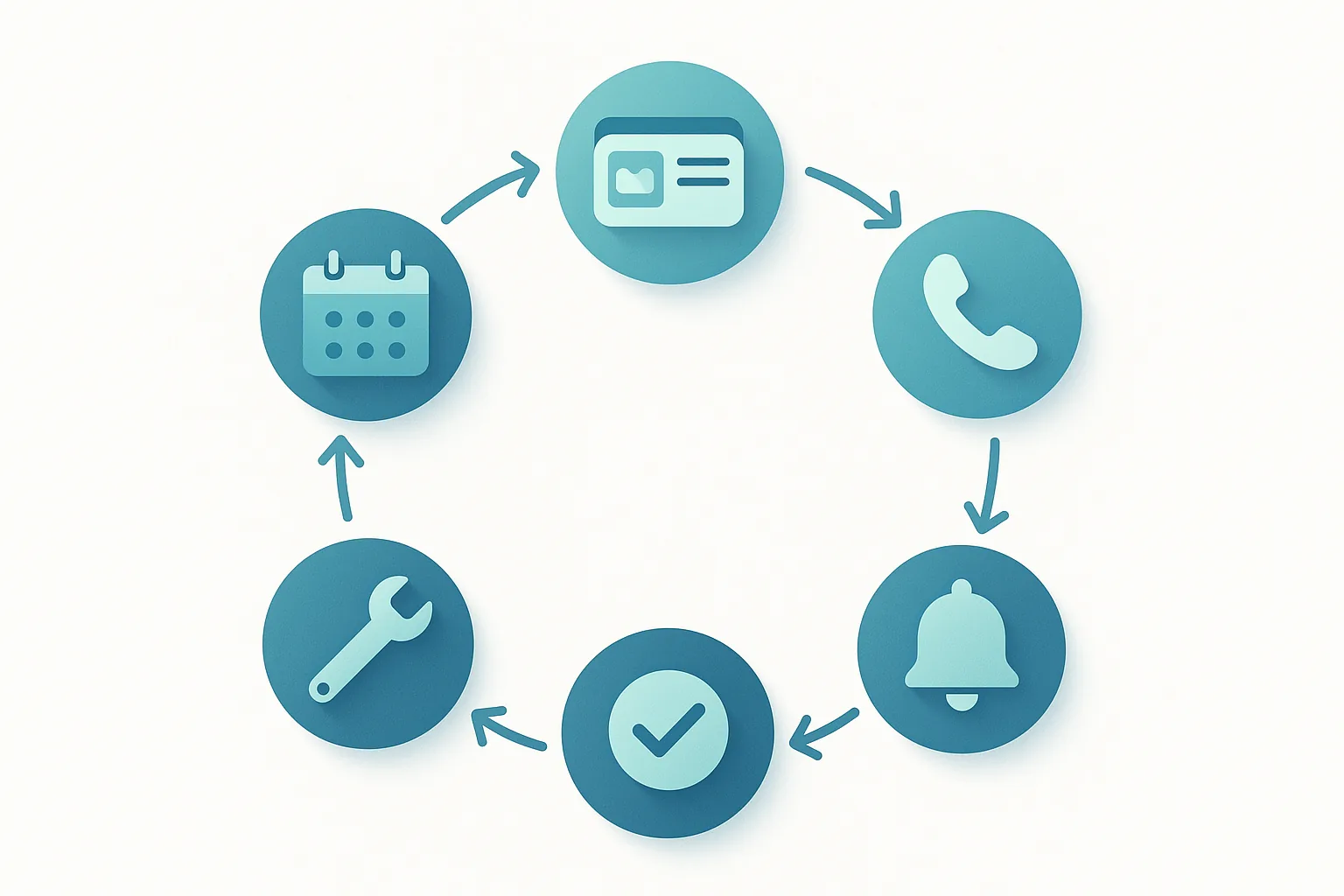
Moment 1: Appointment Booking
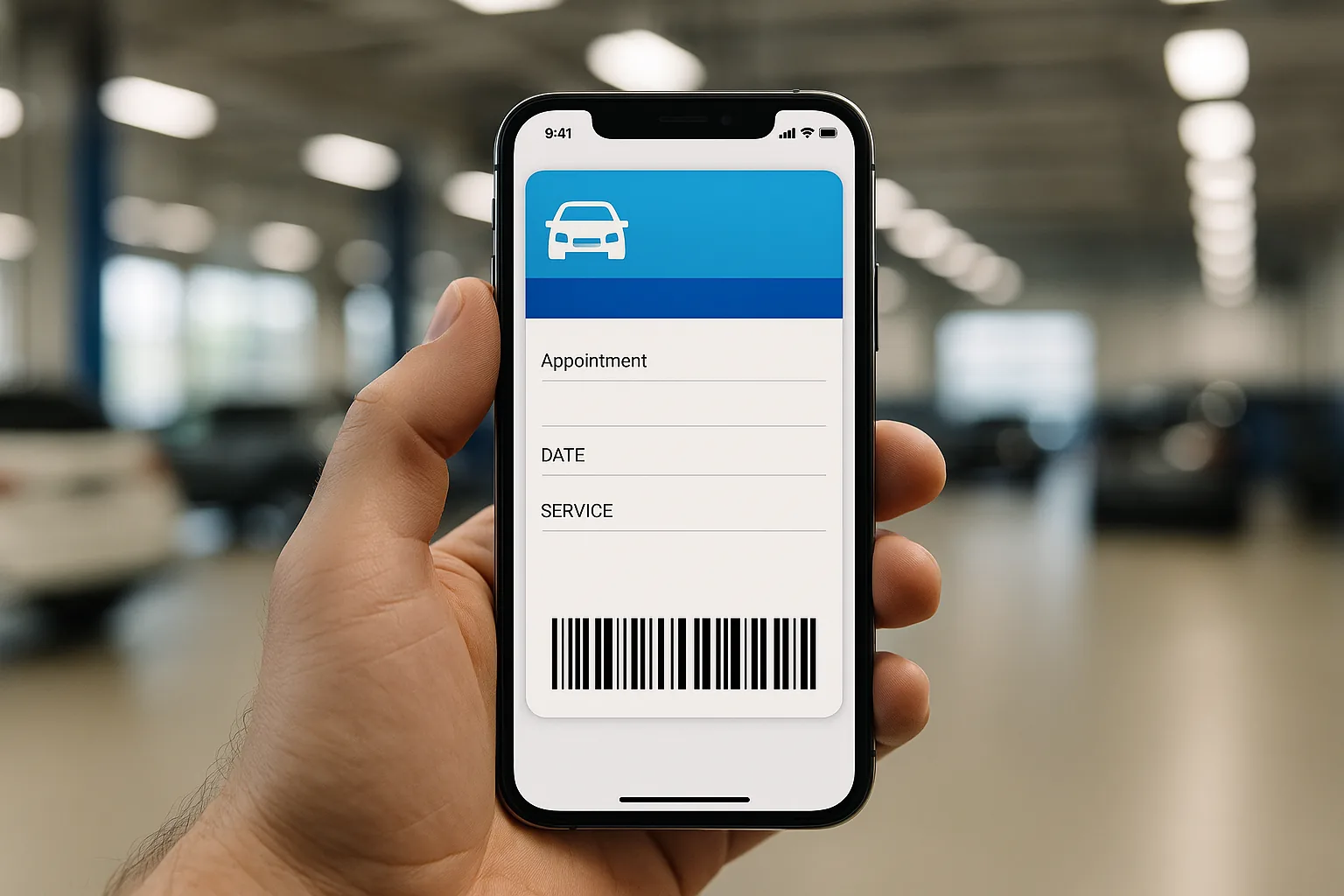
When a customer books online or by phone, they receive a wallet pass link in SMS or email. One tap saves the pass to Apple Wallet or Google Wallet.
The pass displays:
- Appointment date and time
- Service type
- Vehicle info
- A barcode for express check-in
Moment 2: 48-Hour Reminder
Two days before the appointment, a push notification updates the pass with a reminder. Smart dealerships add relevant context, such as:
"Rain expected Thursday. We will check your wiper blades too."
This shows attentiveness and gives the customer another reason to show up.
Moment 3: Morning Of
On the morning of the appointment, a lock-screen notification confirms the visit. For example:
"We are ready for you at 8:30 a.m. Use express check-in when you arrive."
This reduces anxiety about timing and reinforces the commitment.
The revenue impact can be significant.
Reducing no-shows from 25% to roughly 16% is a 35% relative reduction in this example. That recovers around 70 to 72 appointments per week across the group. At $350 per repair order, that is about $25,200 per week. Over a year, it is roughly $1.3 million in recovered revenue.
The cost of wallet pass infrastructure through a platform like Passmint is a small share of that figure.
Then the rebooking flywheel starts.
After service completion, the wallet pass updates automatically. It shows:
"Next recommended service: 35,000 miles / approx. October 2025" with a one-tap booking link.
Push notifications triggered at estimated mileage milestones drive rebooking. You can calculate these milestones from the odometer reading and average driving patterns.
The service advisor who used to spend 30 minutes every morning calling no-shows can now spend that time with customers who arrived.
Beyond appointments: wallet passes for recalls, warranties, and loyalty programs
Appointment reminders are the most obvious use case. Wallet passes also help solve other persistent problems in automotive service.
Recall notifications that get seen
NHTSA data shows that for many recalls, only around 60% of affected vehicles ever get repaired. A common reason is that owners lose the mail notice or ignore the email. The message looks like marketing and blends into the inbox.
A wallet pass push notification marked as urgent changes this.
The pass updates with:
- Recall details
- Severity level
- One-tap scheduling link
The pass sits on the customer's phone until they act. This creates a channel that is hard to miss. It can improve safety outcomes and drive service revenue at the same time.
Digital proof of warranty
Instead of a glovebox folder full of paper, customers can carry a wallet pass that shows:
- Warranty coverage status
- Expiration date
- Key covered components
When something goes wrong, they can open the pass and see whether they are covered. This reduces friction in the decision to bring the vehicle in. It also keeps your dealership as the default service destination. No searching for paperwork. No need to call just to ask about coverage.
Loyalty punch cards that do not get lost
Oil change loyalty programs are common. "Buy 4, get 1 free" offers are familiar to customers. Physical punch cards often get lost, washed, or forgotten.
A wallet pass loyalty card updates automatically after each visit. It can send a push notification when the customer is one visit away from a reward.
Many retail studies show that active digital loyalty members visit more often than non-members. Auto service follows the same pattern.
Other useful scenarios include:
- Tire storage programs with seasonal swap reminders
- Prepaid detailing packages with remaining credit shown on the pass
- Referral programs that show referral count and rewards
Each use case deepens the relationship with the customer through a channel already on their phone.
Industry data: why auto service is ready for wallet pass adoption
The market impact is large.
NADA reports roughly $134 billion in annual service and parts revenue across U.S. franchised dealerships. Independent service centers add more on top.
Even small improvements in retention, applied across this market, add up to billions in recovered value.
Cox Automotive and other sources highlight another trend. A large majority of customers, often around 70%, leave the selling dealership for service after the warranty expires. The main driver is not always dissatisfaction. It is often lack of ongoing engagement.
In other words, this is a communication problem that shows up as a loyalty problem.
The customer-side infrastructure is already there. Pew Research Center reports that around 90% of U.S. adults own a smartphone.
Apple Wallet is pre-installed on every iPhone. Google Wallet is available on virtually all mainstream Android devices. Unlike a dealership-specific app, wallet passes face far less friction. Customers do not need to search an app store, create a new account, or remember a password.
From a competitive standpoint, only a minority of dealerships use wallet passes for customer communication today. Early adopters face little competitive noise and gain clear differentiation.
If a customer has three dealerships nearby for an oil change, the one with a wallet pass on the lock screen showing "Your 5th oil change is free. You are at 4 of 5" has an advantage.
Getting started: a practical implementation roadmap for dealerships
You do not need to roll out every feature at once. A phased approach works best.
Phase 1: service appointment passes (weeks 1 to 4)
Start with the highest-impact use case.
Integrate wallet pass generation with your existing DMS or scheduling tool via API. Common systems include CDK, Reynolds & Reynolds, and Tekion.
When a customer books an appointment, they receive a wallet pass link. Set up 48-hour and morning-of push notifications.
From day one, measure:
- Pass save rates
- Show rate for pass holders vs non-holders
Phase 2: Loyalty and Rebooking (Weeks 5 to 8)
Next, add loyalty program passes and post-service rebooking automation.
After each completed service visit, the pass updates with the next recommended service and a one-tap booking link. Loyalty punch counts increment automatically based on DMS data.
Phase 3: Full Lifecycle (Weeks 9 to 12)
Expand into recall notifications, digital warranty cards, and mileage-based outreach. At this stage the wallet pass becomes a full retention channel rather than just an appointment reminder.
On the technical side, this is more straightforward than many teams expect.
Wallet passes follow the Apple PKPass and Google Wallet Object standards. A platform like Passmint handles pass generation, cryptographic signing, distribution, and push updates through simple API calls.
You do not need a mobile app development team. If your team can make REST API calls, you can issue wallet passes.
Addressing common pushback
"Our customers are not very tech-savvy."
Saving a wallet pass usually takes a single tap. There is no account creation and no password. If your customers can open a text message, they can usually save a wallet pass.
"We already use SMS."
That is good. Wallet passes complement SMS rather than replace it. SMS delivers the pass link. The pass provides a persistent visual card and ongoing push notifications.
"How do we measure ROI?"
Track four core metrics:
- Pass save rates
- Push notification tap-through rates
- Appointment show rates for pass holders vs non-holders
- Rebooking rates
You can run a clean A/B test.
Start with a 90-day pilot on one service lane or a single location. A/B test wallet pass reminders against your current SMS and email approach. Measure the no-show rate difference and customer satisfaction scores. Use the data to decide on broader rollout.
What comes next
The automotive service industry loses billions each year to customer defection and no-shows. Weak communication drives more of that than poor service does.
A wallet pass is a cheap channel that customers actually see, and it addresses the communication gap directly.
You do not need a six-figure app development budget to stay visible on your customers' lock screens. You need a lighter digital touchpoint that meets customers where they already are.
The impact can be material. Lower no-show rates. A rebooking engine that runs mostly on its own. A loyalty program customers actually see and use.
Apple and Google continue to expand wallet capabilities with features such as richer notification types and NFC interactions. Dealerships that build wallet pass infrastructure now will be ready to take advantage of new features as they mature.
If you are ready to see what wallet passes can do for your service department, Passmint makes it easy to create, distribute, and manage Apple Wallet and Google Wallet passes through a simple API.
Start with a pilot. Let the results speak for themselves.
Primary sources
Common questions
Technical content writer, Passmint
Julio is a technical content writer at Passmint. He writes about Apple PassKit, the Google Wallet API, and what breaks when wallet passes meet production traffic.
More from Julio Song →