
It's 7:45 on a Tuesday morning. A regular walks up to the counter, pats down three pockets, rifles through a wallet and pulls out a crumpled loyalty card with six barely visible stamps. The barista squints at it. The customer shrugs. The card goes back in the wallet. The free coffee goes unclaimed. The goodwill is lost.
This happens thousands of times a day in independent coffee shops. Many paper loyalty programs see redemption rates in the low double digits. In multiple vendor case studies, digital wallet passes deliver higher redemption, often several times better than paper.
Here is the tension. Independent coffee shops rely on loyalty. It is your advantage against chains like Starbucks. But the tools Starbucks uses to build that loyalty, including a proprietary app and a full tech stack funded by large annual technology and marketing budgets, have been out of reach for a single-location café with a marketing budget that barely covers a chalkboard sign.
That is changing. Apple Wallet and Google Wallet passes have become a practical leveler. They give indie operators Starbucks-level retention mechanics at a fraction of the cost. Your customers do not need to download a dedicated loyalty app for your café.
The loyalty gap: fighting at a disadvantage
Starbucks invests hundreds of millions of dollars per year in the technology and marketing that power its loyalty ecosystem. The average independent café works with a marketing budget measured in hundreds of dollars, not millions. The gap is wide and structural.
For decades, the paper stamp card was the indie café answer. It was cheap, familiar and simple. It was also leaky by design. Cards get lost in coat pockets, shredded in the wash or forgotten at home. They collect zero data on customer behaviour. Staff have no way to re-engage a lapsed regular. The stamp card is a loyalty program with no memory.
Then came the third-party app era. Platforms like Square Loyalty, Stamp Me and Punchcard offered an upgrade. Digital tracking. Customer profiles. Automated rewards. They also introduced new friction. Customers hesitated to download another app for a single coffee shop. Monthly SaaS fees of $50 to $100 or more cut into already thin café margins. Adoption often plateaued.
Consider a realistic example. A coffee shop owner runs a Square Loyalty program for 12 months and finds that fewer than 30% of customers who signed up ever redeem a single reward. The program exists, but it does not deliver.
The core problem was not loyalty program design. It was the delivery mechanism. The card, whether physical or app-based, was the bottleneck.
What is a wallet pass, and why should a coffee shop owner care?
A wallet pass is a digital card that lives inside Apple Wallet or Google Wallet. Apple Wallet comes pre-installed on iPhones. Google Wallet is available on most modern Android phones, often pre-loaded by manufacturers or easily installed from the app store. It works like a boarding pass or a concert ticket, but for your loyalty program. It sits in your customer's Wallet app and can surface on the lock screen at the right moment. There is no separate loyalty app for your café.
For food and beverage businesses, three pass types matter most:
- Stamp or loyalty cards. The digital equivalent of a punch card. Buy nine coffees, get the tenth free.
- Offer passes. One-time discount coupons, such as 20% off the next latte.
- Membership passes. For cafés that run subscription programs, such as unlimited drip coffee for $30 per month.
The biggest practical advantage is simple. No dedicated app download. A customer taps a link or scans a QR code at the counter. The pass lands in their wallet in a few steps, often in under 10 seconds on a good connection. At that point, they are enrolled.
Wallet passes are also live objects. Your coffee shop can push updates directly to the pass through your wallet-pass platform. When a customer earns a new stamp, the pass updates to show the new total. When they hit the free-drink threshold, a notification can appear on their lock screen. The customer does not have to open anything or remember anything. The pass and the system behind it do the work.
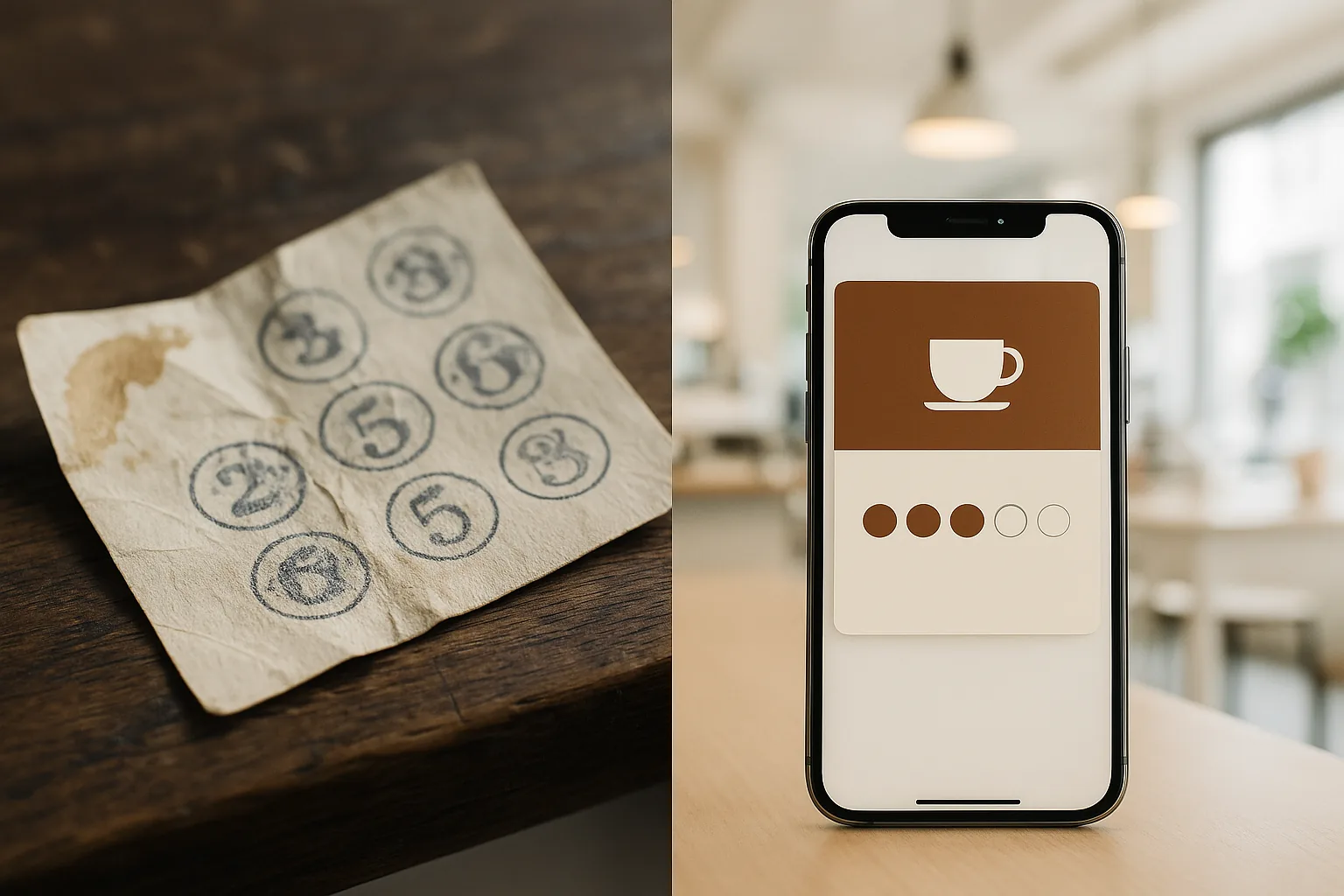
That contrast matters. A branded, dynamic pass on a phone screen sits in your customer's daily flow. A bent, coffee-stained paper card sits behind a debit card and is easy to forget.
The features that actually drive repeat visits (and why they work)
A digital wallet pass does more than a prettier punch card. It comes with capabilities that change how your café stays connected to customers.
Location-triggered relevance and notifications. Wallet passes support geofencing-style relevance. When a customer walks within a set radius of your café, for example 200 metres, their phone can surface the pass with a gentle prompt such as a pass update notification or suggestion: "Your morning coffee awaits, 2 stamps away from a free flat white." This is very different from an email blast that sits unread in a promotions tab. It reaches the customer when they are nearby and more likely to act, subject to their device settings.
Real-time stamp updates. With a paper card, the customer does not know where they stand until they find the card and count stamps. With most loyalty apps, they need to open the app to check progress. With a well-integrated wallet pass, the stamp count updates shortly after each visit. The customer can receive a lock-screen notification when it happens. Seeing "7 of 9" is a small but important signal.
Time-based notifications via your platform. Apple Wallet and Google Wallet support time-based relevance and pass updates. Your wallet pass provider can add logic on top. If your visit data shows customers tend to lapse mid-week, your provider can schedule a Tuesday morning nudge by updating the pass or sending a related message. This is not random spam. It is a timely reminder to someone who already chose to carry your pass.
Persistent branding on the customer's phone. The pass itself is a branded touchpoint. Your logo. Your colours. Your message. For an indie café, this is prime space on a customer's most-used device. Paper cannot do that.
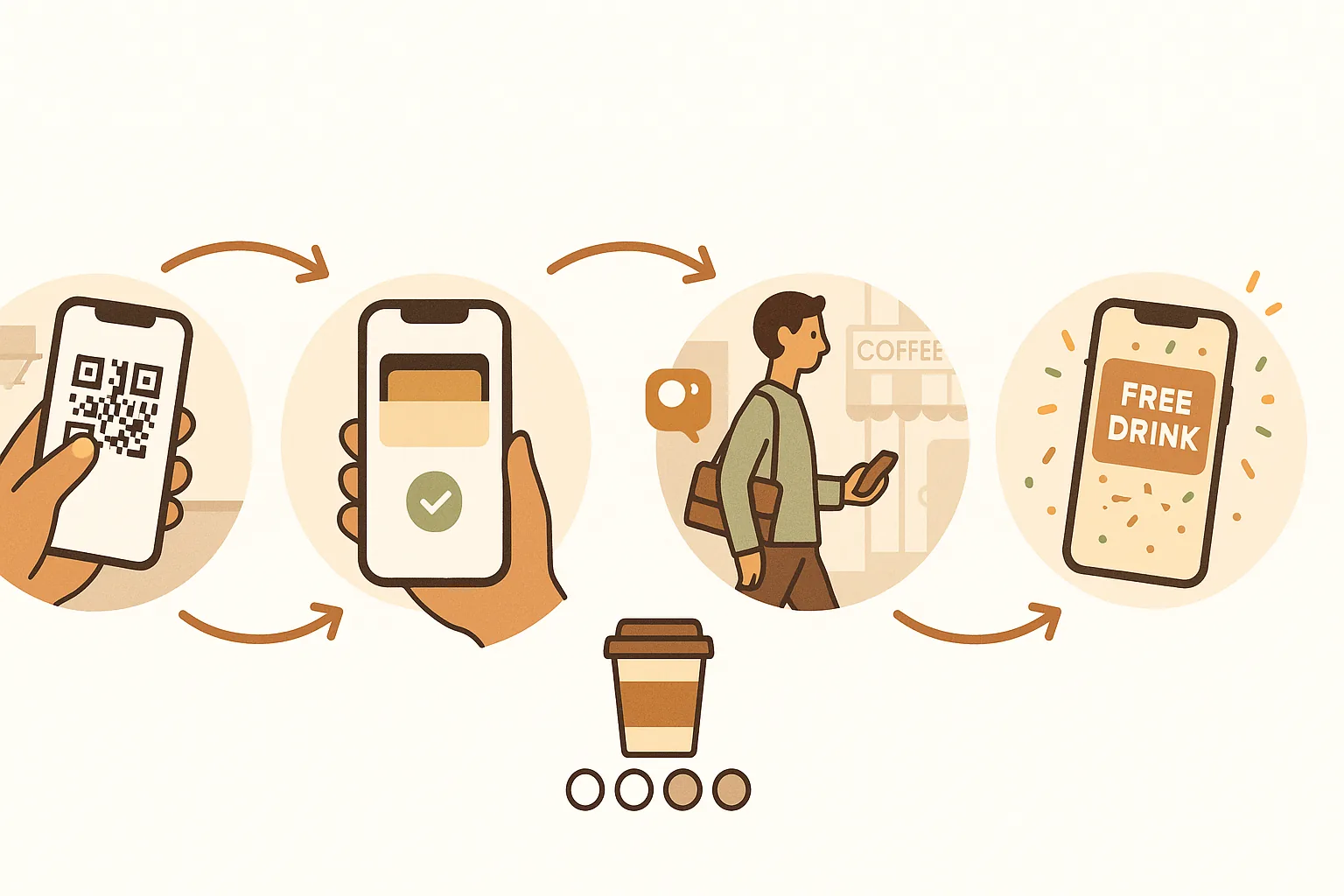
That journey from QR scan to wallet add to geofence prompt to updated stamp to free-drink redemption runs in the background of your customer's routine. They do not have to manage it.
A closer look: how one independent café replaced paper cards and increased redemption rates
Here is an illustrative example. This is a composite case study based on realistic scenarios, not a specific business.
Meet "Groundwork Coffee Co.", a single-location specialty coffee shop in a busy neighbourhood. For two years, Groundwork used paper stamp cards. The owner, Sarah, saw that regulars liked the idea, but the numbers told a different story. Redemption was about 12%. Many cards were lost or abandoned before the tenth stamp.
Sarah moved to a wallet pass program built on Passmint. Setup took an afternoon. She designed a branded pass with her shop's colours and logo. She configured a simple "buy 9, get 1 free" mechanic. She printed a QR code and placed it on the counter, on the receipt footer and on a small table tent.
She set a location-based prompt with a 200-metre radius around the shop: "Morning, coffee lover. You are close to Groundwork. Pop in and get closer to your free flat white."
After 90 days in this composite scenario, the results looked like this:
- Paper card redemption rate: about 12%
- Wallet pass redemption rate: about 38%
- Pass additions in first 90 days: four times the number of previous loyalty app sign-ups over the same period
- Average return visit frequency for pass holders: up 22%
She also saw a fraud benefit. Each pass lives in an individual customer's Apple Wallet or Google Wallet and is managed centrally by her system. It is much harder to game. No more regulars photocopying a card with eight stamps already on it. In this composite example, reported fraud incidents dropped sharply.
The moment Sarah knew the switch worked was simple. A customer walked in one afternoon and said, "I got a notification when I was walking by and figured I would grab my usual." A stamp card cannot do that.
What small F&B operators actually look for in a wallet pass platform
Independent café owners are not evaluating enterprise software. You want something that works, is affordable and does not require a technical background. Here is what matters most:
Ease of setup without a developer. The best solutions offer no-code pass builders with branded templates. If you need API knowledge to start, it is a non-starter for most operators.
Cost structure that matches café economics. Flat monthly pricing or low per-pass fees work best. Percentage-of-transaction models feel punitive when your average ticket is a $5 cortado.
POS integration or a lightweight workaround. Some operators want a Shopify, Square or Lightspeed integration. Others are fine with a simple QR-code-scan-to-stamp workflow that any barista can run from a tablet. Both paths should be available.
Analytics and customer insight. Even basic data, such as how many passes you issue, your redemption rate and visit frequency, is a big step up for operators who had zero visibility. You cannot improve what you cannot see.
Support and onboarding quality. Small business owners do not have IT departments. They judge solutions by whether there is a real human to talk to, or at least a clear and useful knowledge base. A chatbot alone is not enough.
The no-app-download advantage: why this matters for indie cafés
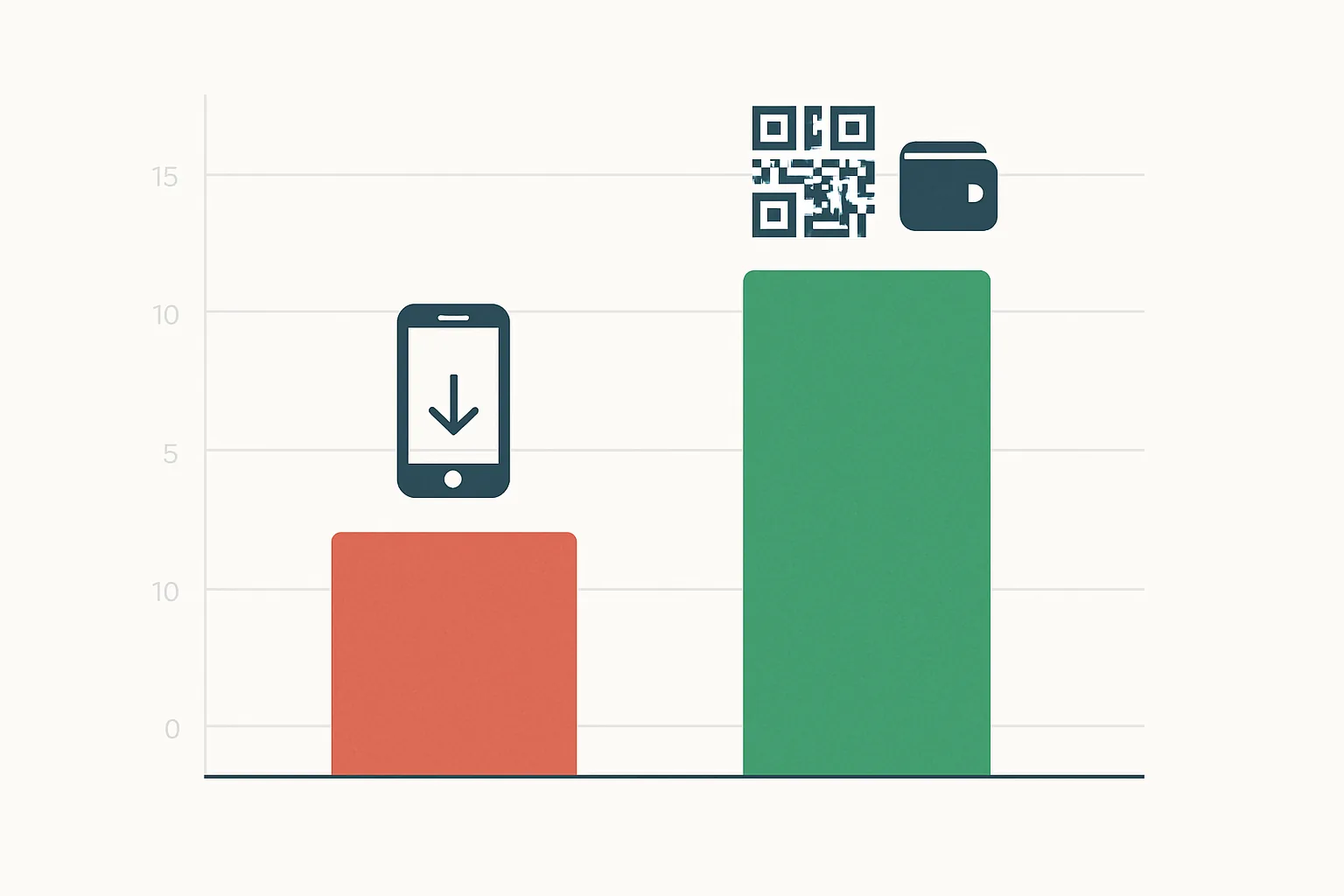
One data point still shapes how many marketers think about customer engagement. In 2014, comScore reported that the average U.S. smartphone user downloaded zero new apps per month. Behaviour has changed since then, and newer studies show some variation, but many users still download few new apps. Asking a customer to download a dedicated loyalty app at the point of sale often converts poorly in food and beverage, frequently only in the low double digits according to various case studies.
Now compare that to wallet pass addition rates. In well-executed campaigns, QR-to-wallet-add flows can convert in the 60% to 80% range when presented at the right moment, such as at checkout, on a receipt or on a table card. Actual results depend on the offer, user experience and audience.
The reason is simple. Apple Wallet comes pre-installed on iPhones. Google Wallet is available on most modern Android phones, often pre-loaded. Both products are designed to store cards, tickets and, in supported markets, payment methods. Many customers already use them. There is less of a "do I trust this brand enough to give them space on my phone" calculation. The pass sits next to the cards and tickets the customer already carries.
There is a fair counter-argument. A dedicated loyalty app can give you richer data. It can track in-app behaviour, send rich push notifications and support complex features.
For a single-location indie café, that gap in data richness does not matter if most customers never install the app. If a wallet pass ends up on 70% of your regulars' phones and a dedicated app reaches only 15%, the simpler option wins on reach and real-world impact.
How to get started: a practical roadmap for coffee shop owners
If you are ready to retire the stamp card, here is a five-step roadmap.
Step 1: Choose a wallet pass platform. As of 2026, Passmint is designed for this use case. It offers a no-code pass builder, supports both Apple Wallet and Google Wallet and is priced for small and medium-sized businesses. For context, PassKit often targets larger or more complex deployments. Stamp Me is primarily app-based. Passmint sits in the ideal range for independent operators who want digital wallet passes without the overhead of a full custom app.
Step 2: Design your pass. Keep it clean and on-brand. Use your café's colours and logo. Set up a simple stamp counter mechanic. "Buy 9, get 1 free" works because it is familiar. Add a clear welcome offer to encourage the first add: "Add the pass today and get your next coffee 20% off."
Step 3: Choose your distribution touchpoints. Put a QR code on the counter where customers pay. Print it on receipts. Add the link to your email footer and your Instagram bio. Each touchpoint catches a different customer at a different moment. The counter QR code is likely to convert best.
Step 4: Configure your notifications and logic. Work with your wallet pass platform to set up your geofence. A starting radius of 200 to 500 metres is common. Write one or two notification messages that feel human. "You are 1 stamp away from a free flat white" works. "REDEEM YOUR REWARDS NOW" does not. Plan a clear message for when the free drink is earned.
Step 5: Measure and iterate. Review your numbers at 30, 60 and 90 days. Track pass additions, redemption rates and visit frequency. If redemptions plateau, test a lower reward threshold, for example from 9 stamps to 7. If Sunday pass scans spike, run a Sunday promotion. Use the data to guide your decisions. Paper cards never gave you that.
The stamp card that actually works
Back to that Tuesday morning scene. The regular walks up to the counter. No pocket-patting. No wallet search. The barista scans a QR code. The customer's phone buzzes. A new stamp appears in their wallet pass and on the lock screen. "8 of 9. One more and your flat white is on us." The interaction takes a few seconds.
The tools that make Starbucks' loyalty program effective, such as persistent digital presence, real-time updates and location-aware prompts, are no longer reserved for brands with enterprise budgets. Wallet passes, combined with modern loyalty platforms, make them accessible to the indie café on the corner. The operators who move first can build the kind of habitual, low-friction loyalty that turns a neighbourhood coffee shop into a strong community institution.
It is time to retire the stamp card. Explore Passmint's pass builder and see what a loyalty card looks like when it actually works.
Primary sources
Common questions
Technical content writer, Passmint
Julio is a technical content writer at Passmint. He writes about Apple PassKit, the Google Wallet API, and what breaks when wallet passes meet production traffic.
More from Julio Song →