
A gate agent at a three-gate airport in rural Alaska tears a perforated paper ticket in half. One piece goes to the passenger. The other goes on a clipboard with the manifest. There is no barcode scanner. No kiosk. No jetbridge. The passenger walks across the tarmac, climbs a set of stairs, and boards a 30-seat turboprop.
This boarding process is still in use at many small airports around the world.
A large number of commercial airports still lack modern barcode scanning. In the United States, more than 100 communities receive Essential Air Service (EAS) support. Many of the airports that serve them run on limited digital systems. These are not abandoned airstrips. They are active, federally subsidized stations that connect rural communities to the national network.
Passengers walking onto these small aircraft now expect the same smartphone-based experience they get at JFK or LAX. They already checked in on their phone. They have the confirmation email. They still wait in line for a paper ticket.
A growing group of regional and charter airlines is changing that. Instead of buying expensive scanner hardware, they use mobile wallet boarding passes with visual-verification workflows and QR fallback strategies. Resource-constrained operators are skipping hardware and going straight to phone-based boarding. There is a lot here for developers and aviation tech teams.
The paper-ticket problem: why regional aviation is stuck in 1995
Regional airlines, Part 135 commuter operations, EAS carriers, island-hopping services, and charter operators often fly from airports with no electronic gate readers, no Departure Control System (DCS) integration, and sometimes no Wi-Fi at the gate. The terminal might be a single room with a counter and a few chairs.
The costs of paper add up fast. Internal analyses at some carriers show that a single thermal printer station can cost a few thousand dollars per year in supplies and maintenance. That includes ribbon cartridges, pre-printed ticket stock, and repairs. Multiply that across 15 to 30 stations and you have a material expense for a small carrier. Then add labor hours for manual manifest reconciliation and boarding-count discrepancies from illegible thermal prints, lost ticket stubs, and human error.
Major carriers are less constrained by this. Delta or United can mandate "scan at gate" because almost every airport they serve has the infrastructure for it. A regional carrier flying into 30 or more small airports cannot assume that. Each station is different. Some have basic scanners. Some have only a folding table and a handheld radio.
This creates a consistent gap. Passengers check in on their phones via the airline website or app. The digital journey works until the final step at the gate. There, the process falls back to paper. Many airlines assume there is no way to verify a digital pass without a scanner.
That assumption is wrong.
How wallet passes change the equation: visual verification over hardware dependency
Apple Wallet and Google Wallet passes are structured visual documents, not bare barcodes. They include passenger name, flight number, seat assignment, boarding group, gate, and date. An agent can check these fields at a glance, the same way they check a paper ticket today.
During paper boarding, the agent looks at the ticket, confirms the name matches the passenger's ID, checks the flight number and date, and marks the manifest. That is the core workflow. A wallet pass supports the same steps with no extra hardware.
A visual verification process looks like this. The gate agent checks the phone screen. They confirm the name matches the ID. They confirm the flight, date, and seat. They then mark the passenger as boarded on their manifest, digital or paper. The QR or Aztec barcode on the pass is there as a fallback for stations with readers or for future use. It does not need to be scanned for the pass to be useful.
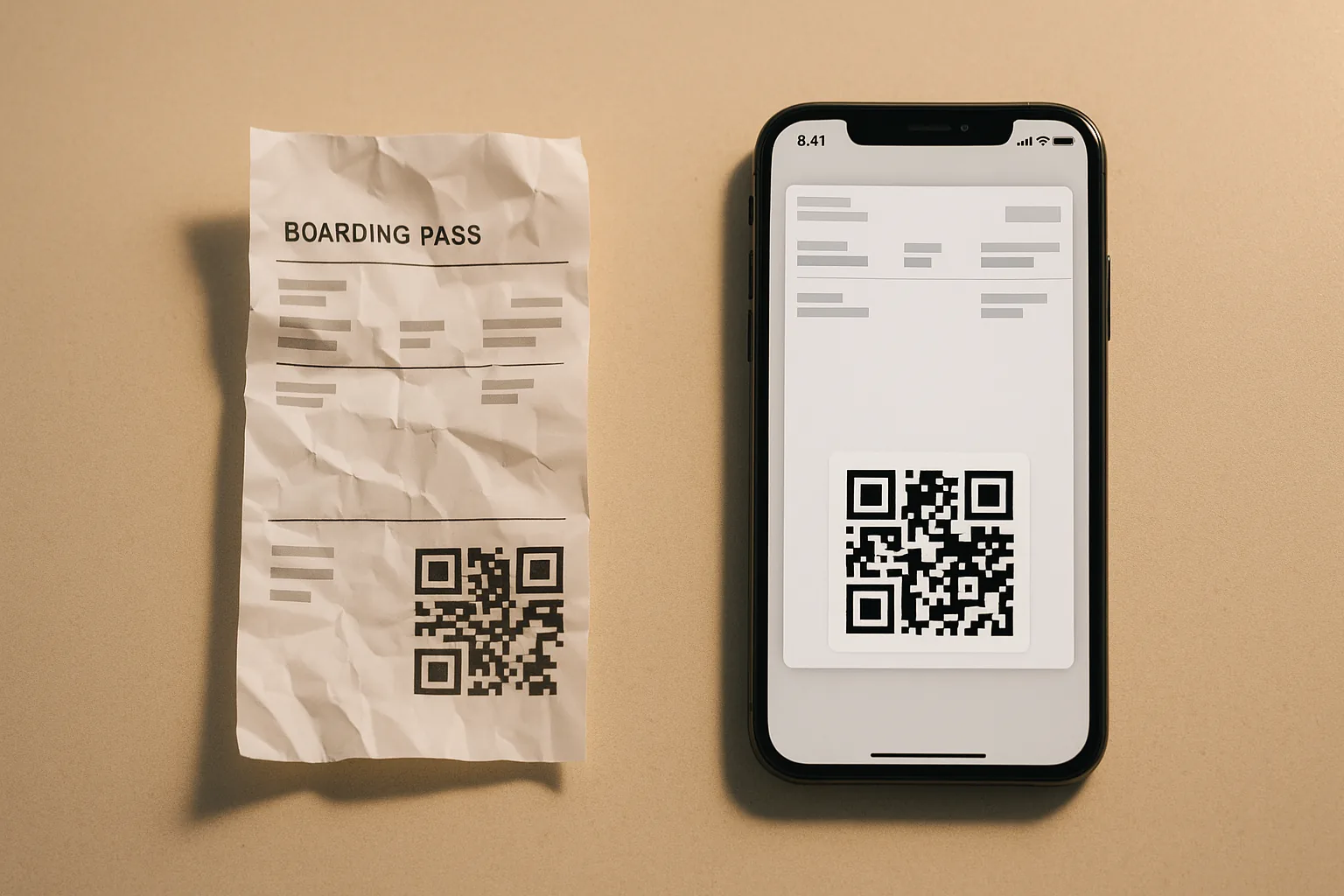
Wallet passes also reduce basic fraud risks compared to paper. The pass renders inside the wallet app, not a generic PDF viewer. It is harder to fake that experience than a PDF or a forwarded email. iOS and Android present wallet passes in a dedicated app context with system UI elements. This makes it easier for staff to distinguish a valid wallet pass from an image in a photo gallery.
Because wallet passes can be updated by the issuer, airlines can use time-limited or frequently updated barcodes and validate them server-side. This reduces the value of static screenshots.
What if the phone is dead. Airlines typically pair wallet passes with a printable PDF fallback sent via email. It is the same backup they use today, but now it becomes the exception rather than the default. Most passengers arrive with a charged phone.
QR fallback strategies: designing for mixed-infrastructure environments
Regional airlines face a mixed-infrastructure problem. Route A might depart from an airport with gate scanners. Route B might depart from a grass strip with only a windsock and a gate agent. The wallet pass needs to work in both situations without any extra steps for the passenger.
A QR fallback architecture solves this. The wallet pass includes a QR or Aztec barcode that encodes a booking reference or PNR. At scanner-equipped stations, agents scan it through the existing DCS workflow. At stations without scanners, the agent can read the booking reference from the human-readable text on the pass. They can also use an inexpensive handheld Bluetooth barcode reader paired with a smartphone or tablet. These readers typically cost in the range of 30 to 80 dollars.
This supports a progressive approach. You start with visual verification everywhere. You then add scanning at specific stations as budget allows. The wallet pass does not need to change. Only the ground-side process changes. When an airport adds a scanner, it can start scanning the same passes passengers already use.
The pass formats support this flexibility by design. Apple's PKPass format and Google Wallet's JSON or JWT-based format both support visual fields and machine-readable barcodes in one pass. You do not need separate versions for scannable and visual-only environments. One pass. Multiple verification methods. Minimal passenger friction.
Adoption patterns from the regional aviation sector
Here is how this can look in practice. The following is an illustrative composite scenario based on publicly reported implementations and industry data across several carriers.
Consider a Caribbean island-hopping carrier operating ATR 42s and Cessna Caravans across 12 destinations. Eight of those destinations have little or no barcode infrastructure at the gate. The carrier's digital journey followed these steps.
Phase 1: The airline emailed PDF boarding passes after online check-in.
Phase 2: They saw that most passengers either screenshotted the PDF or printed it at home. The digital boarding pass behaved like paper. Passengers did not trust that a PDF on their phone would work at the gate, so they created a physical backup. The airline shifted printing cost from the airport to the passenger's home printer, but the process did not change.
Phase 3: They adopted wallet passes through an API-based pass generation service. When a passenger checked in online, the confirmation page and email included "Add to Apple Wallet" and "Add to Google Wallet" buttons. One tap, and the pass appeared on the phone's lock screen, ready for boarding day.
Phase 4: Among passengers with smartphones, wallet passes became the primary option within the first year. The lock-screen convenience drove adoption faster than the PDF approach.

The operational outcomes can be specific. Some carriers report reductions of roughly one third in paper and thermal supply costs across their station networks. Average boarding times often fall, mainly because the counter no longer needs to print for every passenger. Manifest discrepancies from illegible or lost paper tickets also drop.
Passenger-experience metrics move as well. In case studies, NPS scores for check-in and boarding improve after wallet pass rollout. The main driver is the ability to bypass the counter.
Implementation playbook: ship wallet boarding passes in weeks, not months
If you run a small airline or build tech for one, here is what a minimal integration looks like.
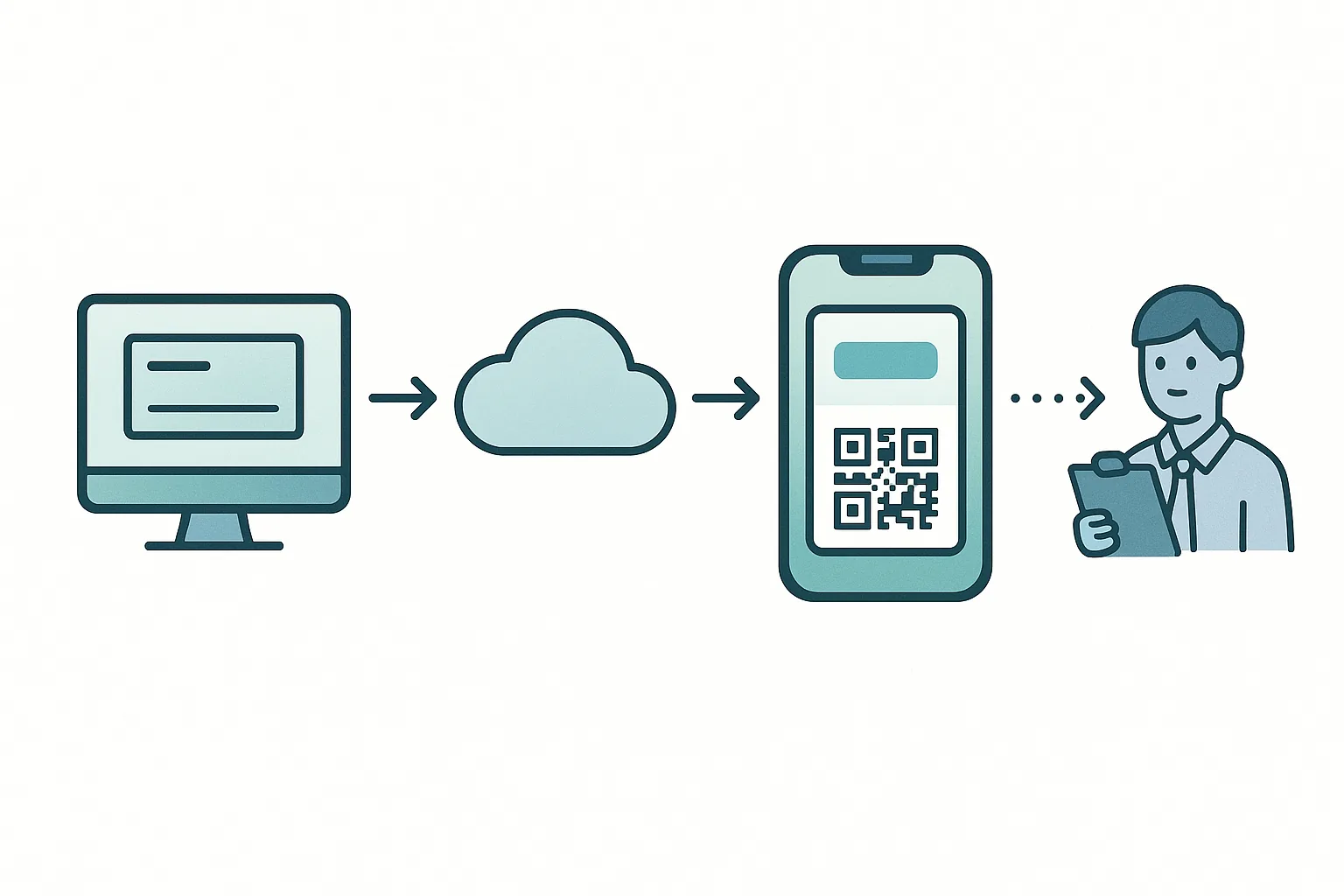
- Your existing booking or check-in system generates a passenger record.
- An API call sends passenger and flight data to a wallet pass generation service such as Passmint.
- The service creates an Apple Wallet (.pkpass) pass and a Google Wallet pass.
- The pass is delivered to the passenger via SMS link, email link, or an in-app button.
- The passenger taps "Add to Wallet" and the pass is ready.
You do not need changes to airport infrastructure. You do not need mandatory DCS integration, although you can integrate if you have a DCS. You do not need a mobile app download by the passenger. If a third-party service handles certificate management, you also avoid direct Apple Developer account setup for pass signing.
A few key implementation decisions to work through:
- Barcode format. QR is the most universally readable. Aztec and PDF417 are common in aviation under the IATA BCBP standard. Choose based on whether your stations use IATA-compliant scanners or general QR readers.
- Pass template design. Optimize for visual verification. Passenger name, flight number, and date should be large and prominent. Do not bury critical fields.
- Real-time updates. Gate changes, delays, and seat changes can be pushed to the wallet pass through Wallet update mechanisms. On Apple devices this uses APNs. On Android this uses Google's backend and FCM. The pass updates without passenger action, and notifications can appear on the lock screen depending on user settings.
- Expiration logic. Set passes to expire and archive automatically after the scheduled arrival time. This keeps the passenger's wallet clean.
On cost, many wallet pass API services charge a few cents per pass, depending on volume and features. Internal analyses at some carriers place the fully loaded cost of a printed boarding pass in the tens of cents once you include thermal ribbon, ticket stock, and printer maintenance. Even at modest volumes, the savings add up over a year. At scale across dozens of stations, the economics are strong.
Beyond boarding: what wallet passes make possible for small airlines
Once the boarding pass lives in the passenger's wallet, you can do things that used to require a full airline app.
Push notifications through the pass itself. You can send gate changes, delay alerts, and boarding announcements directly to the passenger's lock screen through wallet pass updates, subject to device settings. For small airlines that cannot justify a full native app, this is a practical channel. The wallet pass acts like a lightweight, zero-download app for each trip.
Ancillary revenue touchpoints. Wallet passes can include tappable links to pages for seat upgrades, extra baggage, or lounge access. You can update passes after the flight with loyalty balances or offers for a return trip.
Passenger behavior data. Even without scanners, wallet pass delivery and engagement data gives you new insight. You can track add-to-wallet rates, update acknowledgment, and link click-through. You can measure what share of passengers saw a gate change notification before they arrived at the airport.
Looking ahead, Apple continues to expand Wallet as a credential platform for car keys, hotel keys, and IDs. Google keeps adding features to Google Wallet APIs. If you adopt wallet passes now, you create a base for future capabilities such as digital identity verification and, where allowed, automated boarding reconciliation through NFC once that hardware is in place.
The leapfrog
Return to the gate agent at the three-gate airport. She does not need a scanner to go digital. The wallet boarding pass matches the reality of regional aviation. Infrastructure varies. IT teams are small. Budgets are tight. Boarding still depends on staff.
The wallet approach also reverses the pattern used by many major airlines. Large carriers built infrastructure first, installed scanners at every gate, integrated DCS systems, and then rolled out digital passes. Some regional carriers show that you can skip widespread scanner deployment and move from paper to phone directly on many routes.
For developers and aviation tech teams, the takeaway is clear. Design for visual verification first, scanning second. The wallet pass format already supports both. You only need to design your workflow to match your constraints.
If you are building boarding pass solutions for airlines outside the major-carrier infrastructure bubble, Passmint's API makes it straightforward to generate, deliver, and update Apple Wallet and Google Wallet passes for every passenger, every flight, and every station. No fixed scanners required.
Primary sources
Common questions
Technical content writer, Passmint
Julio is a technical content writer at Passmint. He writes about Apple PassKit, the Google Wallet API, and what breaks when wallet passes meet production traffic.
More from Julio Song →