
It's Friday at 4:40 and procurement wants a one-page comparison of wallet pass vendors by Monday. You open nine tabs. Seven of them have a pricing page, and no two of them count the same thing.
One bills per template. One bills per pass that someone actually installs. One bills per update. One gives you a calculator that ends in a number so large it needs a footnote. You try to build a spreadsheet and find that the rows don't line up, because the vendors aren't selling the same product at different prices. They're selling different slices of the same job.
This guide is the comparison we wanted when we started. It covers seven hosted platforms (including ours, which we flag as we go) and six open-source libraries, read on 26 October 2026. We use the same five questions for each one, run the same three cost scenarios across them, and say plainly where we couldn't verify something. Prices move, and no vendor page we read carries an effective date, so treat every figure as a snapshot and check it before you commit.
The five questions that sort every option
Feature matrices hide the differences that matter. These five don't.
1. Who signs? Every Apple Wallet pass is signed with a Pass Type ID certificate. Some vendors make you bring your own. Others sign with theirs and let you swap yours in later. This decides who holds the key to your identity in Wallet, and what happens when that certificate expires. Our complete guide to pass signing and certificates goes deep on why it matters.
2. What does the meter count? Active passes, installed passes, passes created, creates plus updates, templates, team seats, credits. The same program can cost very different amounts depending on which one your vendor picked.
3. Who runs the update service? A pass that can change after install needs a web service and an APNs sender, as the update protocol describes. Libraries leave it to you. Platforms run it.
4. Is the second wallet included? Google Wallet works on a different model, a signed JWT and a REST API. Some options cover both wallets from one call. Others stop at Apple.
5. What does the API surface look like? REST or gRPC, official SDKs or none, webhooks or not, and what the docs are like on the first afternoon.
Keep these in mind as you read. A cheap option that fails question three isn't cheap.
The landscape at a glance
This table summarizes what each platform's own pages say. A dash means we found no statement, and it isn't a claim that the feature is missing.
| Platform | Wallets | API style | What the meter counts | Entry paid price | Certificate |
|---|---|---|---|---|---|
| PassKit | Apple, Google | REST and gRPC | Team seats plus banded passes | $39.50 a month | Your own for live Apple passes |
| PassNinja | Apple, Google | REST, SDKs | Templates plus active passes | $21 per template, plus $0.11 per pass | Theirs, or yours later |
| Passcreator | Apple, Google, Samsung | REST V1 to V3 | Downloaded passes (registrations) | €16 a month | Not stated on pages we read |
| Pass2U | Apple, Google | REST, PDF guide | Credits, or active passes | $39 a month | Not stated |
| WalletWallet | Apple, Google | REST, no SDK | Creates plus updates per month | $39 a month | Theirs, yours on Pro and up |
| PassEntry | Apple, Google | REST | Seats, templates, passes | £199 a month | Not stated |
| Passmint | Apple, Google | REST, Node SDK | Active passes | $15 a month | Shared in test, yours in live |
The next sections take each in turn. We start with the broadest platform and work toward the narrowest.
PassKit: the broad platform
PassKit.com (not Apple's framework of the same name) is the best-known hosted platform. Its docs describe REST and gRPC APIs, with solution areas for members and loyalty, coupons, flights and event tickets, and shared APIs for templates, images, certificates, analytics and distribution. It supports Apple Wallet and Google Wallet. Its docs site was on version 1.1.159 when we read it, with quickstarts, SDKs on GitHub and a Postman collection.
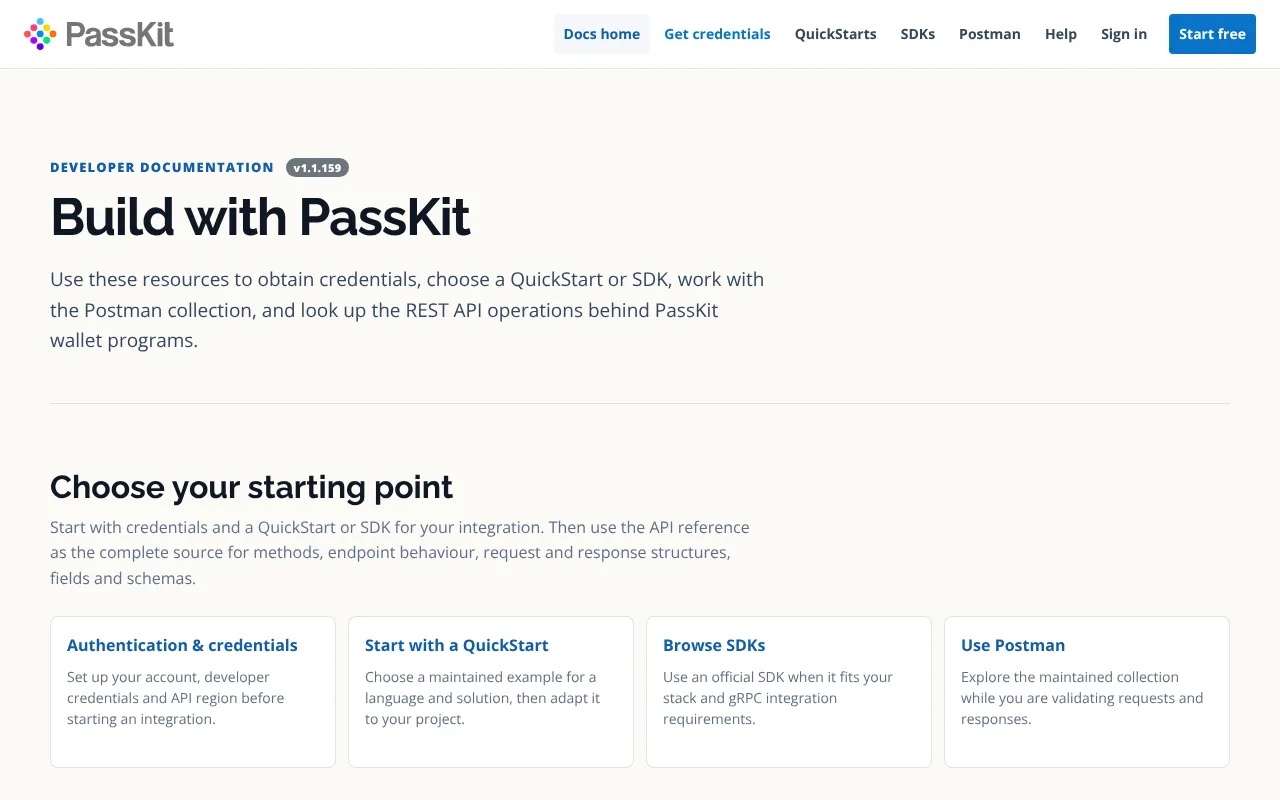
PassKit's developer documentation home page, captured 26 October 2026.
Pricing has two parts. The platform fee depends on how many team members you have, in US dollars: $39.50 a month for one, $59.25 for two, $75.75 for three, $89.50 for four, $99.75 for five, $114.75 for six to ten, $159.25 for eleven to twenty and $249.50 for unlimited. That fee includes 250 multi-use and 250 single-use passes. Beyond that, multi-use passes are billed in bands. The first band, 251 to 2,500, is $0.045 per pass, and it falls to $0.034 for 2,501 to 5,000, $0.023 for 5,001 to 10,000 and $0.0125 for 25,000 to 50,000. Single-use passes cost more per pass, at $0.0945 in the first band.
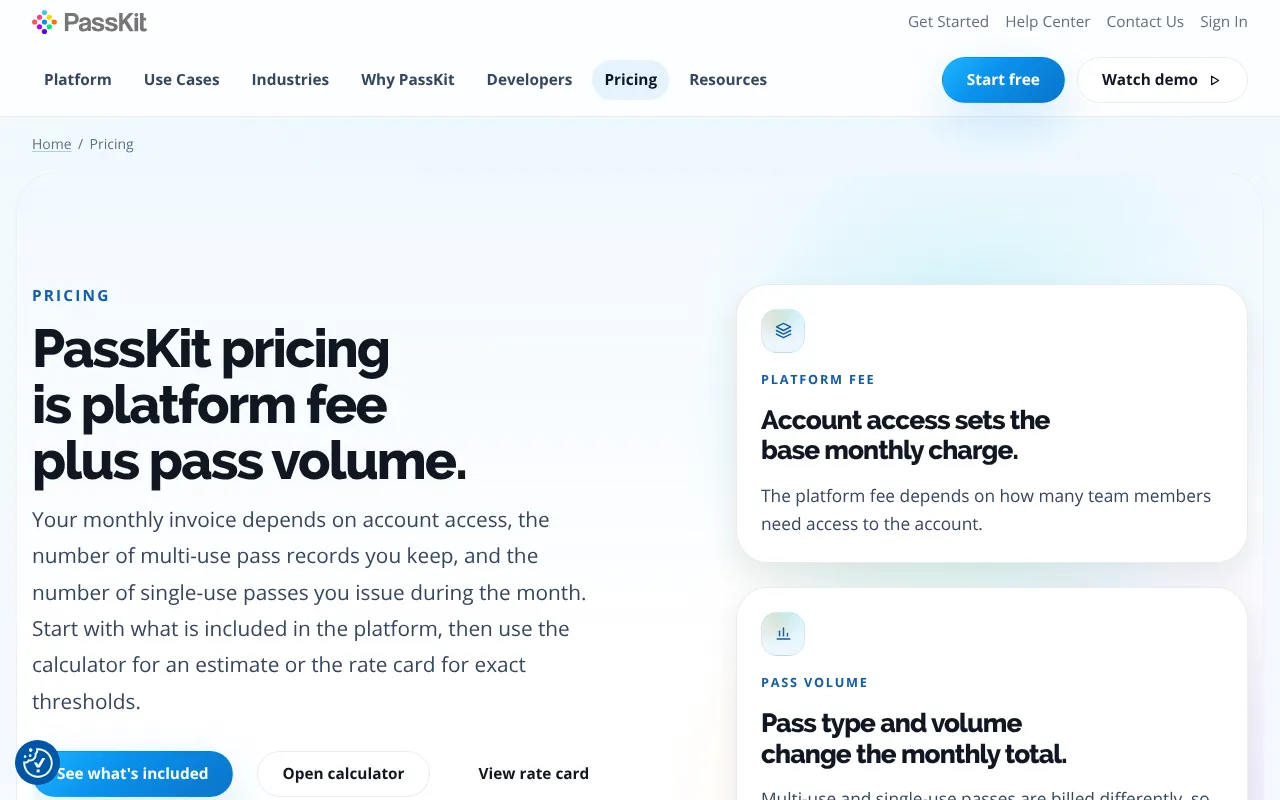
PassKit's pricing page, captured 26 October 2026. The rate tables sit below the first screen.
The details that change a bill are in the FAQ. PassKit says it doesn't charge per API call. It says the billable count for multi-use passes is records created minus records deleted, and that records are deleted automatically 90 days after they expire. It offers a 45-day trial with no charge on draft projects, and a live project needs a verified email, a payment method and your own Apple signing certificate. Webhooks exist, and its developer page shows a pass.updated example. For scanning, the home page names a PassReader app for validating and redeeming passes, and it claims SOC 2 Type II.
Choose PassKit when several non-engineers will work in the tool, when you want gRPC, or when one program spans several pass types. The cost is the pricing model, which takes a calculator and a patient afternoon.
PassNinja: priced by template
PassNinja is API-first, with libraries for Node.js, Python, Ruby, PHP and Swift, plus React Native, and a reference docs landing page with an API reference, SDKs and platform parameters. It supports Apple and Google Wallet and sells NFC readers, and says it works with any Apple VAS or Google SmartTap reader.
The meter is unusual. Its pricing page lists $21 a month per pass template plus $0.11 a month per active pass, where active means installed and not expired. New verified accounts get $10 in credits, and delivering a pass by SMS or email costs $0.10 a message. The page's own calculator example, two templates and 1,000 passes, comes to $152 a month.
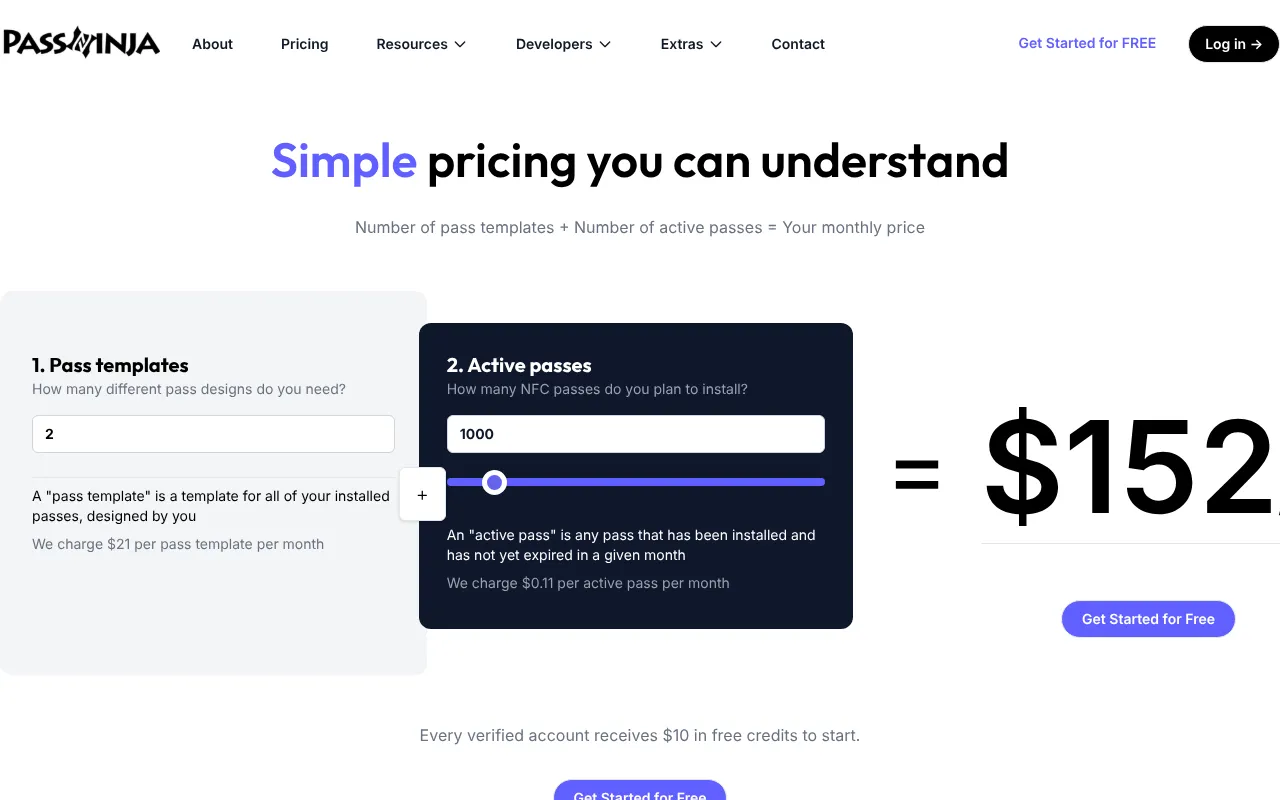
PassNinja's pricing calculator, captured 26 October 2026.
Two points set PassNinja apart. First, certificates. Its FAQ says you can sign and issue passes with PassNinja's certificate and later swap in your own Pass Type ID or Google collector ID. That lowers the cost of a first launch, though you'll want to own the certificate before real members rely on it. Second, enterprise. It offers on-premises licensing, with no public price.
One correction to our earlier coverage. We previously listed PassNinja as supporting webhooks. On its docs landing page we found only an FAQ mention of public endpoints that receive Wallet webhook calls, which is Apple's own web service protocol and not a customer webhook feature. We can't confirm a customer webhook product from what we read, so check before you plan around one.
The template charge rewards teams with one or two designs and penalizes teams with many. Count your templates before you read anything else on the page.
Passcreator: pay for what people download
Passcreator, a German platform, charges only for passes that get downloaded to a device, which it calls registrations. Creating passes is unlimited and free. Its pricing page lists a free plan with 5 active registrations, Starter at €16 a month for 200 (€0.08 each), Professional at €120 for 2,000 (€0.06) and Business at €400 for 10,000 (€0.04), excluding 19 percent VAT. The page also lists an enterprise pay-as-you-go option with an SLA and white labeling. Push notifications and API access are unlimited on every plan, and it supports Apple, Google and Samsung Wallet on all of them.
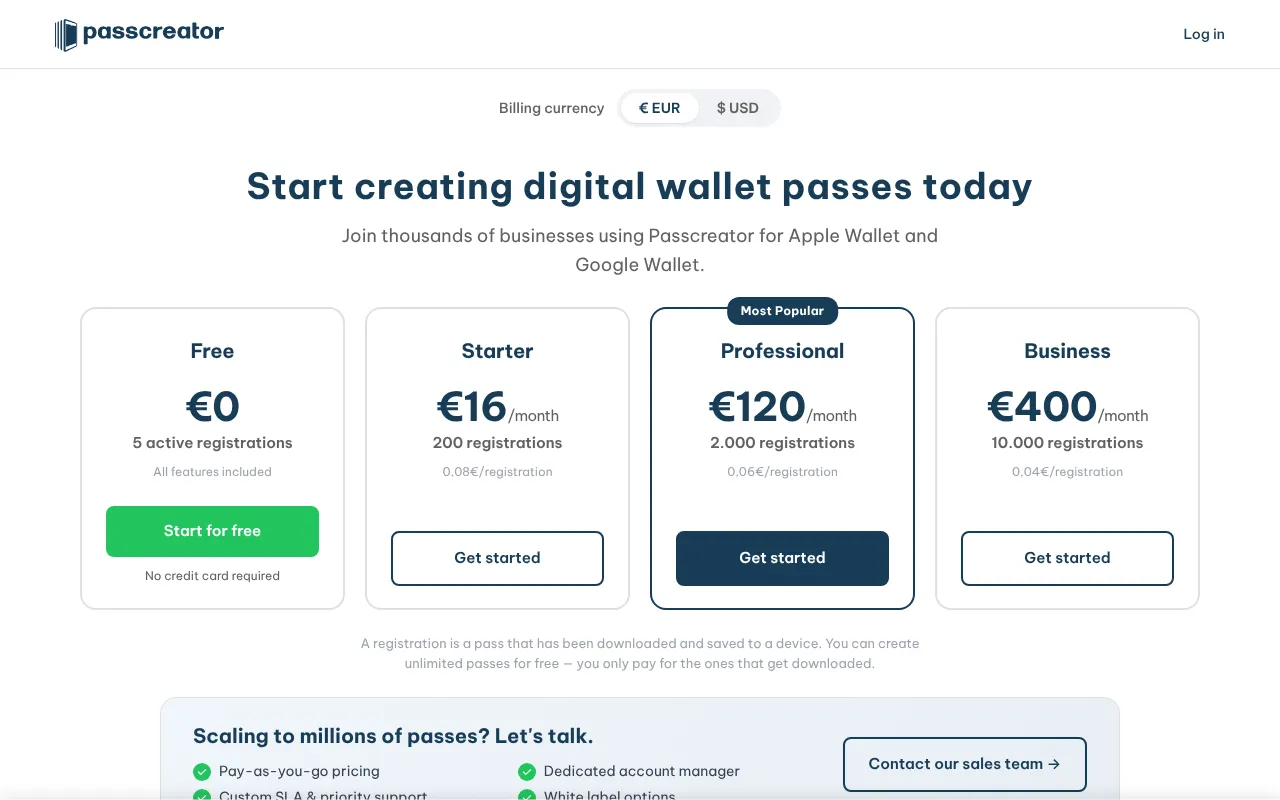
Passcreator's plans, captured 26 October 2026. Its pricing route redirects to the registration page, so this is the URL the site sends you to.
Its developer site documents REST versions 1 to 3, a Postman collection, a PHP package, a query language and bulk operations. Webhooks are documented for passes, templates, app scans and messages. It also lists ISO 27001 certification, GDPR compliance and EU hosting, which matters if procurement asks where customer data lives.
What we couldn't establish is certificate handling. The FAQ entry on whether you need an Apple Developer account had no visible answer when we read it, and we found no rate limits. Ask both questions before you commit. Choose Passcreator when your passes are issued widely but installed selectively, such as invitations or mailed offers, or when EU hosting is a requirement.
Pass2U: credits and a very old guide
Pass2U, from MicroMacro Mobile in Taipei, offers Apple and Google Wallet and its own Pass2U Wallet app. Its API guide is a RESTful Pass API, version 2.2.3, dated 1 March 2023, shipped as a PDF with Java and C# samples. That date isn't disqualifying, but it tells you what kind of docs you're getting.
Our earlier article said we couldn't read Pass2U's pricing. The rendered page now shows it. There are two ways to pay. Pay-as-you-go credits cost $50 for 8,000, $100 for 20,000, $200 for 50,000 and $400 for 125,000, with 30 free credits to start. Creating a normal pass costs 3 credits and a punch card 10. Emailing a pass costs 2, and each update costs 3. Redeeming and voiding cost nothing. Monthly Premium plans are priced per model. The $0 tier gives unlimited updates for 10 active passes, $39 covers 2,000 active passes and $79 covers 5,000. Exceeding the quota blocks new issuance. Its SMS charges vary by country, and SMS hasn't been supported in the United States since July 2023.
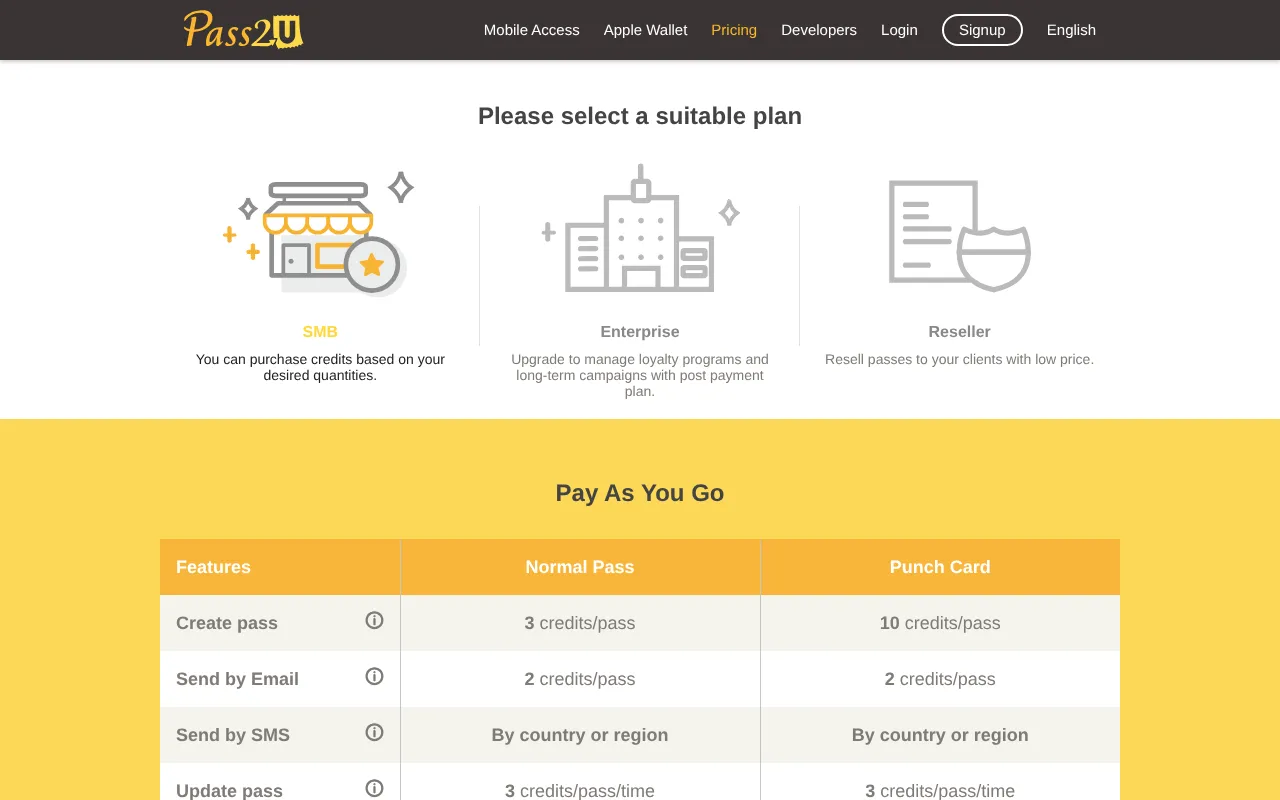
Pass2U's pricing page, captured 26 October 2026.
Two cautions. Credit systems are hard to forecast, because you're pricing three kinds of events at once. And the rendered page and a text summary of it disagreed on several numbers when we checked (free credits, pack sizes and bonus credits), so we used what the page itself displays. Confirm every figure with Pass2U before you rely on it. It states no position on webhooks, certificate ownership or data location that we could find.
WalletWallet: the closest price comparator
WalletWallet, at walletwallet.dev, is a newer API aimed squarely at developers, and it is the platform most like ours. One POST returns a .pkpass, a Save to Google Wallet link and a hosted share page. Keys look like ww_live_..., the base URL is api.walletwallet.dev, and updates are a PUT that pushes to both wallets. An identical body returns unchanged: true with no push and no usage. It has no official SDK, and the docs show samples in cURL, JavaScript, Python, Ruby, PHP and Go.
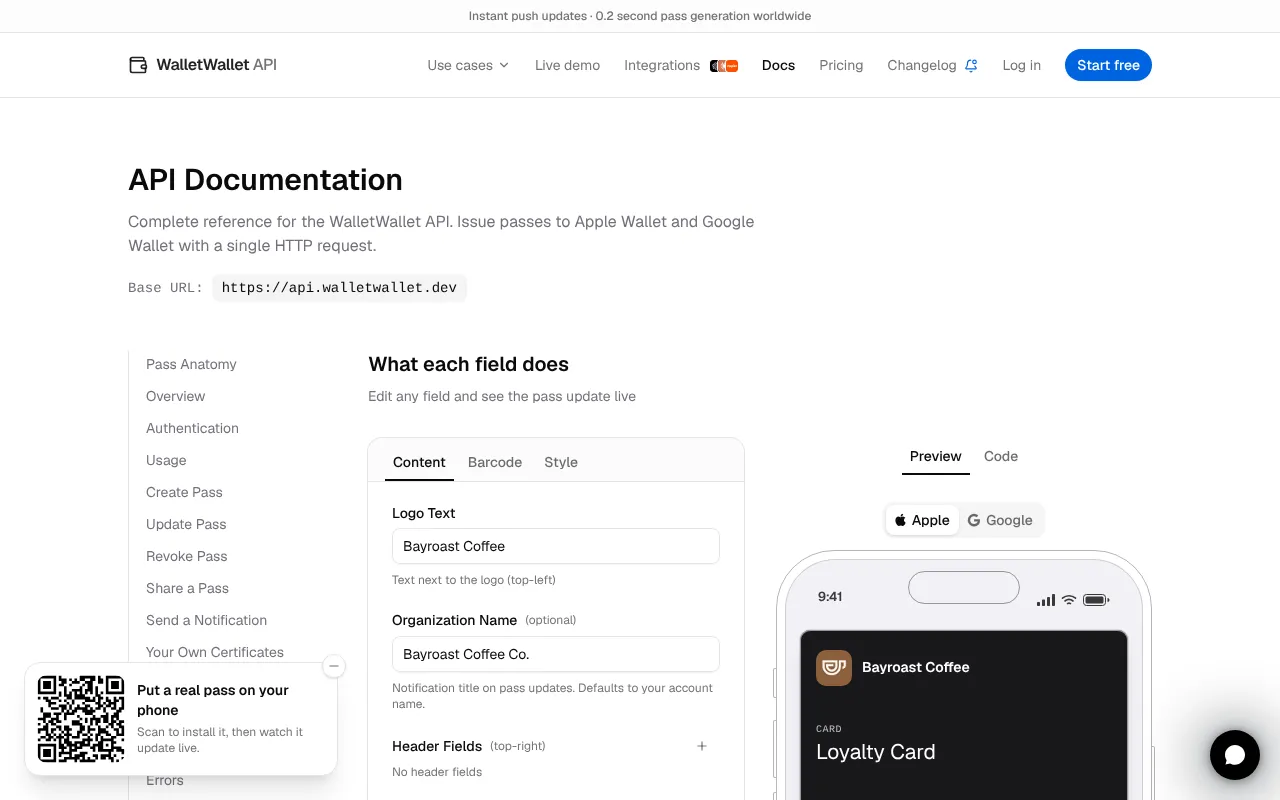
WalletWallet's API documentation, captured 26 October 2026.
The meter is the interesting part. Its pricing page says it doesn't bill per device or per active pass. Free is $0 for 1,000 passes a month, Pro is $39 for 100,000, and Business is $99 for 1,000,000 as a soft limit, with a Scale tier from $379. Creates and updates both count, a pass that serves Apple and Google counts once, and wallet devices polling for changes don't count. Every account starts with a 30-day trial of all features and no card needed.
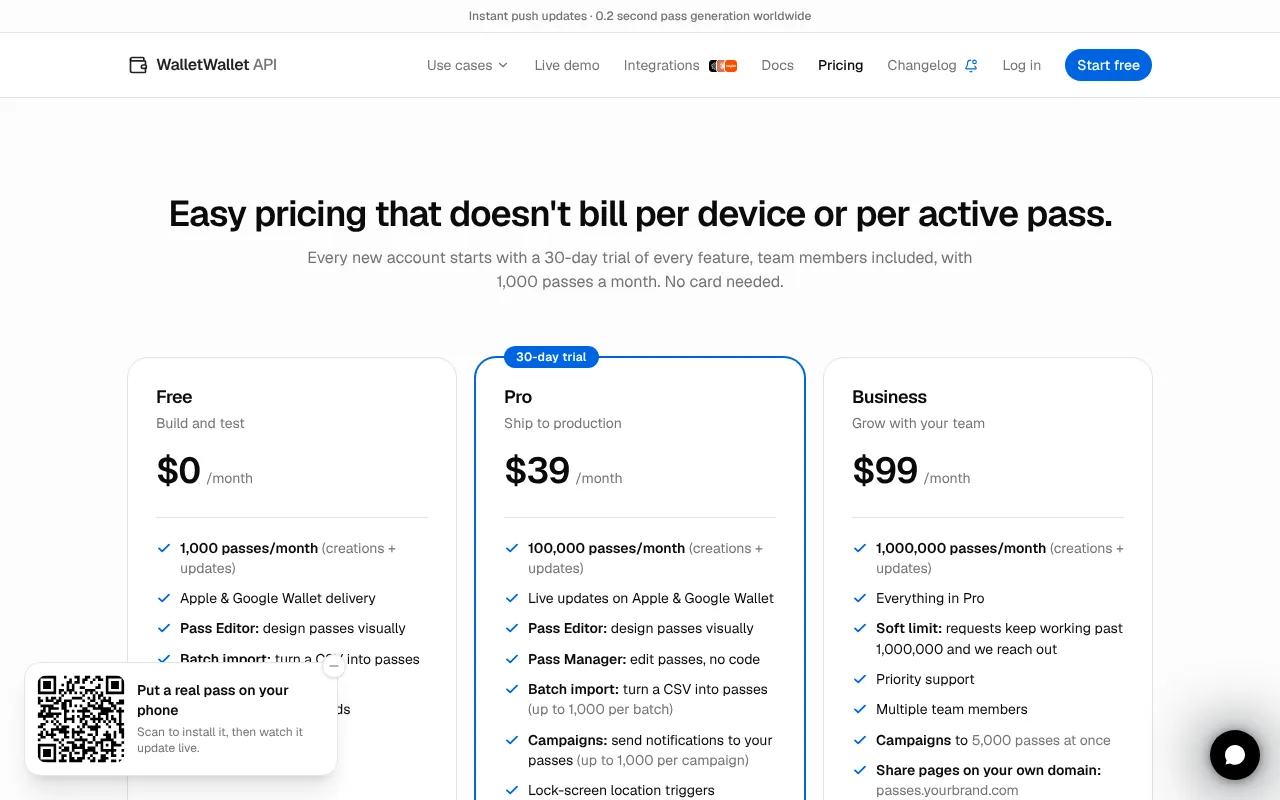
WalletWallet's pricing page, captured 26 October 2026.
On certificates, the default is WalletWallet's own. Using your own Apple Pass Type ID and Google issuer needs Pro or higher, and its docs say the private key is generated server side from a signing request and never leaves its servers. Its trust page says data at rest sits in Cloudflare's EU region, and it offers a data processing agreement, though it makes no SOC 2 or ISO claim. We found no webhook documentation and no documented redemption flow. Some of its comparison content is vendor marketing, so we read the docs and not those pages.
The honest summary is that WalletWallet's meter favors programs that create many passes and rarely update them, and punishes the reverse. If a pass changes every week, the count of updates matters more than the count of members.
PassEntry: a UK platform with a dashboard
PassEntry is the other newcomer to our list. It calls itself API-first, with a dashboard, an API reference and Zapier and point-of-sale integrations. Its pricing, in pounds and excluding VAT, starts with a 14-day trial with no card (one seat, one template, 100 passes), then Pilot at £199 a month or £167 a month billed annually, covering one seat, one template and 500 passes. Custom plans start from £200 a month, and enterprise is by quote.
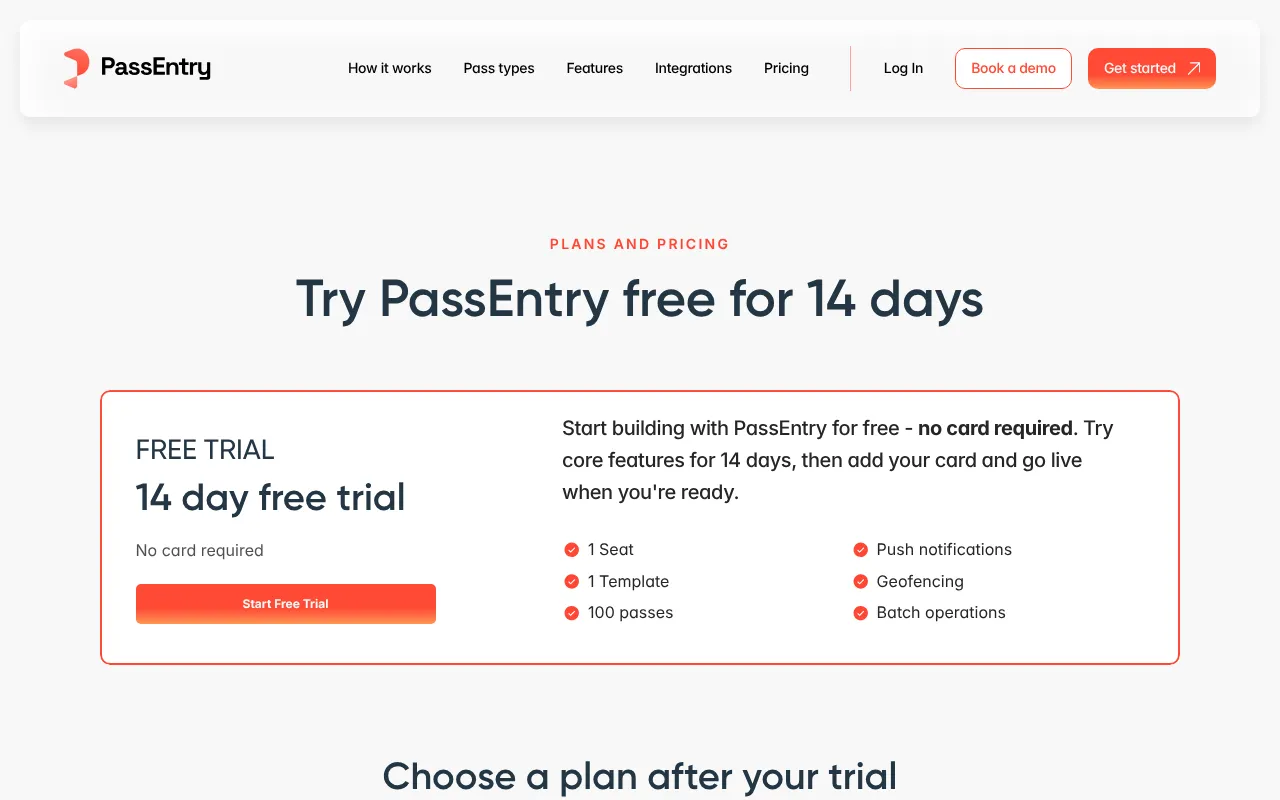
PassEntry's pricing page, captured 26 October 2026.
It lists a reader app, third-party validation, readers that use the VTAP protocol, bulk operations, geofencing and a guide to handling GDPR erasure requests. It claims SOC 2 compliance. We couldn't verify certificate ownership or webhooks. The page's annual savings figure didn't reconcile with the monthly prices, so we don't quote it. The price floor is the highest on this list, so PassEntry fits teams that want an operations tool around passes more than teams that want a thin API.
Passmint, and where we sit
We run Passmint, so weigh this section accordingly. It's a REST API with templates, webhooks and test and live keys. You post a template ID and field values and get back something both wallets can install, and Passmint runs the update service and pushes. The meter is active passes. Free covers 10, Hobby is $15 a month for 500, Pro is $49 for 5,000 and Scale is $149 for 25,000, with $0.01 for each pass over the limit on paid plans.
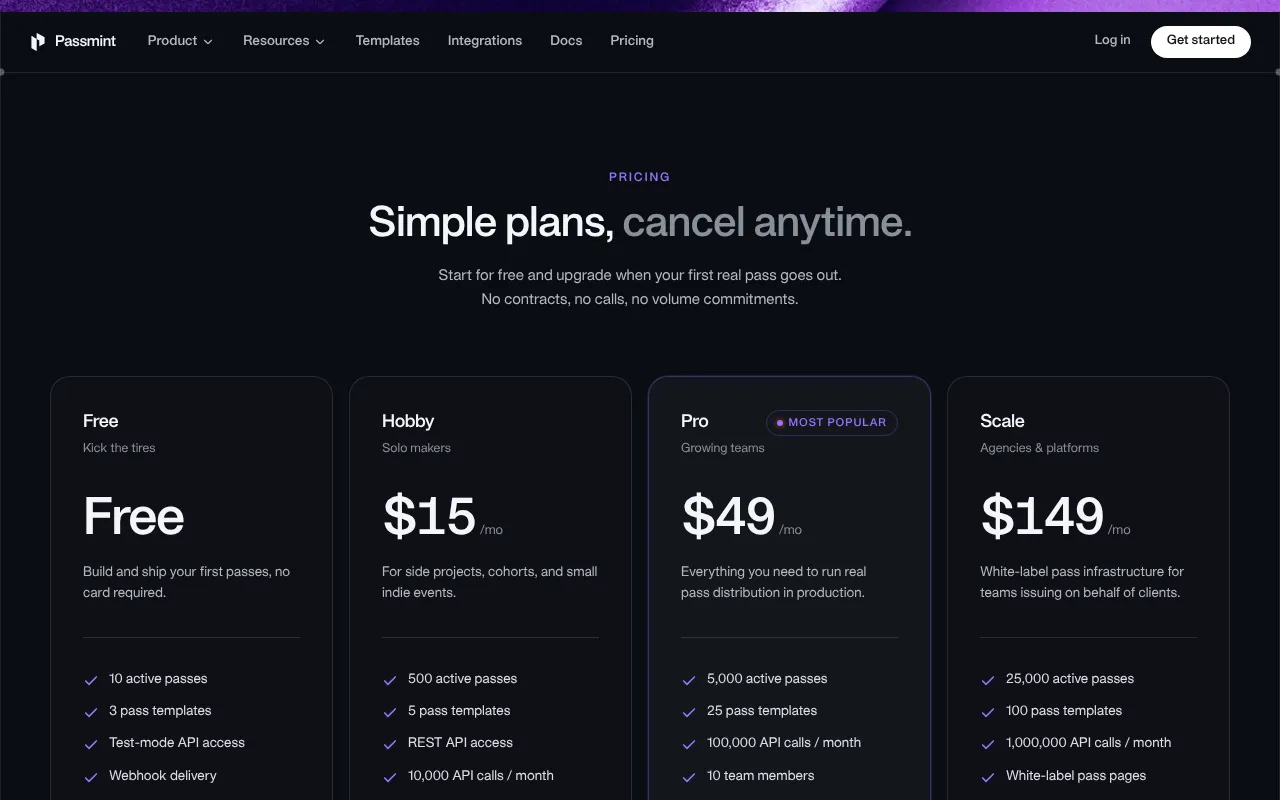
Passmint's pricing page, captured 26 October 2026.
In fairness to the comparison, there's a second limit you should know about. Each paid plan also carries a monthly API call quota: 10,000 on Hobby, 100,000 on Pro and 1,000,000 on Scale. A program that updates passes heavily needs to count calls as well as members.
On certificates, test mode signs with a shared Passmint certificate and marks the pass as a test. Live mode needs your own Pass Type ID certificate, which you create in your own Apple account from a signing request Passmint generates. Passmint never asks for a .p12, and signing happens in a separate service that holds the key. The open-source passmint package lets you sign from your own certificate files if you'd rather run it yourself, so the pass format stays portable.
What we don't have is breadth. PassKit has solution-specific APIs and gRPC. Passcreator has Samsung Wallet and EU hosting with ISO certification. PassEntry has an operations dashboard and reader integrations. Passmint is one narrow API for developers.
The open-source libraries
A library signs a pass and leaves the rest to you. That's a fair deal for one wallet and a small number of passes, and a heavy one beyond that. These are the ones we reviewed, with versions and dates read on 26 October 2026.
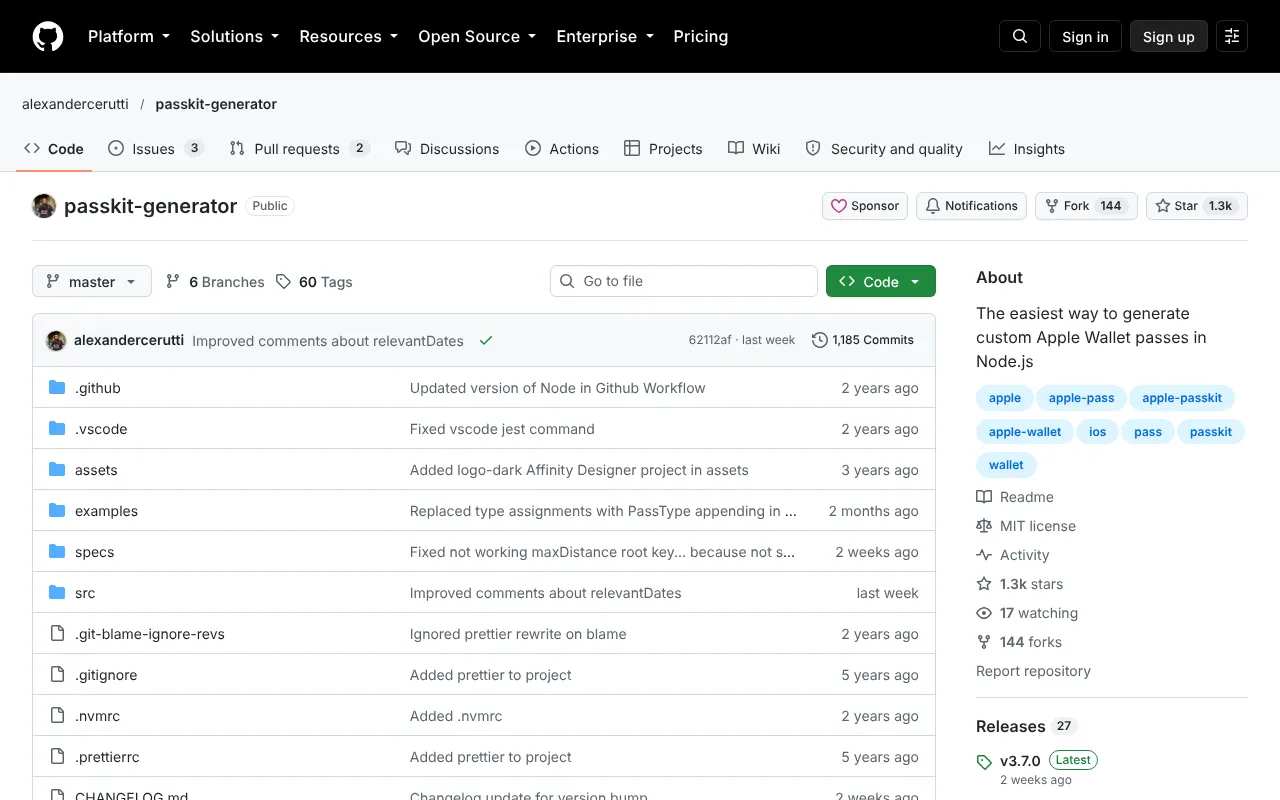
The passkit-generator repository, captured 26 October 2026.
passkit-generator (Node). Version 3.7.0 was published on 14 October 2026. It's MIT licensed, has about 1,300 stars on GitHub, and signs Apple passes only. Its README points to separate libraries for the web service and for APNs. We covered the gap in what passkit-generator leaves you to build.
@walletpass/pass-js (Node). AGPL-3.0-or-later, about 742 stars, and the README says zero runtime dependencies. It supports localization, NFC and web service push updates. The npm registry's latest tag was 7.2.0 (May 2026) while the GitHub release was 7.2.1, so check which you install. If you ship closed-source software, read the license before the API.
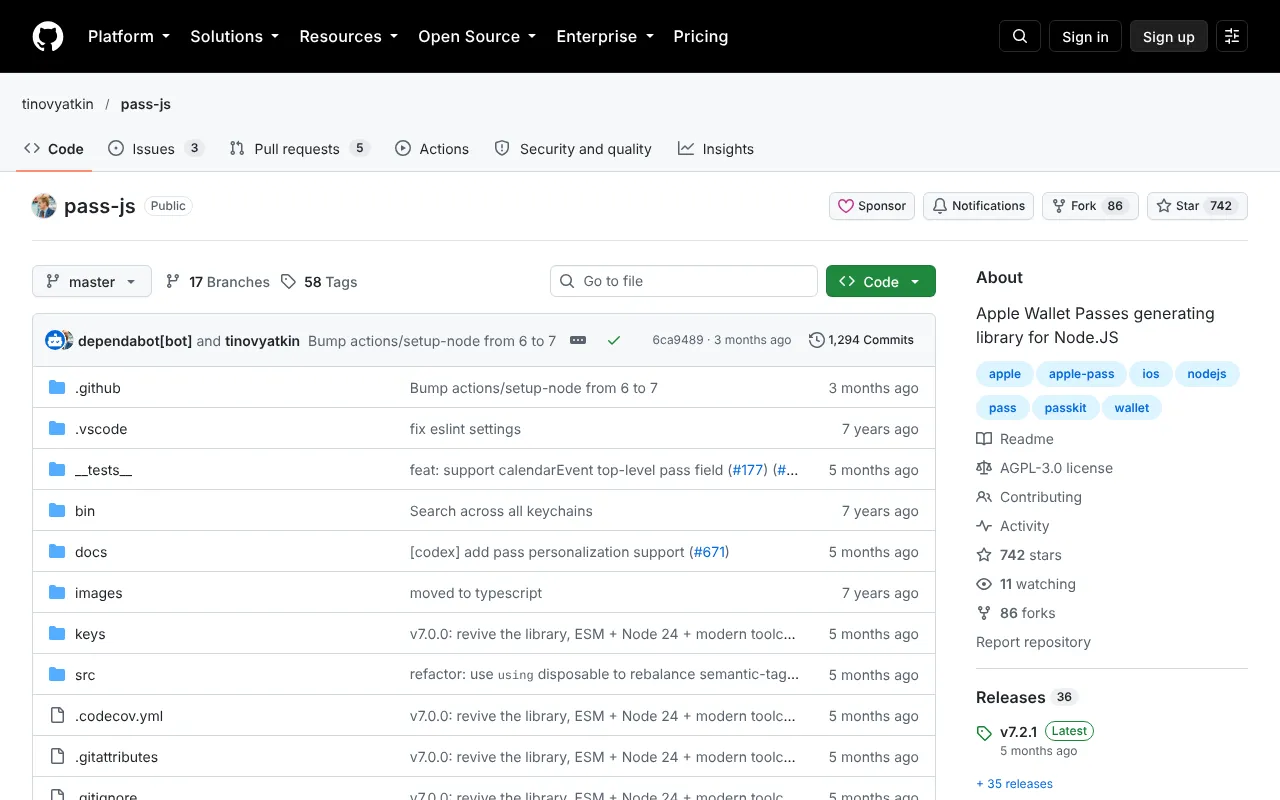
The pass-js repository, captured 26 October 2026.
alvinbaena/passkit (Go). MIT, about 122 stars, no tagged releases, with the latest activity in August 2026. Apple only. Our Go guide shows the signing step in the standard library plus two small packages.
py-pkpass (Python). MIT, version 1.0.2 from April 2025, descended from the older passbook fork lineage. See signing in Python.
eo/passbook (PHP). MIT, version 3.2.0 from August 2026, Apple only.
spatie/laravel-mobile-pass (PHP). MIT, version 1.11.2 from 19 October 2026, with about 202,000 downloads. This is the one library here that covers both Apple and Google Wallet, with push updates, so a sentence we've written before, that libraries sign Apple passes only, is no longer true of everything on this list.
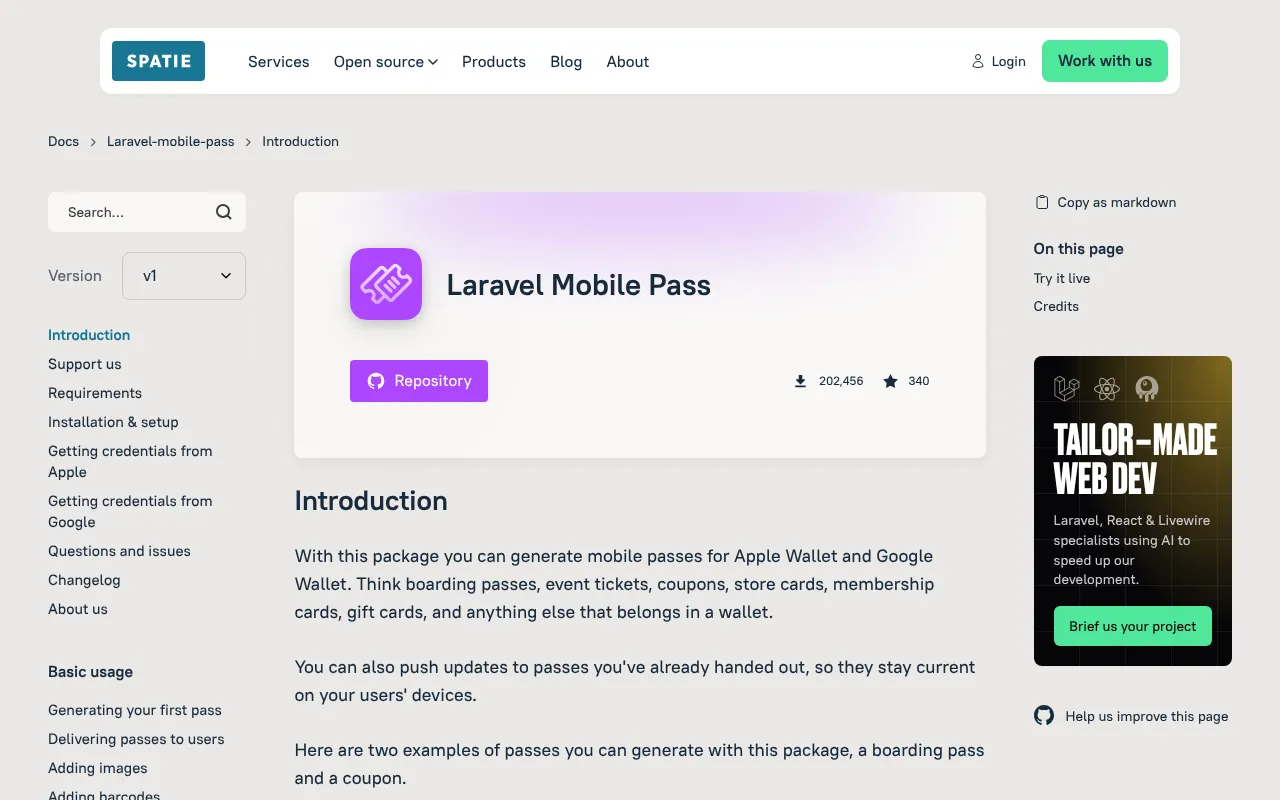
The Spatie Laravel Mobile Pass documentation, captured 26 October 2026.
Ruby. We found no well-maintained option. The passbook gem last shipped in 2017, and wallet_passkit was at 0.1.0 from August 2025. Our Rails guide uses a hosted API for that reason.
Libraries cost nothing in license fees, and you still pay in servers, an APNs sender, a device table and the certificate calendar. They're also where you keep full control of custody.
What the same program costs on each meter
Here's the experiment that procurement's spreadsheet needed. Take a program with one template, one developer and all passes active and multi-use. Here is the list price per month at three sizes, using only the numbers above.
| Platform | 500 passes | 5,000 passes | 50,000 passes |
|---|---|---|---|
| Passmint | $15 | $49 | $399 |
| PassKit (one seat) | about $51 | about $226 | about $896 |
| PassNinja | $76 | $571 | $5,521 |
| Passcreator | €120 (Professional) | €400 (Business) | Quote |
| Pass2U | $39 plus credits | $79 plus credits | Not listed |
| WalletWallet | $0 to $39 | $39 | $39 to $99 |
| PassEntry | £199 (Pilot) | From £200, custom | Quote |
| A library | Hosting and time | Hosting and time | Hosting and time |
Here is how we got each line, so you can redo it with your own numbers.
- Passmint. At 50,000, the Scale plan is $149 for 25,000 passes plus 25,000 extra at $0.01, which is $250.
- PassKit. $39.50 plus banded volume above the included 250. At 500 that's 250 passes at $0.045. At 5,000 it's 2,250 at $0.045 plus 2,500 at $0.034. At 50,000 it adds the next three bands. We assumed each band prices the passes that fall inside it.
- PassNinja. $21 plus $0.11 per active pass at list price. Volume discounts may exist for enterprise customers, and we didn't find any published.
- Passcreator. The smallest tier whose registration count covers the program. The page doesn't say how overages work, so we don't extrapolate.
- Pass2U. The Premium plan that covers the active pass count. Creating a pass also costs credits, so the real bill is higher.
- WalletWallet. The meter counts creates and updates per month. A mostly static program of 5,000 passes fits well inside Pro. A program that updates every pass weekly can use roughly 20,000 events a month at that size.
- PassEntry. The only published number that fits is Pilot, at 500 passes.
Three observations fall out of the table. The meter matters more than the headline price, because the cost curves cross. PassNinja is cheap at small scale with one template and expensive at large scale. WalletWallet is the reverse, since its meter ignores active pass count. And the right-hand column is where most vendors stop publishing numbers, which tells you that large programs get negotiated.
The table also leaves out the line that decides most projects, which is engineering time. A library at $0 is the right answer when you'd rather own the system, and the wrong one when nobody on your team wants the certificate calendar.
Who holds the certificate
Certificate custody is the most consequential row, and it's the one that vendors describe least consistently. This is what we could establish.
| Platform | Apple certificate for live passes | Source |
|---|---|---|
| PassKit | Your own, required for a live project | PassKit pricing FAQ |
| PassNinja | Theirs, with a swap to your own later | PassNinja pricing FAQ |
| WalletWallet | Theirs by default, yours on Pro and up | WalletWallet docs |
| Passmint | Shared in test mode, yours in live mode | Passmint docs |
| Passcreator, Pass2U, PassEntry | Not stated on the pages we read | None found |
An earlier version of our own comparison said that for live passes you generally need your own certificate. That was too absolute. PassKit and Passmint work that way, and two others don't. Don't generalize it across the market.
A vendor's certificate is the easier start and the harder exit. Passes signed with their Pass Type ID carry their identifier, so moving later means issuing new passes. Ask any vendor you shortlist what happens to installed passes if you leave.
How to choose
Skip the matrix and work through these in order.
Do you need Google Wallet? If yes, most libraries drop out, with spatie/laravel-mobile-pass as the exception for Laravel teams. If you only need Apple and your volume is small, a library is a sensible start.
Who touches the tool? If marketing and support need to design and send passes, look hard at PassKit, Passcreator and PassEntry, which invest in dashboards. If only engineers touch it, a seat-based fee buys you little.
What will your meter count in year two? If members churn and you only pay for active ones, active-pass pricing helps. If you update often, avoid a meter that counts updates. If you invite widely and few install, Passcreator's model fits.
Who should hold the certificate? If compliance or brand ownership matters, choose a vendor that uses yours from day one. If speed matters, a vendor certificate is a fine start, as long as you plan the exit.
Where does the data live? If your members are in the EU, Passcreator and WalletWallet both state European hosting. Ask every vendor the same question and write down the answers.
Then run a ten-minute test on your shortlist. Issue one pass, install it on your own phone, change a field and time how long the update takes to appear. The platform that gets you through that with the least friction is usually the one your team keeps using.
What we couldn't verify
A comparison is only as good as its gaps, so here are ours. No vendor publishes a pricing effective date. We couldn't verify PassKit's SDK languages or its data residency, PassNinja's customer webhooks or its reference docs, Passcreator's certificate handling and rate limits, Pass2U's webhooks, certificate ownership and data location, WalletWallet's webhooks, or PassEntry's certificate ownership. We didn't test any vendor's API against a real device. And as a competitor, we're a biased reader of everyone else's pages. If a figure here is wrong, tell us and we'll correct it with the date.
If a REST call and one meter fits your project, the Passmint quickstart gets a test key issuing a signed pass in about five minutes, and the side-by-side with PassKit goes deeper on the broadest alternative. More at Passmint.
Primary sources
Common questions
Technical content writer, Passmint
Julio is a technical content writer at Passmint. He writes about Apple PassKit, the Google Wallet API, and what breaks when wallet passes meet production traffic.
More from Julio Song →