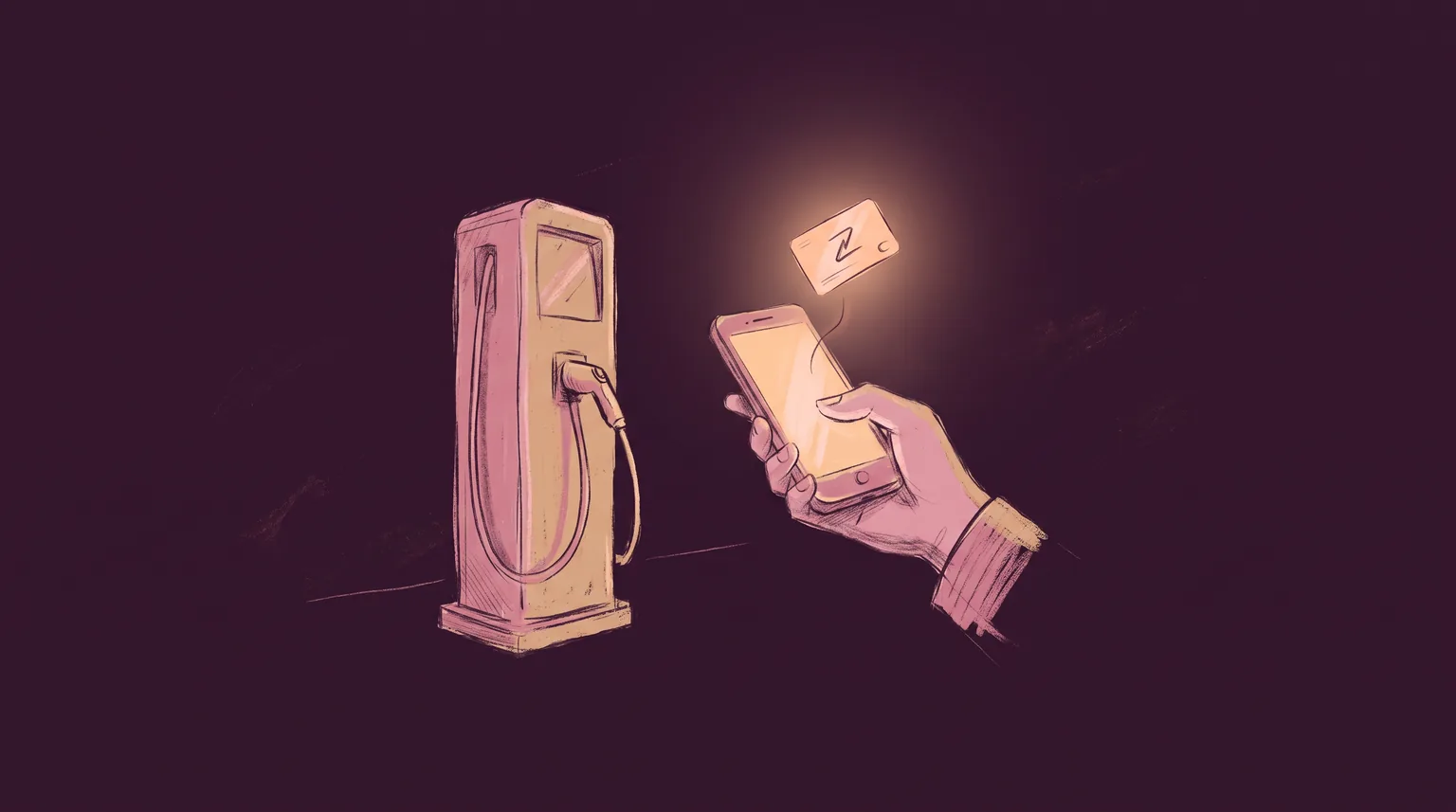
It's 9:40pm at a highway service plaza in Ohio. A driver coasts into a row of eight chargers with 11 percent left in the battery. Her kids are asleep in the back. She plugs in, opens the network's app, and watches a spinner. The plaza sits in a cell dead zone behind a truck stop. The app wants her to log in again.
She has a plastic membership card somewhere. It is in the other bag, in the trunk, under the stroller.
Nobody in that story did anything wrong. The charger works. The network's billing works. The thing that failed is the handshake between a person and a machine, the moment where the driver proves who she is. That moment is small, and it decides whether she comes back.
This piece covers why that handshake is the weakest link in public charging, what a membership pass in the wallet changes for you, who already ships one, and what you should copy before your next roadmap is set.
One in seven charging visits fails, and drivers remember
Start with the number that should worry you if you run a network. J.D. Power's 2025 U.S. Electric Vehicle Experience Public Charging Study, based on 7,428 owners of battery electric and plug-in hybrid vehicles surveyed from January through June 2025, put failed charging visits at roughly 14 percent. That was down from around 19 percent the year before, which is real progress.
It also means roughly one visit in seven still ends without a charge.
The same study found that most of those failures came from the equipment. Chargers that were out of service or not working properly accounted for about 60 percent of failed visits. You can fix that with maintenance contracts and uptime targets, and the best networks are doing so. Tesla's Superchargers came in lowest at around 4 percent failed visits in that study, and Electrify America reported around 6 percent.
That leaves the other 40 percent or so. Those are the failures that live in software, payment and identity. A driver who cannot authenticate looks, from the outside, exactly like a driver whose charger is broken. Both leave with a dead battery and a story.
You can think about the handshake as four separate ways to fail:
- The app has to open. A forced update, a cold start or a login screen all add friction before the session can begin.
- The phone has to reach the network. Chargers sit in garages, plazas and rural lots. Signal is often the first thing to go.
- The card has to be in reach. A membership RFID card works with no signal, but only if the driver brought it.
- The account has to match. A card tied to a lapsed payment method, or a second card from a roaming partner, fails with an error nobody can read at 10pm.
A wallet pass attacks the first three directly. The fourth is a data problem, and a pass can help there too, which we will get to.
Why the plastic card never scaled
Public charging grew up on RFID cards. Each network mailed a card, the driver tapped it, and the charger sent the card's ID to a back end. The design is sound. It works offline at the plug, it needs no screen, and it is cheap per reader.
The trouble is multiplication. Parkopedia cites a 2022 Shell survey finding that more than a quarter of European EV drivers carry five or more charging cards. That is a vendor's blog quoting a vendor's survey, so treat the exact figure with care. The direction is hard to argue with. Every network wants its own card, and every driver ends up with a wallet full of them.
Plastic has costs for you too. You pay for the card, the envelope, the stamp and the support ticket when it does not arrive. You pay again when a driver loses it. You pay a third time when a card is cloned or shared, because a static ID printed on plastic is easy to copy.
Then there is the first-charge problem. A new member signs up in the app, orders a card, and waits several days. The moment of highest intent, the first week of ownership, is the moment they cannot use the thing you sent them.
A pass in the wallet turns that wait into zero. Your member signs up and adds the pass in the same minute. The credential is live before they reach the car.
What a membership pass changes at the plug
Look at it from the driver's side first. The pass sits in Apple Wallet or Google Wallet. It carries the network's name, the member's tier and a balance or status. At the charger, the driver plugs in, holds the phone near the reader and waits for the beep. No app, no login, no scan.
Now your side. The reader sees a credential and sends it to the same back end that already handles your RFID cards. The pass is a different container for the same identity, which is why the integration is smaller than it sounds. You are not rebuilding authentication. You are changing where the credential lives.
Three things come with the container for free.
It works with the screen locked. Apple's express mode and the equivalent Android behaviour let a pass respond without a fingerprint or a face scan, which matters when a driver is juggling a cable and a bag. Whether you allow that for a payment-linked credential is a risk decision, and the wallet will not make it for you.
It can be updated. A static card cannot tell a driver that the membership expires next week. A pass can. Change the status, the tier or the message on the back, and the pass on your driver's phone changes with it. That is the lever for the fourth failure above. When the payment method lapses, the pass can say so before the driver reaches the plaza.
It shows up where the phone already looks. A pass can carry location and date hints, so it surfaces on the lock screen when the driver is near a charger. That is one less thing to hunt for on a dark lot.
The networks that already did it
The earliest mover was ChargePoint. In a September 2017 announcement, the company launched Tap to Charge, which let drivers start a session by holding an iPhone, an Android phone or an Apple Watch near a ChargePoint station. The company said the feature worked at more than 40,000 charging spots across North America, and described itself as the first to let drivers start a charge with an Apple Watch. A driver adds a ChargePoint pass to Apple Wallet from the app, then taps the station.
Electrify America followed the same pattern with what it calls a digital membership pass. Its mobile app support page says Pass and Pass+ members who have the app and a valid payment method on file can start a session by tapping or holding the phone near the charger's RFID reader. The instructions are plain. Plug in the connector first, follow the steps on the charger screen, then tap. On an iPhone the reader is on the right side of the charger. On Android the screen must be unlocked and NFC turned on, but the app does not need to be open.
Notice what both networks did. Neither threw out its RFID readers. Each one made the wallet a second way to present the same credential, and kept the app as the fallback for drivers who prefer it.
Hardware vendors have noticed. ELATEC, a maker of RFID and mobile ID readers, announced that its readers were certified for use with iPhone and Apple Watch, which lets charging operators identify customers with an NFC membership pass stored in Wallet. If your readers come from a vendor with that certification, the hardware question is mostly answered.
This is not a smooth story everywhere. App Store reviews of ChargePoint include drivers praising the Wallet card and others reporting that the virtual card failed at a station after several tries, including at roaming partner stations. Those are user reports, not official statements, but they point at the real risk. A pass is only as good as the reader and the back end behind it. A rollout that skips testing at the oldest chargers will find those drivers fast.
A representative case, and where it goes wrong
Consider a regional network with 300 chargers across a dozen sites, based on an anonymized, invented example. It has an app, a mailed RFID card and a support line that fields the same three calls all day: the card did not arrive, the app would not log in, and the charger did not start.
The network adds a wallet pass. It does not touch the readers at first. It issues passes that carry the same ID as the member's existing card, so the back end sees nothing new. New members get the pass at sign-up and skip the mailed card entirely.
The effects are easy to predict even if the exact numbers are not. Card shipping drops, because new members no longer need one. The "card did not arrive" calls vanish. A share of "app would not log in" calls vanish too, because members stop using the app to start a session. Whether the savings cover the build is something you should measure on your own network, not take from anyone's headline.
Here is where it goes wrong. The pilot only tests the newest chargers, which all have readers that handle the wallet's NFC format. Six months in, drivers at older sites tap and nothing happens. The pass looks like it is broken. The reader is the problem.
The fix is dull and effective. Audit every reader model before launch. Tag sites by capability in your back end. Show the pass's message field a line such as "Tap works at 11 of 12 sites", so your driver knows where to use the app instead. Honest limits beat a mysterious failure.
The part nobody likes, the Apple and Google gatekeeping
A wallet pass that talks to an NFC reader is not the same as a loyalty pass that shows a barcode. Both platforms treat tap-to-identify as a controlled capability.
On Apple's side, NFC passes need an entitlement and a certificate that Apple issues to approved partners, and the reader has to speak Apple's Value-Added Services protocol. On Google's side, the equivalent is Smart Tap, which also requires enabling with Google and a compatible reader. The details change, and both companies decide who gets access, so check each program's current terms before you commit a date to anyone.
This is the practical reason to separate two tiers in your plan:
- Tier one is a barcode or QR pass. It needs no special approval. A driver can show it to a camera-equipped charger or a handheld scanner, and your back end resolves it. It is slower than a tap, but it ships in weeks.
- Tier two is the NFC pass. It is the experience drivers will actually love. It needs approval, compatible readers and a longer test cycle.
Many networks should ship tier one first and earn the right to tier two. A pass with a scannable code is still a pass. It still lives in the wallet, still updates, and still works with no signal. You can move the same pass to NFC later without asking the member to do anything.
What to build, in order
If you run a charging network, a campus fleet depot or a property with a few dozen plugs, here is the order that tends to hold up.
- Audit the readers. List every model in the field and note which ones can read a wallet NFC credential. This takes an afternoon and saves a quarter.
- Map identity once. Decide that the pass carries the same member ID your RFID card does. Do not invent a second identity system.
- Issue the pass at sign-up. The first-week gap is the cheapest win. A member who has a working credential before they leave the parking lot is a member who charges again.
- Use the update channel. Put the membership status, the tier and any payment warnings on the pass. This is what a plastic card can never do.
- Keep the app and the card. Some drivers will never use the wallet. A second path costs little and removes the argument.
- Apply for the NFC programs early. Approval takes calendar time that no amount of engineering can shrink.
- Measure the handshake. Track sessions started by pass, by card and by app, and the failure rate of each. If you cannot see it, you cannot improve it.
None of this requires a mobile team. A pass is a signed file plus a small web service, and the part that is hard to get right is signing and updates, which is the part a hosted API handles for you. If you want the mechanics, the Passmint docs cover issuing and updating a pass from a single API call.
The bet underneath all of this
Charging is about to become ordinary. In the next few years the novelty drains out of it, and drivers will judge a network the way they judge a gas station, by whether it works the first time and whether they have to think about it.
Plug and Charge, the in-car standard that lets a vehicle authenticate itself, is the long answer to the handshake problem. It needs the car, the charger and the back end to all support it, and in the meantime those three parties do not always line up. Drivers fall back to an app or a card. The wallet pass is the bridge. It fixes the handshake today, on the phone every driver already carries, without waiting for a vehicle program.
The network that wins the plaza at 9:40pm is the one whose driver never opened an app. She plugged in, held her phone near the reader, and went back to her sleeping kids.
If you run a network and want to see what a membership pass looks like on a real phone, you can start at Passmint and issue your first one in an afternoon.
Common questions
Technical content writer, Passmint
Julio is a technical content writer at Passmint. He writes about Apple PassKit, the Google Wallet API, and what breaks when wallet passes meet production traffic.
More from Julio Song →