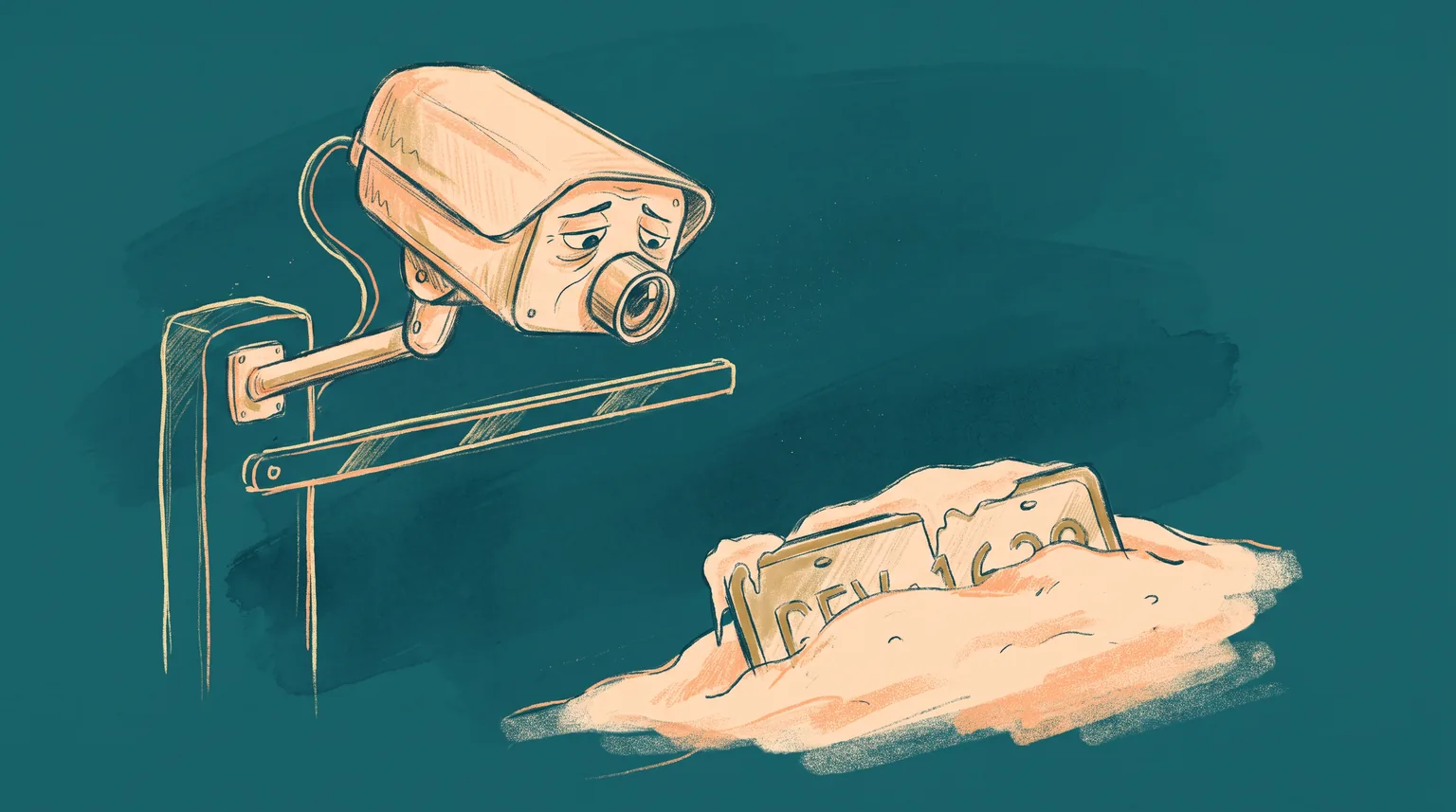
It's the first snow of the semester, and a freshman is idling at your garage gate with a rental car her parents dropped off that morning. Her real car, the one whose plate is on file with your university, is back home. Your camera reads plates, not people, and this plate has never been seen before. The arm stays down, the line behind her grows, and somewhere a shift supervisor is about to field a phone call that a database was never going to prevent.
If you run permit parking, you already know this moment. Over the last few years, campuses and cities have quietly rebuilt permit parking around a single idea: skip the physical credential entirely and let a camera read the car. It works beautifully for the driver whose plate never changes. It has nothing to offer the driver whose plate your camera has never met, and if you are running this system, you already built a workaround for that gap. You just probably do not talk about the workaround out loud, because it undercuts the pitch you used to justify the cameras in the first place.
The bet you made on the plate
The pitch behind license plate recognition, or LPR, is simple: a permit stops being a piece of plastic or paper and becomes a row in a database, matched to a plate number. The University of Central Florida moved its entire campus to virtual permits in July 2022, retiring decals and hangtags in favor of cameras that read plates at every gate and lot. George Mason University runs the same model today. Register your plate, buy your permit, and the gate opens because the camera recognized the car, not because a document was displayed.
You like this system for a reason that has nothing to do with convenience. A hangtag can be photographed, printed, and hung in a second car. A decal can be peeled off and moved to a friend's dashboard. A plate welded to one specific vehicle cannot. Automated, database-driven enforcement closes the sharing and forgery problem that paper credentials never fully solved, and it does it without anyone on your staff checking a windshield by hand. That is a real win, and it is why campus after campus has made the same move.
What your camera cannot read
The same design that kills forgery has a blind spot, and it is the population of drivers whose plate is not the one on file. If you run LPR, you already list the exceptions in your own FAQ: a rental car, a loaner from the dealership, a borrowed vehicle for the week, an out-of-state plate not yet updated in your system, or a plate simply covered in enough snow that your camera cannot resolve it. None of those drivers did anything wrong. They just are not the car in your database, and no amount of camera resolution fixes a plate the driver has not registered yet.
Universities running LPR know this well enough to have already built the patch, even if they never called it one. Harvard's parking office issues a QR code as what it calls a secondary credential, generated specifically for the driver whose plate cannot be read at the gate, sent by email and scanned as a fallback when the camera comes up empty. George Mason does something similar: garage entry runs on the registered plate, but a QR code printed on the permit receipt, or saved to a phone, is the backup for a gated area when the primary check fails. Visitors get their own separate track entirely, because a guest's plate was never going to be in the account in the first place.
Put those two systems next to each other and the pattern is obvious. The plate is your primary key. The wallet pass, or at least a bare QR code standing in for one, is the credential every LPR deployment already needed and built anyway. It just was not built as if it mattered, because the whole pitch for LPR was that you would not need a credential at all.
The permit that is not a plate
That fallback tends to arrive as an email attachment or a printed slip rather than an actual pass, and the gap shows up in exactly the moment you most need the credential to work. A screenshot buried three scrolls down in an inbox is not something a driver can find one-handed at your gate with a line building behind them. A printed slip left on the passenger seat does nothing once it is left at home instead. Neither one updates itself if the visit gets extended, the permit gets revoked, or the rental gets swapped for a different car at the counter, which means your staff is now manually re-issuing a credential you already thought you had automated away.
Washington, DC's transportation department made a version of this trade-off explicit when it moved its residential Visitor Parking Permit program fully digital in August 2025. Permits are now issued and verified by license plate number, the same LPR-style bet UCF and George Mason made. The city still had to solve for the visitor whose plate was not previously known, which is the entire point of a visitor permit. If a plate-first system built at the scale of an entire city still needs a second credential for the population it cannot recognize on sight, yours almost certainly does too.
The registration tax you charge your own drivers
Even the driver you already know is not free of friction, because a plate-first system only works if you keep the plate current. George Mason tells its own permit holders to update any vehicle change in two separate places, the garage vendor's system and the university's own parking portal, or the gate simply will not recognize the car anymore. Harvard lets you register up to five plates per account precisely because drivers rotate cars more often than a single-plate system can gracefully handle. Every one of those updates is a task you are asking a driver to remember to do before they need the garage, not at the moment they actually show up.
A wallet pass does not carry that requirement, because it was never tied to the vehicle in the first place. It travels with the driver's phone, not their license plate, which means a rental swap, a second car, or a borrowed vehicle for the weekend does not require anyone to log back into a portal and re-register anything before the gate will open. You are trading a database lookup that fails silently on stale data for a credential that simply does not go stale the same way.
Where the wallet pass is already the main event
Outside campus gates, parking has already answered this question for you, just not by choice. Apple added SpotHero's parking inventory to Apple Maps in January 2023, covering more than 8,000 locations across roughly 300 cities in the US and Canada. Book a spot and the confirmation offers an "Add to Apple Wallet" button. There is no plate database behind it, because there cannot be one. The car booking the spot is whatever car shows up, and the pass, not a camera, is the credential that proves the booking is real.
Stadiums run the same logic for event parking, where every car is a stranger to the system by definition. JustPark's guides for parking at stadium events in Dallas and Philadelphia tell drivers plainly that a digital pass gets them through the gate faster than a printed one. Rutgers' athletics department gives fans the same instruction ahead of the 2026 season: load your parking pass into Apple Wallet or Google Wallet before you arrive, so a weak signal at the gate does not strand you outside with no way to prove you paid.
None of these operators are choosing wallet passes over license plate recognition. LPR was never an option for them, because the driver was never going to be in a plate database ahead of time. That is precisely the population your QR fallback exists to catch, and right now you are probably building that fallback like an afterthought instead of like the actual product SpotHero and stadium operators treat it as.
What the paper fallback still costs you
Your old permit economy has not actually gone away. It has just moved to the edges of your LPR system, where it is easy to stop noticing. Universities that kept a physical fallback around still price it like a real cost center: $15 for a replacement decal at William & Mary, $30 for a lost hangtag at the University of Illinois Chicago, $35 at McNeese State. Those fees exist purely because the credential was a physical object someone could misplace, and if you eliminated the primary permit but still staff a desk and a fee schedule for the exceptions, you are paying to run two systems at once, the automated one you built for most of your traffic, and the manual one you still run for the visitors, the rentals, and the unreadable plates that LPR could not absorb.
The bare QR code standing in as that exception's credential brings a weak point of its own. A QR code is just an image, and images can be screenshotted, forwarded, and printed by anyone who receives one, with no way for your gate to tell the fifth copy from the first. Law enforcement agencies including the New York City Department of Transportation have had to warn drivers separately about a related problem: scammers placing counterfeit QR stickers over legitimate ones at parking meters. Static QR codes, wherever they show up in parking, carry a trust problem that a signed, issuer-controlled wallet pass, tied to a specific device and updatable after the fact, does not share.
Build the fallback like it is the product
Consider a representative regional parking operator, based on an anonymized example. LPR covers the 90 percent of its traffic that is residents and staff with registered plates. The remaining tenth, visitors, rentals, and unreadable plates, gets routed to a proper wallet pass instead of an emailed QR image. The pass carries a barcode your existing gate scanner already reads, updates itself the moment a visit gets extended or a permit gets revoked, and needs no new camera hardware at any entrance. None of that requires ripping out the LPR investment you already sunk into your garages. It requires deciding that the fallback deserves the same design attention as the primary system, instead of being the credential nobody got around to building properly.
You do not have to guess at the split before you start. Pull a month of gate exceptions, the manual overrides, the visitor codes issued by hand, the calls to the office about a plate the camera missed, and you will likely find the same tenth of traffic driving nearly all of it. That is the population worth moving to a real pass first, while the plate-matched majority keeps working exactly as it does today.
That turns out to be a smaller build than it sounds like, because none of it needs an in-house signing setup or a homegrown update server. Passmint issues Apple and Google Wallet passes with the same update infrastructure your LPR-first system is already recreating by hand for its exceptions, so the visitor permit, the rental workaround, and the snow day at the gate stop being the one credential your parking program never got around to building properly.
Primary sources
Common questions
Technical content writer, Passmint
Julio is a technical content writer at Passmint. He writes about Apple PassKit, the Google Wallet API, and what breaks when wallet passes meet production traffic.
More from Julio Song →