
Picture this. You're sprinting through a terminal, coffee in one hand, phone in the other. Your flight boards in fifteen minutes. Then your phone buzzes. The boarding pass already on your lock screen quietly updates itself: gate B12 is now gate D47. You never opened an app. You never checked email. The pass just knew, and it told you seconds after the airline's system fired the change. You pivot, you run, you make it.
That small moment is one of the most impressive pieces of consumer technology ever built. And it's everywhere. Mobile boarding pass adoption now tops 80% on major carriers, making the airline wallet pass the most widely used digital credential in consumer history. Nothing else is close.
So here's the question worth sitting with. How did one industry crack mobile wallet adoption so completely, while retail loyalty cards still rot in kitchen drawers and event tickets still get screenshotted as blurry JPEGs?
The answer isn't luck. Airlines didn't just digitize a paper pass. They built a system of contextual, time-sensitive value delivery. And the good news for everyone else? That system can be reverse-engineered.
How airlines got here first
Airlines had a head start most industries never got: a mandate.
In 2010, IATA required all member airlines to move to 2D barcode boarding passes. That single rule created a forcing function. Every carrier, every airport, every gate scanner had to align around one standard. Retail and events have never had anything like that. They evolved in a messy, fragmented way, with no shared infrastructure to lean on.
But the road wasn't smooth. From roughly 2007 to 2012, airline apps were clunky. PDF boarding passes broke on half the phones people owned. Gate scanners couldn't reliably read screens. Passengers didn't trust any of it, so they printed paper backups just in case.
Then came the inflection point. In 2012, Apple launched Passbook, later renamed Apple Wallet. Airlines were Day 1 partners, and for good reason. The boarding pass was a perfect fit for the format: time-bound, location-aware, built to update. The pass wasn't a marketing gimmick bolted onto travel. It matched exactly what the format was built to do.
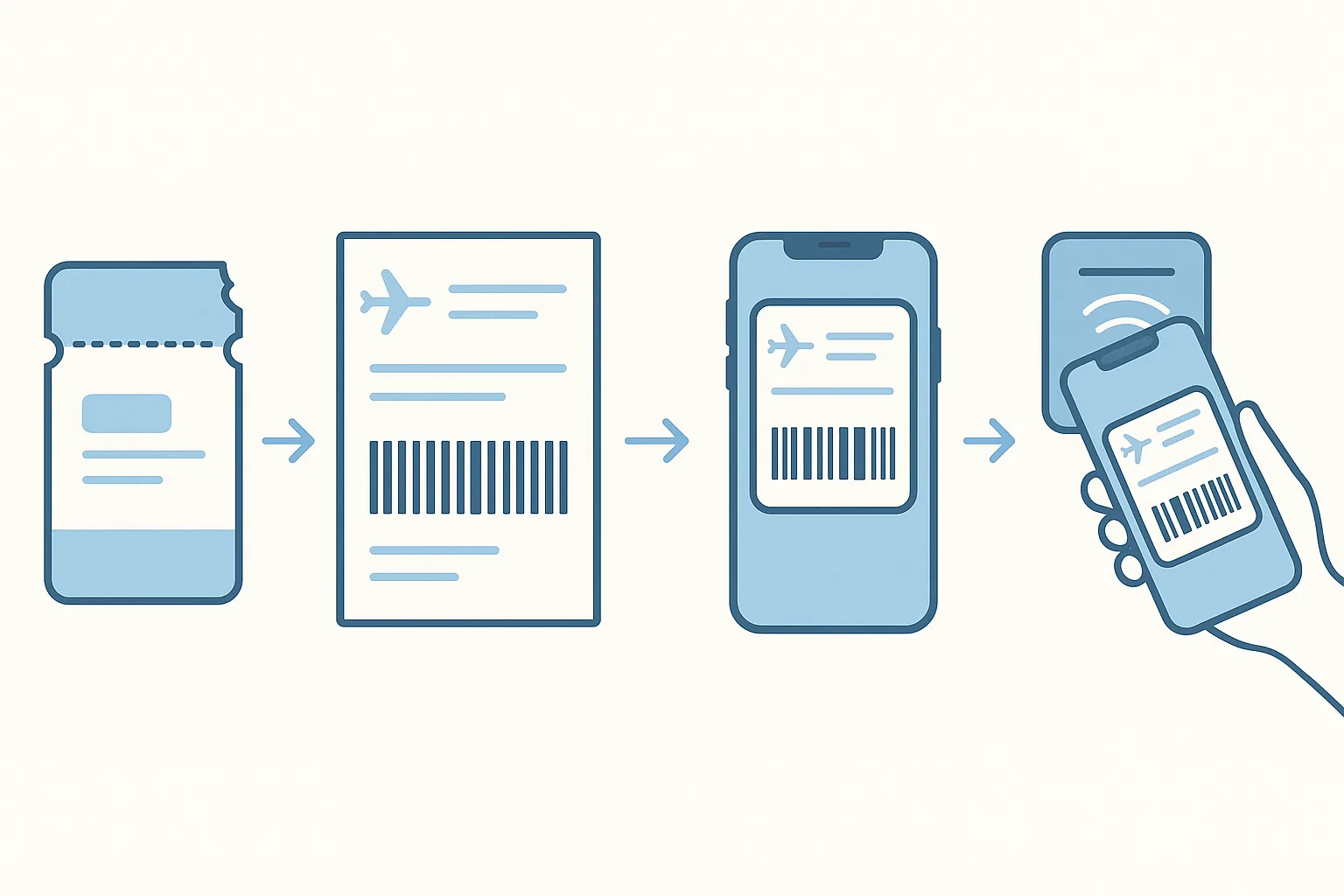
From there, adoption accelerated. Scanners standardized. Gate agents started trusting digital passes. Passengers saw others breeze through with a phone, and trust built quickly. Each successful scan made the next passenger a little braver. That feedback loop is the exact thing other industries have never managed to trigger.
The anatomy of a good pass: what airlines got right by design
Open a boarding pass in your wallet and look closely. It shows exactly what information restraint looks like in practice.
The front shows only what matters right now: departure city, gate, boarding time, seat. The barcode lives on the back, ready when you reach the scanner. The full itinerary tucks away inside for when you actually want it. That's information hierarchy done right. Most retail and event passes get this backwards. They front-load logos, promo copy, and clutter, burying the one thing the user actually needs.
Airline passes are instantly recognizable and clearly branded. But the branding never fights the function. Compare that to early loyalty card passes, where the logo was enormous and the useful information was an afterthought. Readability builds trust. Decoration doesn't.
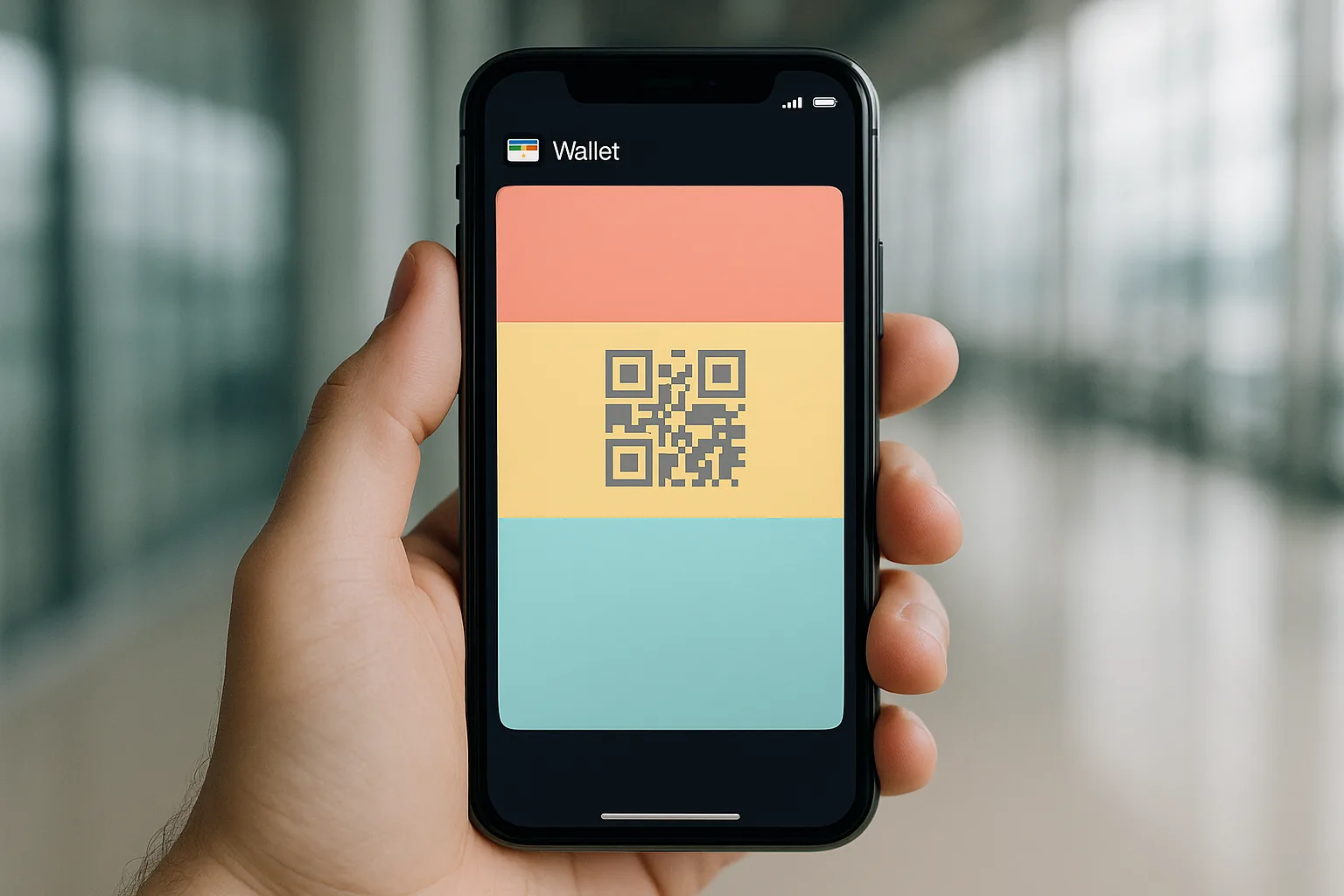
Then there's the "relevant fields" principle. When your gate changes, the airline doesn't issue a brand-new pass. It updates the existing one in place. Your saved pass stays saved, current in your wallet instead of buried under a duplicate you have to hunt for. That small technical choice keeps the whole experience coherent.
And the part almost nobody else uses: contextual lock screen behavior. Your boarding pass surfaces automatically based on time and location. Arrive at the airport, and there it is. Airlines exploited this early. Most other industries have never configured it, even though the feature sits right there in both Apple and Google Wallet, free to use.
The gate-change notification: a masterclass in right-time value delivery
If you want to understand why the airline playbook works, study the gate-change push.
It's the single most celebrated example of wallet pass utility. The gate changes, and seconds later the pass field updates and a notification lands on your phone. No app opened. No check-in. No action from you at all. The information finds you.
Why does it land so hard? Because it arrives at the moment of maximum stress and maximum relevance. You're in an airport, time-pressured, worried about missing your flight. A well-timed update at that exact moment feels like magic. It builds trust faster than any ad campaign and drives word-of-mouth because passengers tell each other about it.
The technical anatomy is elegant. Airlines pipe operational data from their operations control systems, using IATA messaging standards, straight into pass update APIs. When a gate changes in the source system, that change flows to every affected pass at once, updating the field and firing a push notification simultaneously across thousands of passes.
Here's what most industries get wrong. They treat notifications as a place to shout promotions at arbitrary times. Buy now. Flash sale. We miss you. That's noise. The gate change is signal, because it's event-triggered and operationally relevant. The gap between those two things is enormous.
The transferable insight is simple. Any industry sitting on real-time operational data already has the raw material. Transit delays. Table-ready alerts. Order status. Event door times. The pattern is proven. Most companies just haven't wired it up.
The update strategy that kept passes alive
Airlines figured out something subtle: a pass has a lifecycle rather than a single moment of use.
Think about the stages. Pre-trip, you get a check-in confirmation. Day-of, you get your gate assignment, boarding time, and any delays. Post-trip, the pass expires and steps aside. Each stage serves a distinct purpose. Nothing lingers without a job to do.
Timing matters more than frequency. A gate change three hours before departure is noise. The same change twenty minutes before is high-signal. Airlines calibrated this through years of iteration, watching what helped and what annoyed. Most other industries update on their own internal schedule, not on customer need, and it shows.
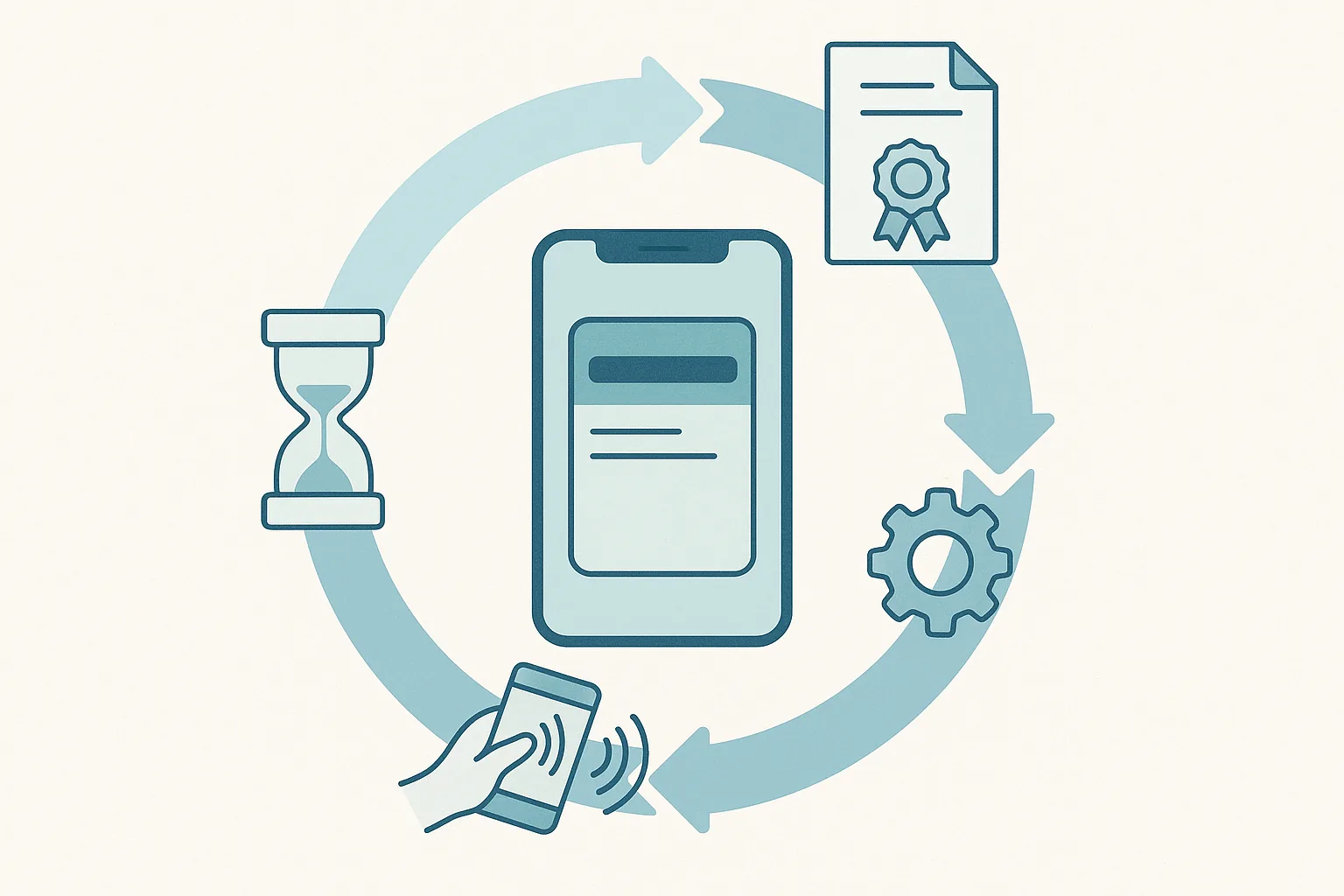
The expiration strategy is worth stealing. After your flight, the pass greys out and moves aside. Your wallet stays clean. Compare that to the retail experience, where expired coupons pile up and clutter the wallet until users stop looking at it entirely. That clutter trains users to ignore the wallet for good.
Here's the compounding payoff. Every relevant, timely update reinforces the habit of checking the wallet. Over time, that habit becomes a reflex. The wallet becomes the first place passengers look. That reflex is exactly what every loyalty and retail program dreams about, and airlines built it one useful update at a time.
What retail, transit, and live events are getting wrong right now
Let's name the misses, because they're instructive.
Retail loyalty passes are usually issued once and then forgotten. No personalized offers pushed to the pass. No location triggers configured. No dynamic point balance that updates as you shop. They become digital business cards. Static. Unused. A logo you never look at.
Transit is the frustrating one, because it's the closest to the airline model. The infrastructure is right there. Riders tap in and out. Agencies know when a line is delayed. Yet many transit passes never use notifications for service alerts, skipping the single highest-value message they could possibly send. "Your train is late" is the transit equivalent of "your gate changed," and it mostly goes unsent.
Live events might be the biggest waste. Tickets are usually static passes with no pre-event updates. No door times. No lineup changes. No parking tips. And nothing after the show ends. No thank-you. No offer for the next date. The pass becomes useless the moment the event ends.
The root cause is the same across all three. These industries treat the wallet pass as a digitized version of a physical artifact. A ticket. A card. A coupon. They forget it's a communication channel with a lifecycle. That's the exact mistake airlines made back in 2008, before they course-corrected.
The opportunity cost is steep. Grocery loyalty, commuter transit, sports seasons. All of them have high-frequency, time-sensitive interactions. They have every ingredient airlines used. The value goes unrealized.
The transferable playbook: five principles any industry can adopt today
None of this is proprietary. Here's the playbook, distilled.
1. Design for the moment of use, not the moment of issuance. Ask what the user needs to see the instant they open their wallet. Build the pass around that answer, not around what your marketing team wants front and center.
2. Wire your operational data to your pass updates. If your system knows something the customer cares about, order shipped, table ready, train delayed, sale started, that event should trigger a pass update. And where it's warranted, a push notification too.
3. Build a pass lifecycle, not a pass moment. Map the pre-, during-, and post-experience stages. Decide what the pass says at each one. Then configure expiration and archival so the wallet stays clean and the user stays uncluttered.
4. Use location and time relevance triggers. Set passes to surface on the lock screen at the right place and time. Store proximity. Event start. Transit stop. This is a free feature of Apple and Google Wallet, and most non-airline passes never turn it on.
5. Measure pass engagement like a channel, not a deliverable. Track update open rates, notification conversion, and pass removal rates the way you'd track email metrics. Then iterate the way airlines iterated their gate-change timing, one adjustment at a time.
The pass is a relationship, not a printout
Come back to that traveler sprinting through the terminal, the one who caught the flight because a notification fired at the right second.
That notification wasn't a happy accident of airline technology. It was the end product of a decade of iteration, infrastructure alignment, and one foundational decision: to treat the wallet pass as a dynamic communication channel instead of a digital printout.
That's the whole thesis. The airline playbook isn't industry-specific or locked behind some special technology. It's a set of design, timing, and update principles available to any product team willing to stop thinking about passes as artifacts and start thinking about them as relationships.
So here's your challenge. Whether you're building a retail loyalty program, a transit card, or an event ticket system, audit your current pass strategy against those five principles. Then find the single highest-value update or notification you could ship this quarter. One useful, well-timed message. That's how the habit starts.
When you're ready to build it, Passmint gives you the API and SDK to generate Apple Wallet and Google Wallet passes, push real-time field updates, and fire notifications the moment your operational data changes. The infrastructure is ready. The playbook is proven. Ship it.
Primary sources
Common questions
Technical content writer, Passmint
Julio is a technical content writer at Passmint. He writes about Apple PassKit, the Google Wallet API, and what breaks when wallet passes meet production traffic.
More from Julio Song →