
It's Tuesday afternoon and you have nine browser tabs open. Four of them are npm packages, three are pricing pages, and two are Apple documentation. You need to put a loyalty card into Apple Wallet by the end of the sprint, and every tab claims to be the easy way.
They are all easy at the first step. Generating a signed pass is a solved problem. What separates these options is everything after the first install, and that is rarely on the landing page. This guide sorts seven of them by the work each one leaves with you, with prices read in early October 2026. Treat any price as a snapshot and check the vendor's page before you commit.
The question that sorts every option
A wallet pass program has three layers of work. Most comparison tables list features and hide this.
Layer one is generation. You build a pkpass bundle, hash every file into a manifest and sign it with your Pass Type ID certificate. Our guide to what a pkpass contains walks through it.
Layer two is the update service. Apple Wallet never polls on its own schedule. Your server hosts the registration endpoints Apple defines, then sends an APNs push when a pass changes, and only then does the phone ask what is new. How the update protocol works covers the sequence.
Layer three is the second wallet. Google Wallet uses a different model, with classes, objects and a signed JWT. Many projects start Apple-only and find out in month two that half their customers hold Android phones.
Every option below does layer one. They differ on layers two and three, and on who pays for the servers. Keep that in mind as you read the prices, because a cheap library with two layers missing is not cheap.
Libraries: passkit-generator and pass-js
The open-source route starts with two Node packages.
passkit-generator is the one most developers find first. It signs .pkpass files for Apple Wallet and nothing else. Its own documentation points to separate companion libraries for the web service and for APNs. We covered the gap in detail in what passkit-generator leaves you to build.
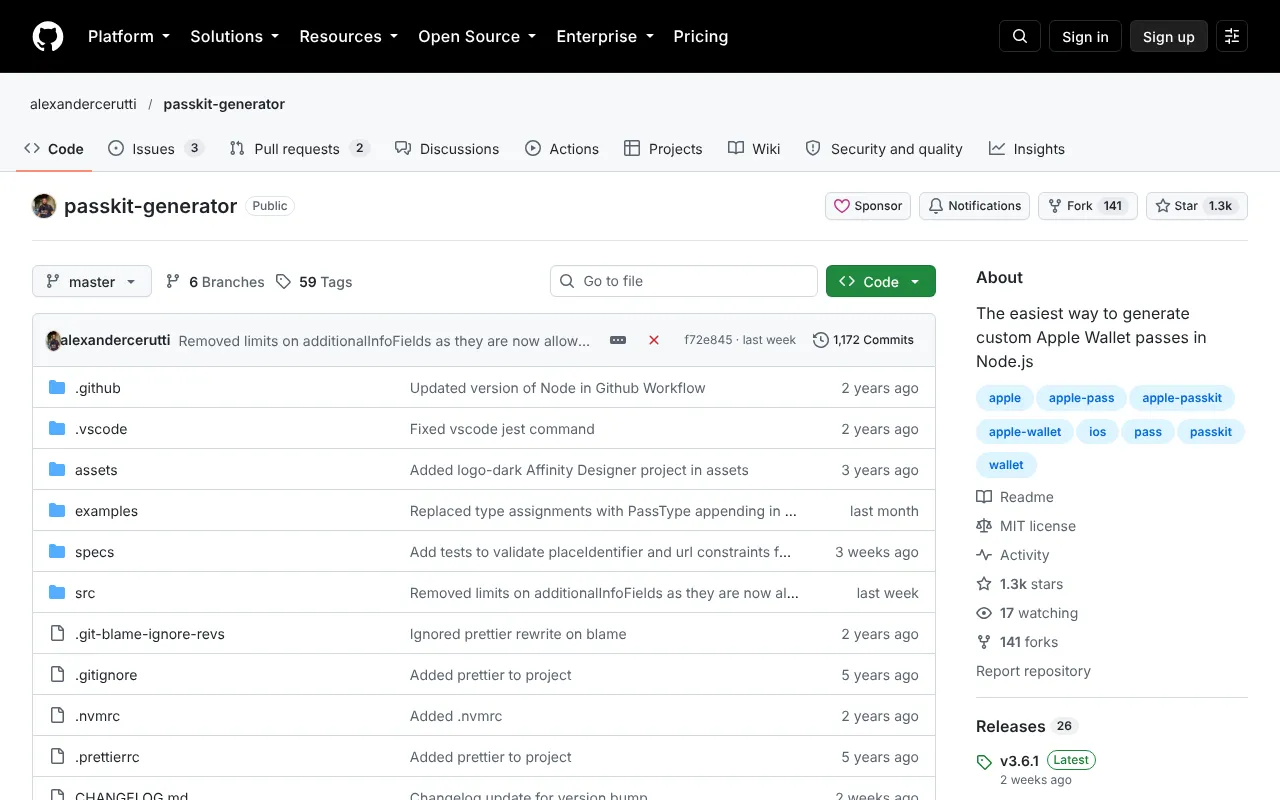
The passkit-generator repository on GitHub, captured 7 October 2026.
@walletpass/pass-js is the other well-known choice. Its README describes passes built from templates or from scratch, localization, NFC and push updates for Apple Wallet, and the package reports zero runtime dependencies. It is licensed AGPL-3.0-or-later, as of its GitHub page this month. If you ship closed-source software, read that license before you read the API.
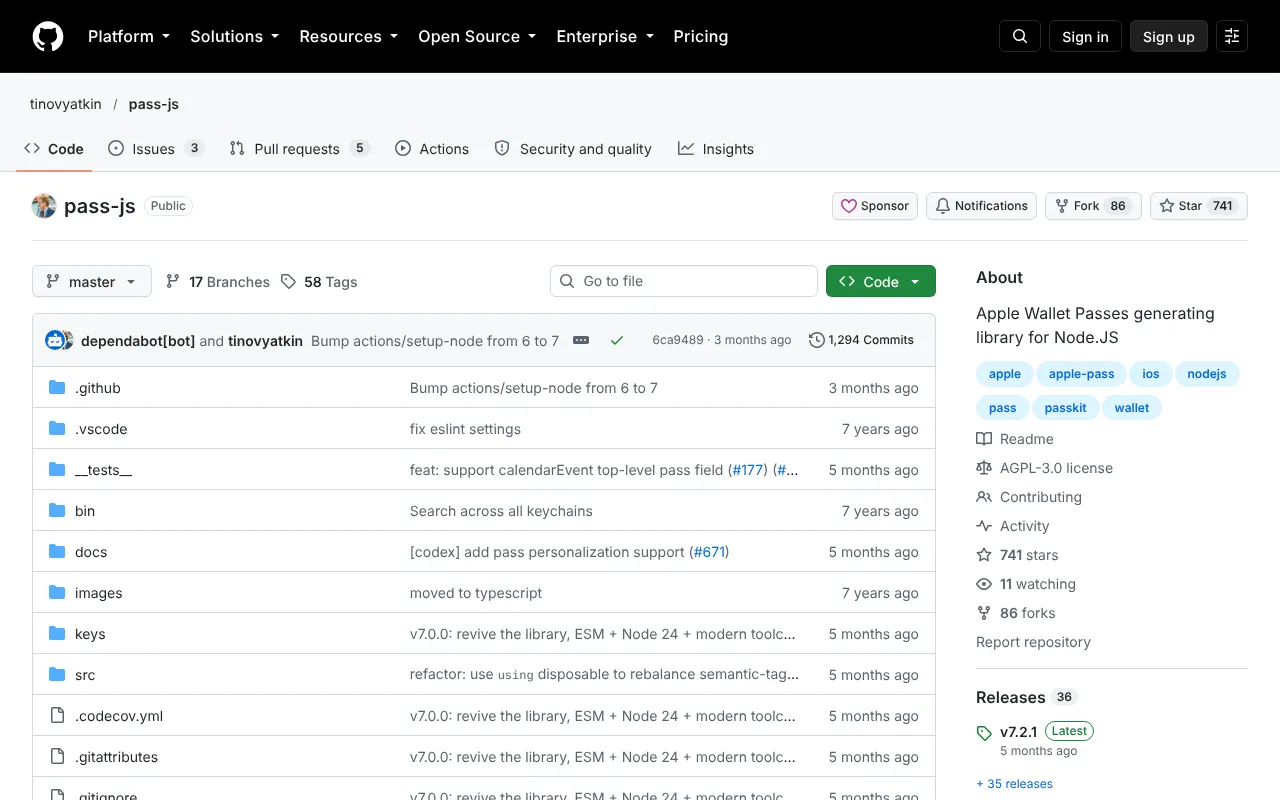
The pass-js repository on GitHub, with the license shown in the sidebar, captured 7 October 2026.
Both are free, and both are a fair choice when you want full control, one wallet and a small number of passes. You host the pass downloads, the update endpoints and the push sender. You also handle certificate renewal, which means you own the failure described in what breaks when a Pass Type ID certificate expires.
The honest cost is your time. A first signed pass takes an afternoon, and a reliable update service takes a lot longer.
PassKit: the broad platform
PassKit.com, not to be confused with Apple's framework of the same name, is the best-known hosted platform. It documents REST and gRPC APIs, official SDKs and solution areas for membership, coupons, tickets and flights. It supports Apple Wallet and Google Wallet.
Its pricing has two parts. A platform fee scales with team members, from $39.50 a month for one person in our side-by-side with PassKit. The fee includes 250 multi-use and 250 single-use passes a month. Pass volume fees then follow tiered rates. PassKit's pricing FAQ says it does not charge per API call and that deleted multi-use passes reduce future bills. It also offers a 45-day trial with no payment method required.
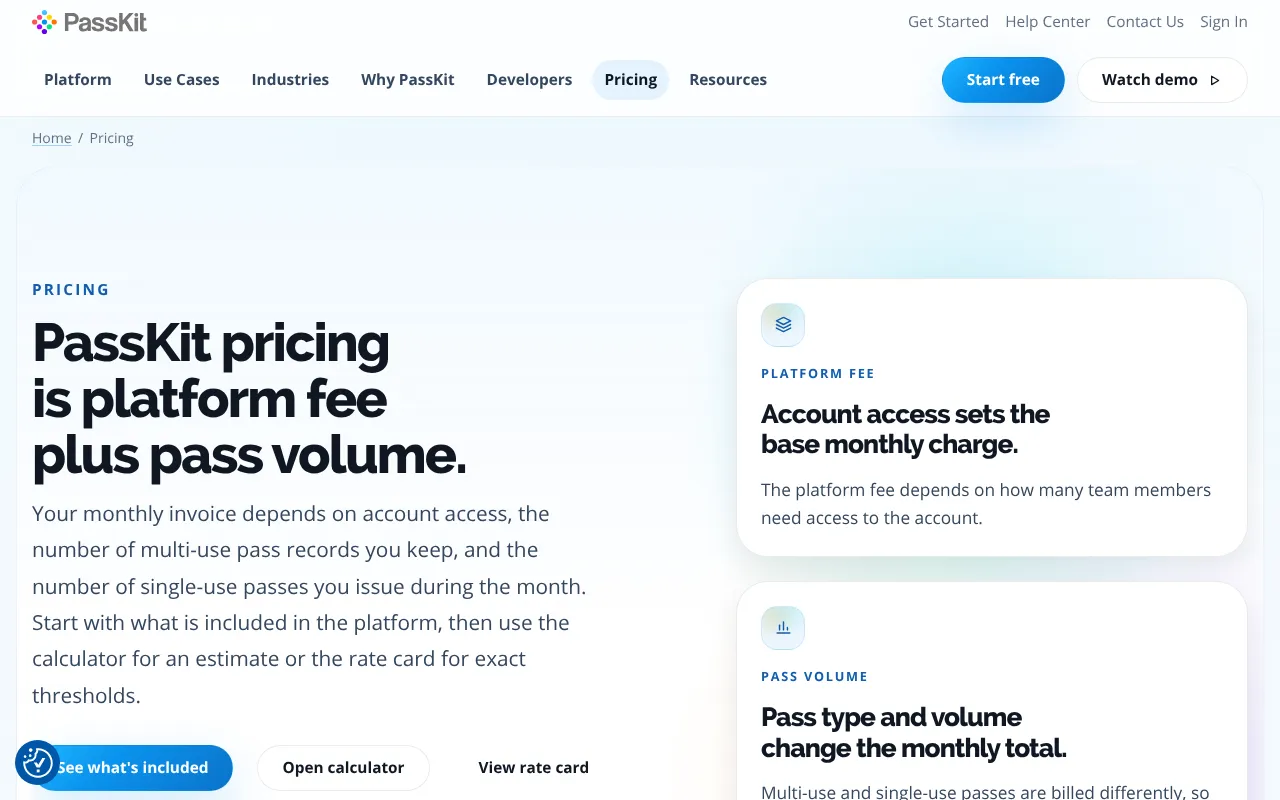
PassKit's pricing page, captured 7 October 2026.
Choose PassKit when non-engineers will work in the tool, when you want gRPC, or when your project spans several pass types. The cost is complexity. You will want a calculator and an afternoon to price it.
PassNinja, Passcreator and Pass2U
Three more hosted services are worth a look, and each prices a different thing.
PassNinja charges per template and per pass. Its pricing page lists $21 a month per pass template plus $0.11 a month per active pass, with $10 in free credits for new verified accounts. It supports Apple Wallet and Google Wallet, NFC, webhooks and on-premises deployment for enterprise customers. SMS or email delivery of passes costs $0.10 a message. The template charge matters if you run many designs, because each one adds to the bill whether or not anyone installs it.
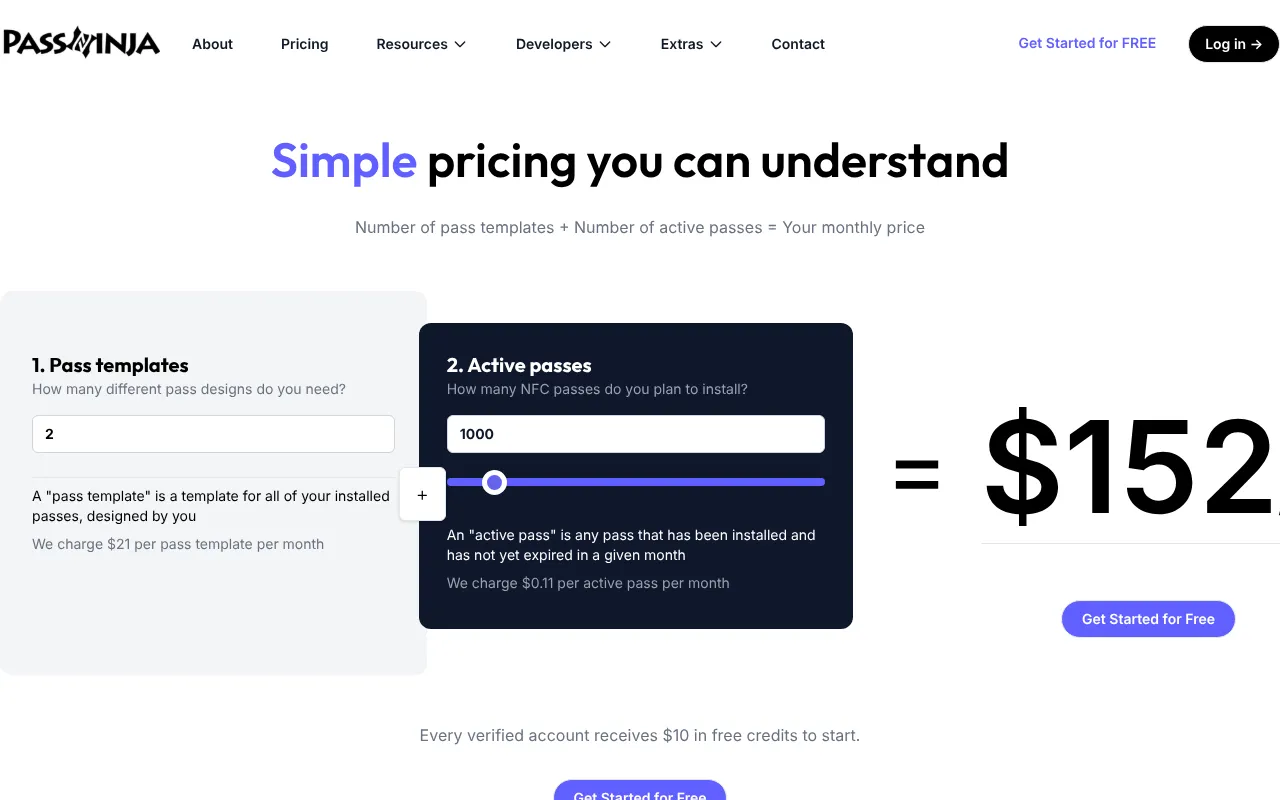
PassNinja's pricing calculator, set to two templates and 1,000 passes, captured 7 October 2026.
Passcreator charges for passes that people actually download. Its page says you can create unlimited passes for free and pay only for the ones downloaded, and the free plan includes 5 active registrations, unlimited push notifications and unlimited API access. It supports Apple Wallet, Google Wallet and Samsung Wallet. It also lists EU-based servers and ISO 27001 certification, which will matter if procurement asks where your customers' data lives. Its page lists Starter at €16 a month for 200 registrations, Professional at €120 for 2,000 and Business at €400 for 10,000, with the per-registration rate falling at each step. Prices can be shown in euros or dollars.
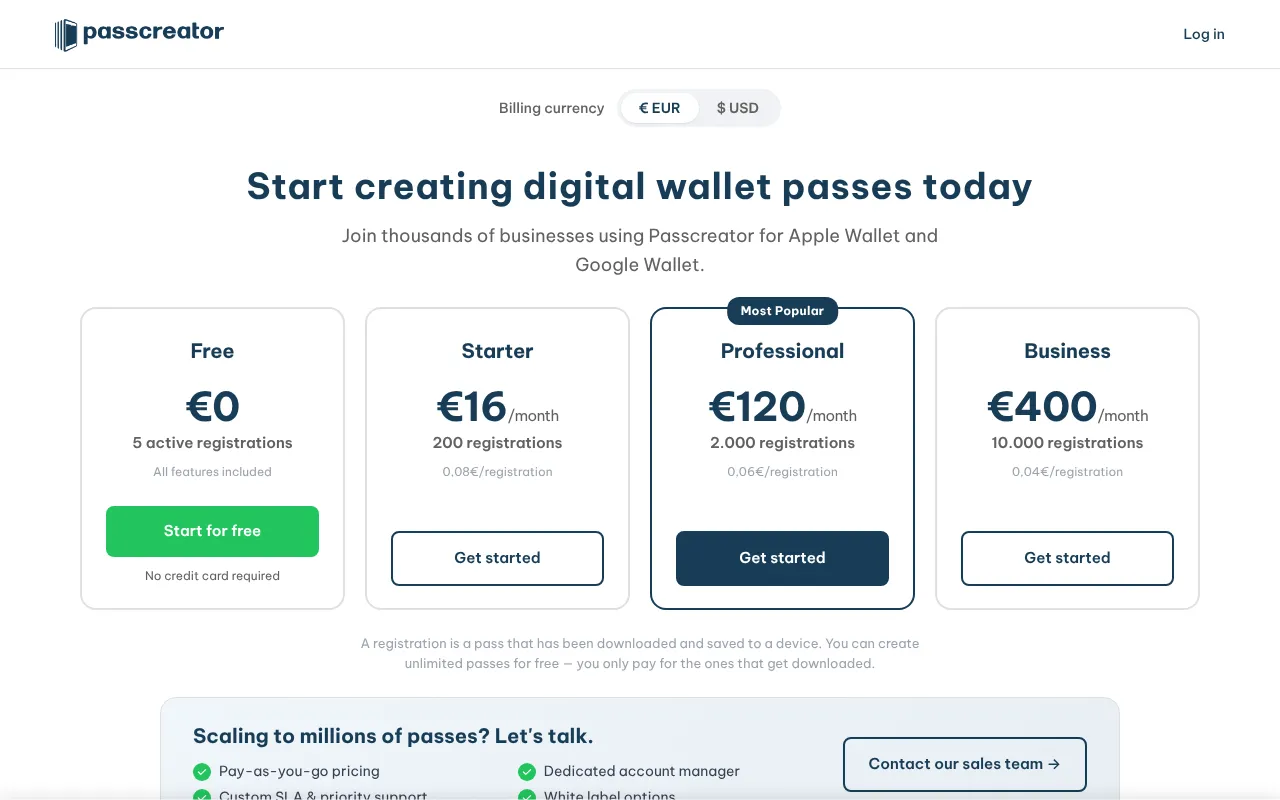
Passcreator's pricing page, captured 7 October 2026.
Pass2U describes a platform to create, distribute and manage Apple Wallet and Google Wallet passes, with a Pass API built on REST. It calls itself a Google Wallet Premier Partner. We could not read its pricing from the page we fetched, so we say nothing about it here. Request a quote and compare it against the others on your own numbers.

Pass2U's home page, captured 7 October 2026.
All three take on layers two and three for you. The differences are the meter, the regional hosting and how much of the surface is API versus dashboard.
Going straight to Google
You can also skip the middleman for one wallet. Google Wallet is the easier of the two to integrate directly, because it has no certificate to renew. You create a Google Wallet API issuer account and use the REST API to define a class, then create objects from it. Developers outside Android also need a Google Cloud account.
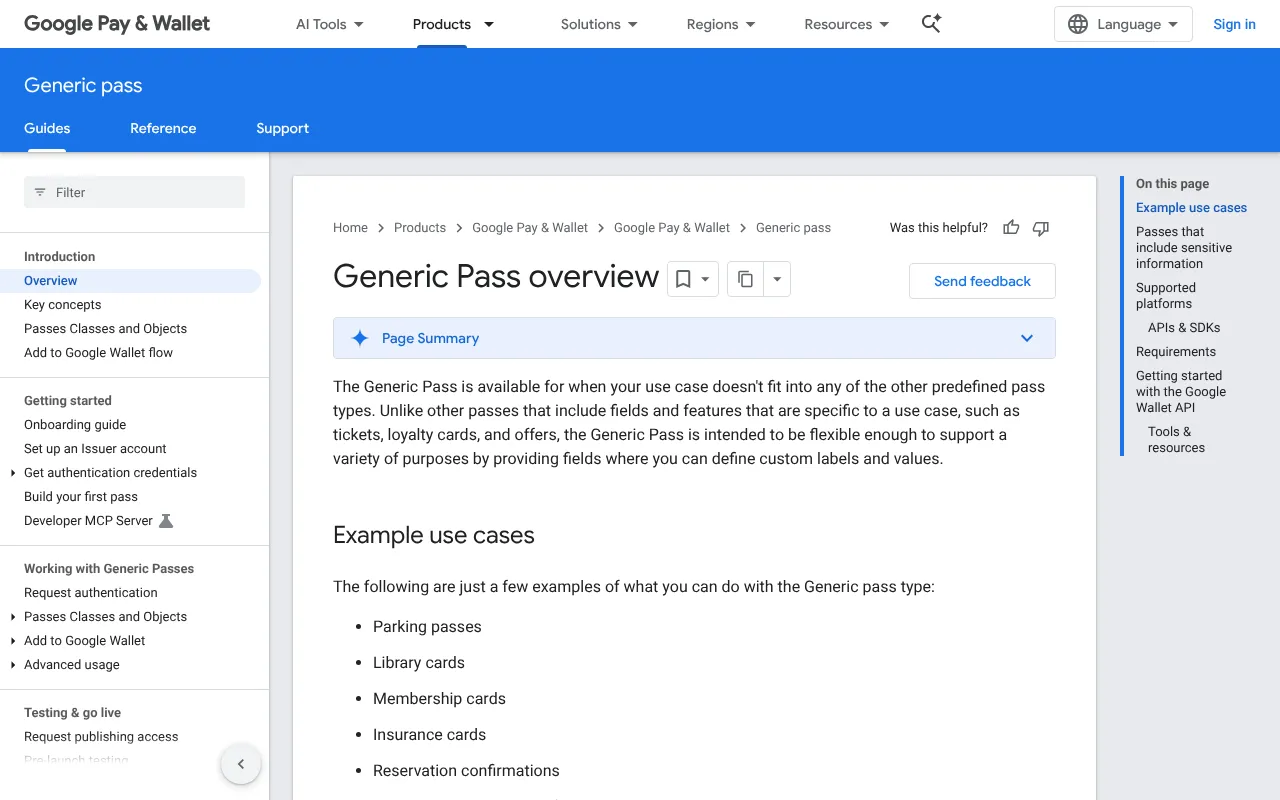
Google's Generic Pass overview in the Google Wallet developer docs, captured 7 October 2026.
That makes Google the easy half and Apple the hard half. A team that integrates Google directly and buys the Apple half is a legitimate pattern, but you now run two systems with two data models. Our Google Wallet JWT flow explainer shows what the Google side asks of you, and Apple and Google rendering differences shows why one design rarely looks right in both.
Passmint
Passmint is a REST API with templates, webhooks and test and live keys. You describe a pass, post it, and get back something both wallets can install. It runs the update service and the pushes for you, and you connect your own Pass Type ID certificate for Apple. The quickstart takes you from an API key to an installed pass.
Pricing is one meter, active passes. Free covers 10 and is meant for building, since live issuance starts on Hobby. Hobby is $15 a month for 500, Pro is $49 for 5,000 and Scale is $149 for 25,000. Paid plans charge $0.01 for each pass over the limit.
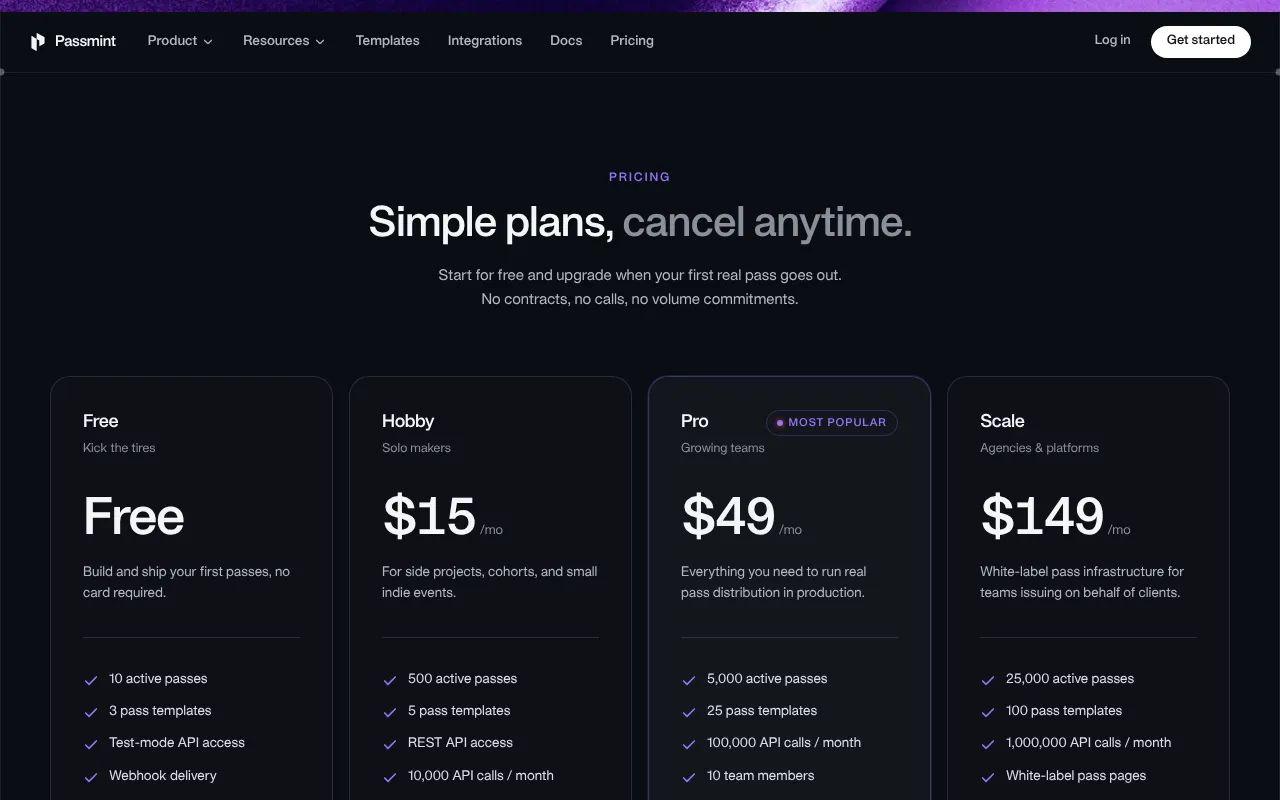
Passmint's pricing page, captured 7 October 2026.
The trade is focus. You get one narrow API aimed at developers. You do not get PassKit's range of solution-specific APIs or a dashboard built for marketing staff. There is also an open-source passmint package for signing passes yourself, so the pass format stays yours if you ever leave.
What a 500-member program costs
Take a representative small program, based on an anonymized example. A coffee shop group has 500 loyalty members, one template and one developer. Here is the rough monthly bill on each hosted option using only the numbers above.
| Option | How the 500-pass bill builds | Rough monthly total |
|---|---|---|
| Passmint | Hobby plan, 500 active passes included | $15 |
| PassKit | $39.50 platform fee, 250 passes included, 250 more at $0.045 | about $51 |
| PassNinja | $21 for one template, plus 500 passes at $0.11 | about $76 |
| Passcreator | 500 registrations falls between Starter (200, €16) and Professional (2,000, €120) | about €16 to €120 by tier |
| Library | Servers, APNs sender and your time | $0 license, plus hosting |
Three caveats keep that table honest. The meters differ, so a pass that never gets installed costs nothing on Passcreator, may cost something on PassKit and counts on PassNinja only while active. A second template adds $21 to the PassNinja line. And the PassKit figure uses the first volume band only, so it moves if your pass mix includes single-use passes.
The table also hides the line that decides most projects, which is the engineer-hours column. Compare a $15 bill against two weeks of building a push sender and the price of the hosted options looks different. Compare a $15 bill against a free library you will never outgrow and it looks different again.
How to choose
Skip the feature matrix and ask four questions in order.
Do you need Google Wallet? If yes, cross off both libraries unless you want to build that half too. If you only ever need Apple Wallet and pass volume is small, a library is a sensible start.
Who touches the tool? If marketing, support and analysts all need access, price PassKit's team tiers and read its dashboard honestly. If only engineers will touch it, a per-seat fee buys you little.
What does your meter count? Count templates if you run many designs, active passes if you have churn, and downloads if many invitations go uninstalled. Run your own member numbers through each calculator, not ours.
Where does the data live? If you have a European customer base, Passcreator's EU hosting is a real point in its favor. Ask every vendor the same question and write down the answer.
Then issue one pass on your shortlist. Connect the certificate, install the pass on your own phone, change a field and time how long the update takes to appear. The platform that gets you there with the least friction is the one your team will keep using.
If a REST call and one meter sounds like your project, start with the Passmint quickstart and see how it goes on the free plan. More at Passmint.
Primary sources
Common questions
Technical content writer, Passmint
Julio is a technical content writer at Passmint. He writes about Apple PassKit, the Google Wallet API, and what breaks when wallet passes meet production traffic.
More from Julio Song →