
The average smartphone user installs far more apps than they use.
Studies from firms like App Annie (now data.ai) and comScore show a clear pattern. Many users have dozens of apps on their phone, often 80 or more. Yet they use only a small number on a typical day. Often this is in the single digits or low double digits.
Your branded loyalty app is almost certainly not in that small group.
That raises a hard question for every brand that has invested in a standalone loyalty app: what exactly are you getting for that money?
Many apps see very steep early churn. Mobile analytics benchmarks often show that roughly 70-80% of users stop engaging within the first few days after install. At the same time, cost per install for many commercial app categories has risen into the low to mid single digits in US dollars in developed markets. That combination often leads to a monthly active user rate that would make any CFO flinch.
Wallet passes are different. These lightweight digital cards live inside Apple Wallet and Google Wallet. They can deliver much higher ongoing engagement at a fraction of the cost because they are simpler to adopt and easier to keep.
This article is not a feature comparison. It is a financial argument. By the end, you will have a concrete ROI framework you can use in an internal business case. The goal is to justify shifting a significant share of your loyalty engagement from a standalone app to wallet passes.
If you decide to test this, platforms like Passmint can launch your first wallet pass campaign in days rather than months.
The true cost of a standalone loyalty app (it's more than you think)
Most teams underestimate the full lifecycle cost of a loyalty app. They budget for the build and ignore almost everything that comes after.
Here is a simple breakdown with realistic planning assumptions.
Initial development for custom iOS and Android loyalty apps often runs into the tens or hundreds of thousands of dollars. Many brands see total build budgets in the $50K to $300K range, depending on complexity. Even a relatively simple loyalty app with account management, push notifications, a points ledger, and reward redemption often exceeds $80K once design, QA, and integration are included.
A common planning rule of thumb is that annual maintenance runs about 15 to 20% of the original build cost every year. This covers OS update compatibility, security patches, bug fixes, and app store compliance changes. Actual percentages vary, but maintenance is rarely trivial.
User acquisition is where costs climb fastest. Industry benchmarks frequently place cost per install (CPI) for retail and loyalty-type apps in the low to mid single-digit dollar range in many developed markets. These costs have generally trended upward over time. If you pay an effective CPI of $3.50 to $5.50, acquiring 50,000 users can cost $175K to $275K before a single reward is redeemed.
Then you have the ongoing costs most teams underestimate:
- QA testing across device and OS combinations
- Backend infrastructure and hosting
- Analytics tooling and attribution platforms
- Customer support for login, password, and account issues
- App store optimization (ASO) work and spend to maintain visibility
Add it all up over three years and the total cost of ownership often surprises people.
| Cost Category | **Year 1 ** | Year 2 | Year 3 | 3-Year Total |
|---|---|---|---|---|
| Development | $120K | $120K | ||
| Maintenance | $20K | $20K | $20K | $60K |
| User Acquisition | $175K | $80K | $50K | $305K |
| Infrastructure & Support | $25K | $25K | $25K | $75K |
| Total | $340K | $125K | $95K | $560K |
In many mid-market scenarios, three-year TCO for a loyalty app lands between a few hundred thousand dollars and upwards of $800K, depending on build scope and user acquisition spend.
The hard part: many consumer apps see monthly active user (MAU) rates in the single digits as a percentage of total downloads, especially when the app is used only for loyalty.
Now compare that to a wallet pass program. A Passmint-powered deployment can often launch in days because you do not need to build and submit a native app. You distribute passes through links, QR codes, and channels you already own, such as email, SMS, web, and in-store, instead of relying only on paid installs.
The download-to-active-user death spiral
The retention curve for mobile apps is steep.
Public benchmarks from analytics firms like Adjust and AppsFlyer show that many apps lose the majority of their initial users within the first few days. In some categories, roughly 70-80% of users stop engaging by Day 3. By Day 90, only a small fraction, often mid single digits to low double digits, are still active.
The main reason is friction. Every step in the app adoption funnel loses people.
Think through the chain: app store search, download wait, permission prompts, account creation form, email verification, password setup, first open. Each step drops a share of the original intent. By the time someone opens your loyalty app for the first time, you have already lost most of the people who started the process.
Wallet pass adoption removes much of that friction. A customer taps a link or scans a QR code. The pass appears in their native wallet app in a few taps. There is no separate app download. In many implementations there is no additional account to create at the point of adding the pass.
There is also a second effect: passive presence. A wallet pass lives inside Apple Wallet or Google Wallet, not as another icon on the home screen. It does not usually trigger the "I should clean up my phone" moment that leads to app deletions. It sits there, ready, and can surface on the lock screen when it is relevant.
When we compare programs that have used both approaches, the retention difference is significant.

In internal analyses across multiple programs, we have seen wallet passes retain a higher share of users at Day 3 and Day 90 than comparable standalone loyalty apps. In some deployments, wallet passes have kept roughly three to four times as many active users at 90 days compared to the prior app-only approach. Exact numbers vary by brand and audience, but the drop-off curve is consistently less steep for passes.
Push notifications: the engagement channel you are losing
Even if users keep your app installed, reaching them is a separate problem.
Benchmarks from mobile engagement platforms show iOS push opt-in rates in the roughly 40-50% range and Android rates around 70% or higher. These vary by category and OS changes over time. Average click-through rates are often in the low single digits, around 2-3%.
Run the math on a 50,000-user base. If about 46% allow notifications and 2.5% click through, your actual engaged reach per send is roughly 575 people.
Wallet-related notifications work differently. Apple Wallet passes can receive updates from your server. When users have Wallet notifications enabled, those updates can appear as lock-screen alerts and pass changes. Google Wallet offers similar behavior. These updates are not tied to a separate, brand-specific app's push permission. They rely on the system Wallet app's notification settings instead.
When you update a field on a wallet pass, for example a new points balance or a new offer, Apple Wallet and Google Wallet can surface that change natively. In many real-world programs, this mechanism has produced higher effective visibility than traditional app pushes, although exact delivery and engagement rates depend on user settings and implementation.
Apple Wallet and Google Wallet can also surface relevant passes contextually. A customer walks near one of your locations. If you set location data on the pass and the user's settings allow it, their loyalty pass can appear on the lock screen automatically. Points balance changed. A Wallet notification can appear without requiring users to open a separate app. Time-sensitive offer expiring. The pass can show updated content or a reminder.
This combination drives the engagement multiplier. Higher retention, higher effective notification visibility in many implementations, and higher contextual relevance together mean wallet passes can generate several times more monthly active engagement touchpoints than a standalone app for the same audience.
Real-world data supports this pattern. In one anonymized mid-size coffee chain we worked with, monthly redemption interactions rose from about 11% of enrolled users to roughly 43% within 90 days after shifting from an app-centric program to wallet-based loyalty passes. The customer base was the same. Engagement was not.
Case study: a QSR brand pivots from a $180K app to a wallet pass
Here is a composite case study drawn from real QSR (quick-service restaurant) program data.
Starting point. A regional QSR chain with 120 locations invested heavily in a branded loyalty app. Over two years, they accumulated 80,000 downloads. Their monthly active user count was 6,200. That is a 7.75% MAU rate.
Modeled cost reality (based on actual spend ranges):
- $140K initial app build
- $28K per year in maintenance
- $45K in user acquisition spend
- $12K per year in backend hosting
- Total 2-year investment: about $237K for 6,200 active users
That is roughly $38.22 per active user.
Wallet pass alternative. The brand deployed Passmint-powered loyalty passes. Distribution used in-store QR codes on table tents and register displays, plus email and SMS to existing lists. There was no new app store submission and no new app download.
Within the first 60 days in this composite scenario, around 34,000 passes were added at near-zero marginal acquisition cost. Distribution flowed through owned channels and in-store traffic. The passes lived in customers' Apple Wallet and Google Wallet apps, surfaced on lock screens near store locations for users with appropriate settings, and updated balances after every transaction.
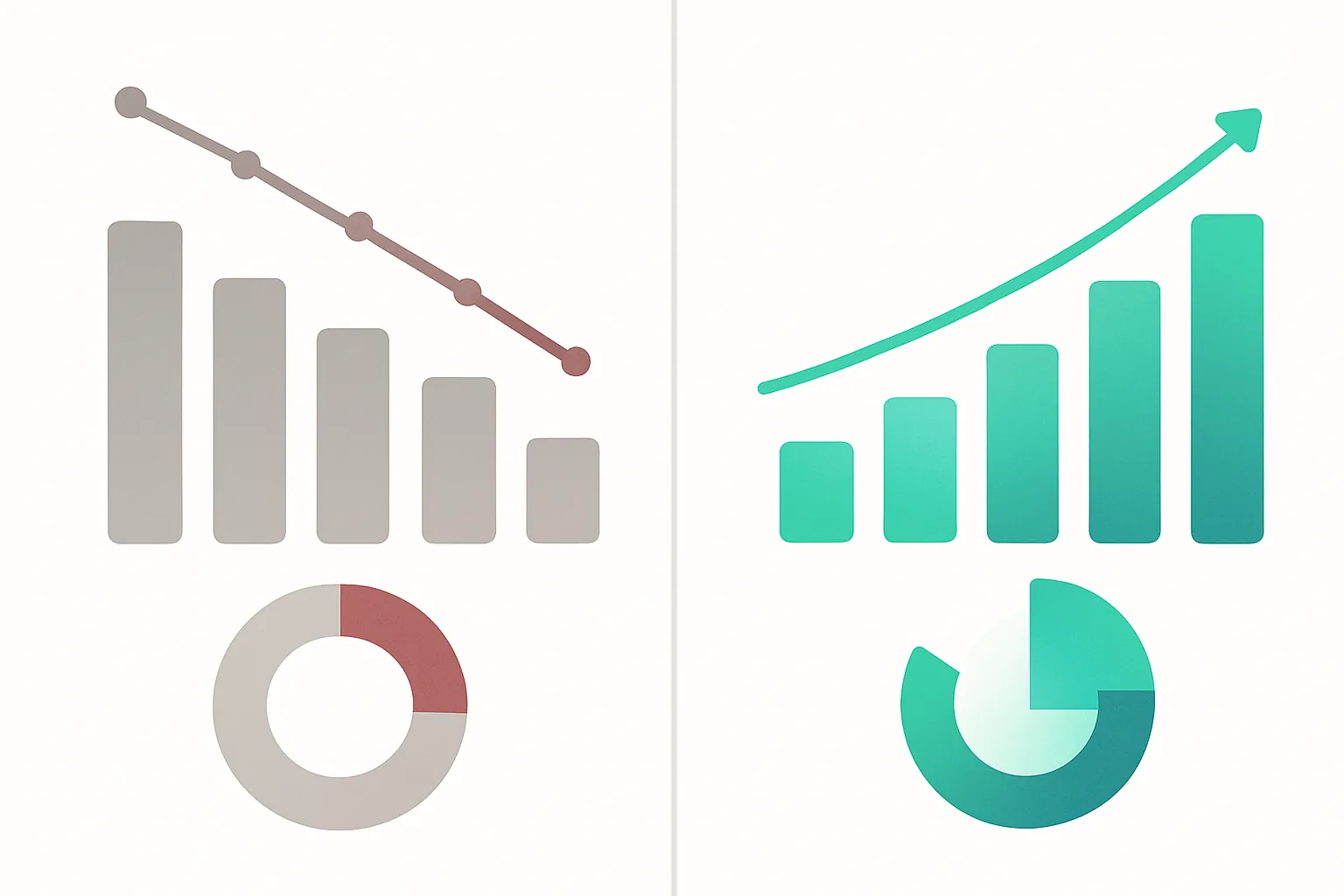
Modeled results in this composite case:
- Monthly active engagement rate about 43% (vs. 7.75% with the app)
- Reward redemptions about 3.1× higher
- Average visit frequency among pass holders about 3.4 visits per month (up from 2.1)
- First-year wallet-pass program cost about $18K (platform fees, design, campaign setup)
- Annualized app cost it replaced about $118K (maintenance, hosting, user acquisition allocation)
In that scenario, the shift represented roughly an 85% reduction in annual program cost with many more active users. The per-active-user cost dropped from about $38.22 to under $1.10.
Actual results vary by brand, but the cost and engagement dynamics often look similar.
The ROI framework: building your internal business case
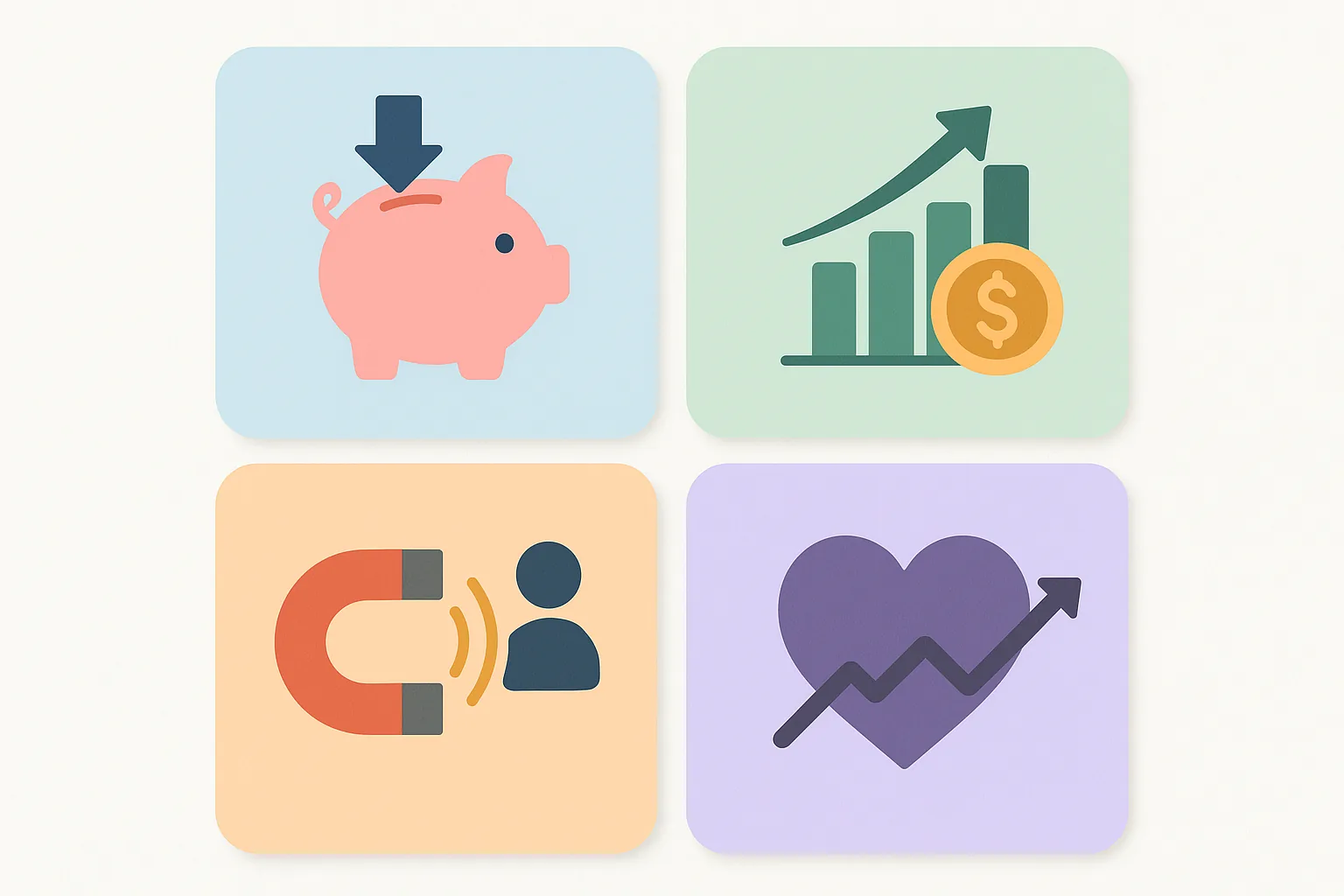
Your VP of Finance needs a framework they can test with your own data. Here is a simple, adaptable four-quadrant model.
Quadrant 1: Cost savings
Calculate the app development, maintenance, hosting, and user acquisition spend you eliminate or reduce by shifting a significant share of loyalty engagement to wallet passes.
Quadrant 2: Incremental revenue
Estimate higher engagement multiplied by average transaction value multiplied by increased visit frequency. Even modest lifts here can generate meaningful incremental revenue.
Quadrant 3: Reduced customer acquisition cost
Wallet passes distributed via owned channels such as email, SMS, in-store signage, receipts, and web carry near-zero marginal cost. This compares to paid app installs that can cost several dollars each in many markets.
Quadrant 4: Lifetime value uplift
Better retention curves extend customer lifetime value (LTV). In many recurring-purchase businesses, modeled scenarios show that even modest improvements in retention can translate into 20-40% or more higher LTV, depending on margins and visit frequency.
Worked example with realistic inputs
Take 25,000 enrolled users with a $22 average order value. With a standalone app at an 8% MAU rate, you have 2,000 active users generating about 5,000 monthly visits at 2.5 visits per month. That is $110,000 in monthly attributed revenue.
Shift to wallet passes at a 40% MAU rate. Now you have 10,000 active users making 25,000 monthly visits. At the same $22 average order value, that is $550,000 in monthly attributed revenue. The difference is $440,000 in incremental monthly revenue from the same enrolled base.
Even if you conservatively attribute only 15% of that lift directly to the channel shift, you still see $66,000 in incremental monthly revenue.
Break-even speed
In our experience and client programs, many wallet pass initiatives reach positive ROI within a few months. Often this happens within 45-60 days for straightforward deployments. Many standalone loyalty apps need a year or more to cover initial development and user acquisition. That difference matters when you present to leadership.
Rebuild this framework in a spreadsheet with your own inputs and the comparison takes about an hour.
A note on the hybrid approach
If your brand already has an app that handles complex functions such as mobile ordering, account management, or in-app payments, wallet passes do not have to replace it. They can serve as the lightweight engagement layer. Passes can handle everyday touchpoints like balance checks, notifications, and reward redemptions, while driving high-intent users back to the full app for deeper actions. It is not either or. It is about using each tool where it performs best.
Common objections (and why they do not hold up)
"Our app does more than loyalty."
That is true for many brands. But if you audit your analytics, you will likely find that most loyalty-related interactions are simple: check my balance, get a notification, redeem a reward. None of these inherently require a full app. Wallet passes can handle them natively and push users to your app or site for high-value actions like ordering.
"We have already invested in our app."
That is a classic sunk-cost problem. The money already spent is gone regardless of what you do next. What matters now is what your ongoing spend delivers per active user compared to the alternatives you have today.
"Wallet passes feel limited."
Modern wallet passes support dynamic content updates, brand-aligned visual design, multiple barcode formats (including QR, PDF417, Code 128, and Aztec), location-based relevance, time-based relevance, and deep links back to web or app experiences. Platforms like Passmint provide APIs and integration tooling so you can create and update passes programmatically. In practice they are far more dynamic than a static card image.
"Our customers prefer apps."
Customers prefer convenience and value. Retention data across the app ecosystem shows that most customers do not actively use most of the apps they download. A single-digit MAU rate is not strong preference. It is weak, sporadic engagement. If you give customers an easier way to get the same value with less friction, many will take it.
"We need user data and analytics."
Wallet pass platforms can track events such as pass creation, updates, and specific redemption or usage actions. Location hints and update events can also provide insight into engagement patterns, depending on implementation and privacy controls. Passmint's platform includes analytics dashboards built on these signals. You get visibility into install volumes, activity, and campaign performance without requiring customers to install a separate app or grant extensive permissions.
The dollar-per-engagement question
The useful comparison is not "app vs wallet pass" in the abstract. It is where each dollar of your engagement budget delivers the highest return.
For a large share of loyalty, membership, and repeat-visit use cases, wallet passes can deliver substantially higher active engagement at a lower cost than a net-new or heavily promoted standalone app. In the composite and real-world examples above, shifts from app-centric to wallet-centric engagement have produced:
- Multiple-times higher monthly active engagement compared to the prior standalone app
- Large reductions in ongoing program costs once development, maintenance, and paid acquisition are included
- Positive ROI in months rather than a year or more
You can run the analysis with your own numbers. Pull your current MAU rate, your per-active-user cost, your average transaction value, and your visit frequency, and see what the math says.
When you are ready to test this, Passmint can often get your first wallet pass campaign live in days, without an app store review cycle.
Your engagement budget should work harder. Wallet passes are one of the most efficient ways to make that happen.
Primary sources
Common questions
Technical content writer, Passmint
Julio is a technical content writer at Passmint. He writes about Apple PassKit, the Google Wallet API, and what breaks when wallet passes meet production traffic.
More from Julio Song →