
Picture this. A retail brand wraps up its holiday campaign and the numbers look great. Fifty thousand Apple Wallet passes installed. The marketing team celebrates. The slide deck practically writes itself: "Wallet campaign: 50K installs, massive success."
Then fast-forward 90 days.
Someone pulls the engagement report and the room goes quiet. Nearly 40% of those passes are gone. Deleted, or sitting dormant in wallets that never open them. No taps. No redemptions. No signal at all. The installs looked like a win. What followed was a steady, invisible decline.
Here is the uncomfortable truth. Most brands measure their wallet pass programs at the wrong finish line. They celebrate the install and stop watching. But the install is step one, not the goal. The real story unfolds over the next three months, and it usually ends badly.
This piece is for the product managers, marketers, and developers building on platforms like Passmint who want to stop the erosion before it starts. We will break down why 90 days is the danger zone, the four things quietly killing your passes, the psychology behind the delete button, and a five-step audit you can run this week.
The 90-day cliff: understanding the wallet pass churn inflection point
Start by defining the problem properly. Silent churn comes in two forms, and they are not equal.
The first is active deletion. A user taps delete and the pass is gone. Painful, but at least it is visible. You can count it.
The second is passive disengagement. The pass stays installed but goes completely dark. Never opened, never scanned, never thought about. This one is harder to spot and more damaging, because your install count still looks healthy while your actual engagement drops underneath. You are reporting a number that means nothing.
So why 90 days? Three forces converge at that mark.
Novelty wears off. The honeymoon effect applies to passes too. That fresh, useful feeling fades in about a month, and by day 90 it is fully gone. Second, 90 days usually maps to a brand's first full promotional cycle, so the reason someone installed the pass has already come and gone. Third, notification fatigue compounds. Push too hard early and users have already learned to ignore you.
Product managers know app retention figures by heart. Apps lose roughly 77% of their users within three days of install. Brutal and fast. Wallet passes face a slower curve, but do not mistake slow for gentle. Pass abandonment tends to peak between 60 and 90 days. The cliff just arrives later, which makes it easy to ignore until it is too late.
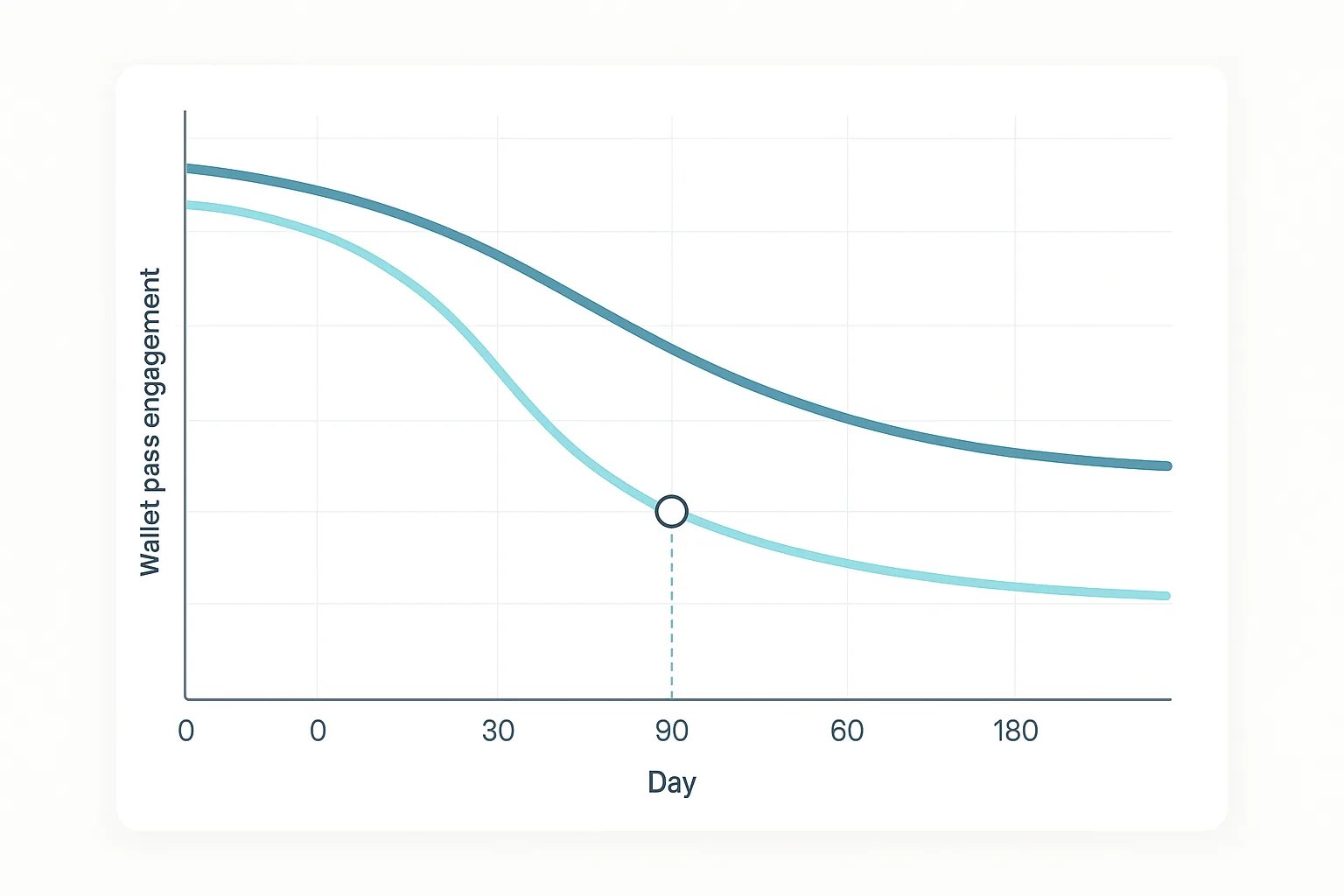
One more thing matters here. Two very different people churn at 90 days, and treating them the same wrecks your strategy.
- Impulse installers added the pass for one specific job. A flight, a concert ticket, a one-time discount. Once the job is done, the pass has no reason to exist.
- Loyalty seekers meant to stick around. They wanted ongoing value, but a weak experience pushed them out the door.
Conflate these two groups and you will build retention tactics that miss both. The impulse crowd needs a reason to stay that they never signed up for. The loyalty crowd needs you to deliver on a promise you already made.
The four killers: what's actually driving pass abandonment
Churn rarely has one cause. In wallet programs, it usually traces back to four specific mistakes.
Killer #1: Notification fatigue. Brands treat wallet passes like an email list and blast notifications in the first 30 days. That is a mistake. Apple Wallet and Google Wallet notifications are tied to pass updates and location relevance, and users grant that permission expecting restraint. Abuse it and people quietly turn notifications off, or delete the pass entirely to make it stop.
Killer #2: Stale pass design. A pass that looks identical on day 1 and day 90 sends one message: nothing is happening here. The same hero image, the same color strip, the same offer baked into the layout months ago. It signals neglect. Even if you are active behind the scenes, a frozen design tells users you have forgotten them.
Killer #3: Misaligned value at install versus after install. Someone installs a boarding pass to board a plane. They install an event ticket to get through the gate. That value is real, but it is time-bound. If you never replace it with a durable reason to keep the pass, deletion becomes inevitable. The value that drove the install has to be replaced with value that outlasts it.
Killer #4: No dynamic content updates. This is the critical one. Brands that skip real-time updates, balance changes, personalized offers, location triggers, tier status, let their passes become digital clutter. The pass becomes that expired coupon buried in a drawer. Present. Invisible.
Notice the pattern. Every one of these killers is a symptom of the same problem: treating the pass as a campaign artifact instead of a living customer touchpoint. Fix the mindset and the four killers start solving themselves.
Behavioral psychology behind the delete button
People do not delete passes randomly. They run a quiet cost-benefit calculation, and understanding it changes how you build.
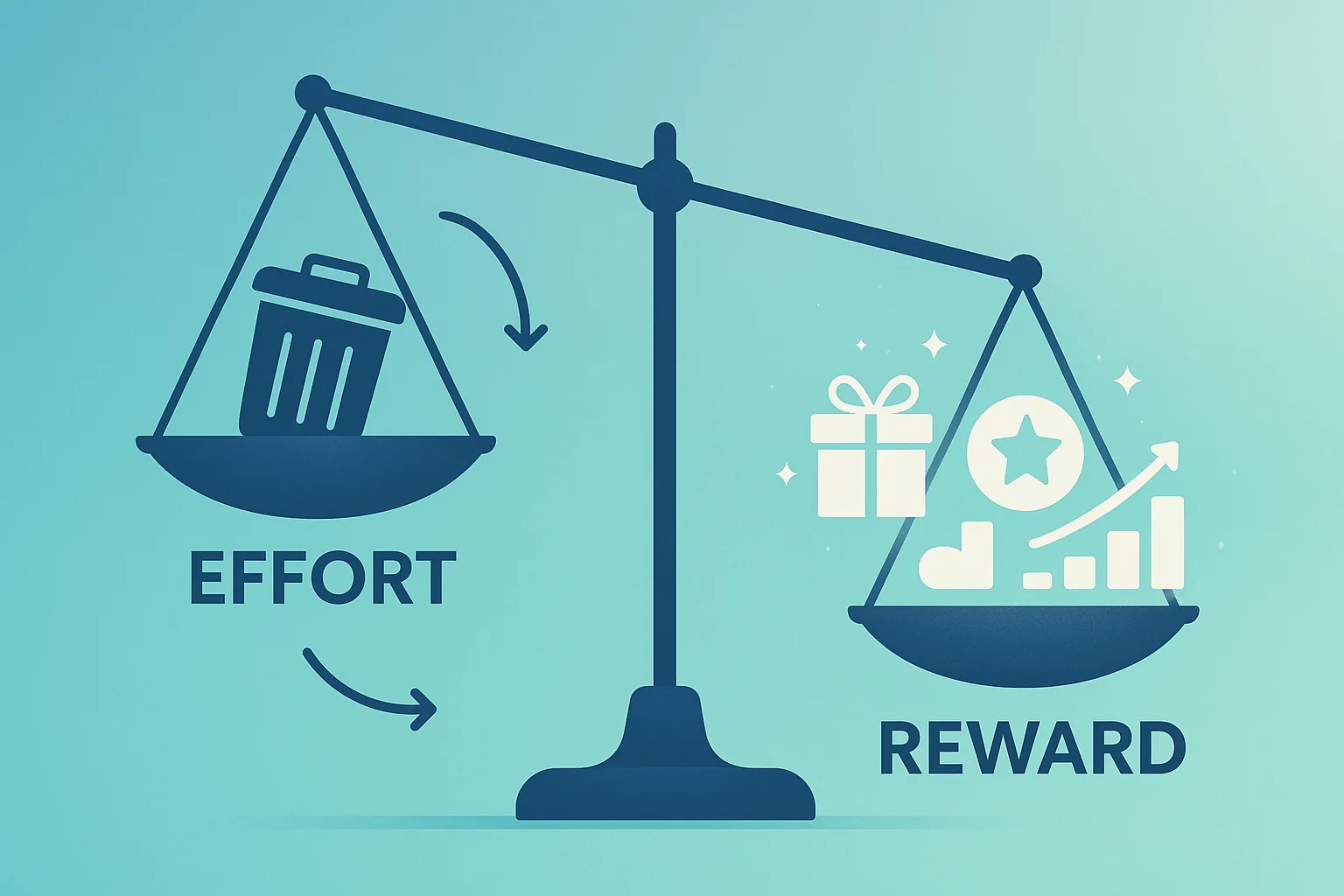
Think of it as effort versus reward. Every pass in a wallet is silently judged. On one side sits the effort: scrolling past an irrelevant pass, dismissing a stale notification, mental clutter. On the other sits the reward: a relevant offer, real savings, a status update they care about. The moment effort outweighs reward, the delete button wins.
There is a second factor worth knowing. The Zeigarnik effect says people remember and fixate on incomplete tasks. A loyalty card showing "7 of 10 stamps toward a free coffee" creates a real pull. That unfinished progress keeps users coming back. Remove the progress indicator and the pull disappears. The user has no sense of momentum and no reason to return.
Then there is contextual relevance decay. A pass feels useful the day you install it because it matches your situation. Over time that relevance fades unless you refresh it. Match the content to the user's current context, their location, the season, their recent purchases, their loyalty tier, and the pass stays relevant. Ignore context and the pass becomes an orphan.
Finally, use loss aversion. People hate losing something more than they enjoy gaining it. A pass that surfaces an expiring reward, a tier downgrade warning, or a limited-time offer taps directly into that response. "Your 500 points expire in 5 days" drives action that "earn points today" never will. Deploy it before churn, not after.
Case studies: how three brands reversed the 90-day churn curve
Theory is useful. Results are better. Here are three examples of brands that turned the curve around.
Retail: a fashion loyalty program. A mid-market apparel brand watched 38% of its holiday passes vanish within 90 days. Their fix had three parts. They pushed dynamic balance updates after every transaction so the pass always reflected reality. They swapped the static hero image for seasonally rotating artwork tied to new collections. And they added a "next reward" progress bar. The result: 90-day retention climbed around 27%, and pass-driven redemption revenue grew quarter over quarter.
Hospitality: a boutique hotel group. Guests were deleting passes the moment they checked out, because the pass had zero post-stay value. The team rebuilt it as a persistent membership card. It surfaced return-guest offers, anniversary perks, and local partner discounts between stays. They added geo-triggered notifications that fired when a cardholder came within five miles of a property. The result: 60-day post-stay retention tripled, with a clear lift in repeat bookings traced back to pass re-engagement.
Healthcare: an urgent care network. A regional urgent care group issued passes for patient check-in, then watched patients delete them after a single visit. They extended the pass's role. It started delivering appointment reminders, prescription pickup alerts, and annual wellness check nudges. A one-time check-in tool became an ongoing care companion. No-show rates dropped, patient lifetime value improved, and pass retention beat their old SMS reminder abandonment rates by a wide margin.
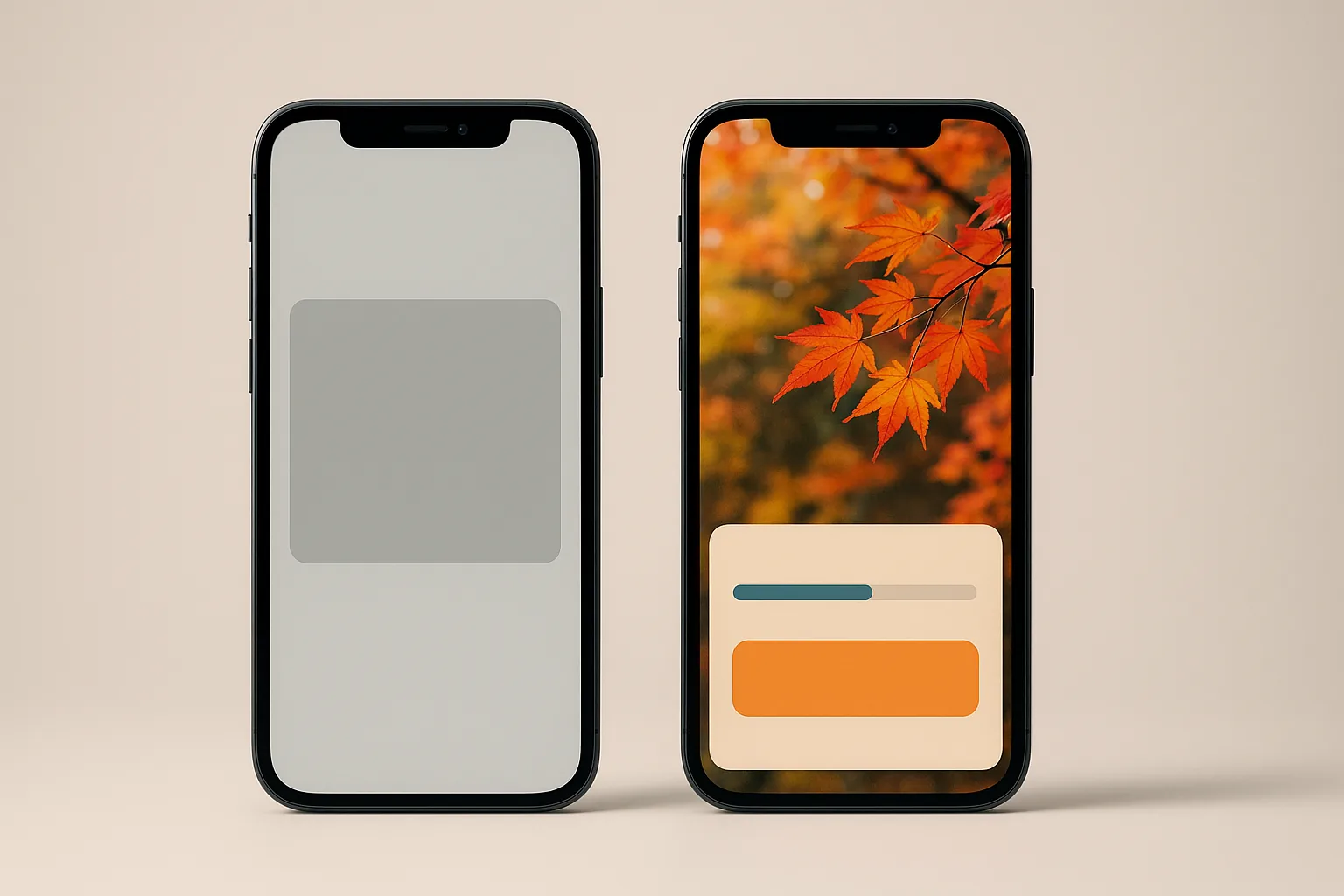
The common thread is clear. Every brand shifted from a campaign pass model to a lifecycle pass model. The pass stopped freezing at the moment of install and started evolving alongside the customer relationship.
The pass lifecycle audit: a framework for product managers and marketers
Ready to run your own diagnosis? Here is a five-step audit you can start today.
Step 1: Instrument your churn metrics first. You cannot fix what you cannot see. Look past installs. Track active pass rate (opened or redeemed in the last 30 days), notification opt-out rate, deletion velocity by cohort (install date, acquisition channel, pass type), and a dormancy threshold that flags at-risk passes after 14 days of silence.
Step 2: Audit your value cadence. Map every touchpoint your pass delivers across days 1 through 180. If the map goes blank between day 30 and day 90, you have just found your churn window. Now fill it. Inject at least two or three moments of value into that gap: a tier update, a personalized offer, a contextual reminder.
Step 3: Evaluate your pass for dynamism. Ask a simple question. Is any field on your pass updated after install? If the honest answer is rarely or never, your pass is static by default. Check which fields connect to live data:
- Balance
- Offer text
- Expiry date
- Tier label
- Hero image
Identify which are connected to your backend and which are orphaned.
Step 4: Recalibrate notifications. Review frequency, timing, and relevance by segment. Add suppression logic for anyone silent for 14 or more days. Send them a re-engagement message, not another promotion. And separate your two notification types. Update notifications (the pass content changed) see far higher tolerance than marketing notifications (promotional push). Lean on the former.
Step 5: Build a re-engagement trigger at day 60. Do not wait for the cliff. Set up an automated sequence at day 60 of dormancy. A "we updated your pass" push, a surprise bonus reward, a loyalty status nudge. Intercept churn while it is still quiet, before it becomes a deletion.
Building retention into your pass architecture with Passmint
Architecture matters here. The four killers all trace back to passes that do not evolve, and that is exactly what Passmint is built to prevent.
Passmint's dynamic update capabilities connect pass fields to live data sources, so your passes change automatically without manual re-issuance. A balance updates. A tier label shifts. A seasonal hero image rotates in. All of it happens automatically, which directly addresses the stale-design and static-content killers.
Segmentation and notification tools let you build cohort-specific re-engagement sequences. Impulse installers and loyalty seekers get different messages based on their behavioral signals, so you stop treating two distinct groups as one.
The analytics dashboard surfaces the leading indicators of churn before the cliff arrives. Dormancy rates, notification opt-out trends, field-level update frequency. You get the warning signs early enough to act.
And the template and design system encourages dynamic-first passes from the start. Seasonal artwork rotations, progress bar fields, and personalized offer zones get structured into the architecture at build time, not added in a panic three months later.
The teams that win treat their pass infrastructure as a retention engine rather than an issuance pipeline. That single shift is what turns an installed base into a real loyalty asset.
Conclusion: obsess over day 90 as much as day 1
Go back to those 50,000 holiday installs.
The wrong question is "how do we get to 100,000 installs?" The right question is "how do we make sure 45,000 of those original 50,000 are still active at day 180?" That reframe is the whole point.
Wallet pass churn is not a user problem. It is a design and strategy problem. It comes from treating the pass as a campaign output instead of a living customer relationship. The four killers, notification fatigue, stale design, misaligned value, and missing dynamic content, all flow from that one mistake. The five-step audit is your way out.
Wallet adoption is growing fast, and early-adopter enthusiasm will not carry programs forever. The brands that win from here will be the ones that care about day 90 as much as day 1, and build their pass programs for the long game from the very first install.
Primary sources
Common questions
Technical content writer, Passmint
Julio is a technical content writer at Passmint. He writes about Apple PassKit, the Google Wallet API, and what breaks when wallet passes meet production traffic.
More from Julio Song →