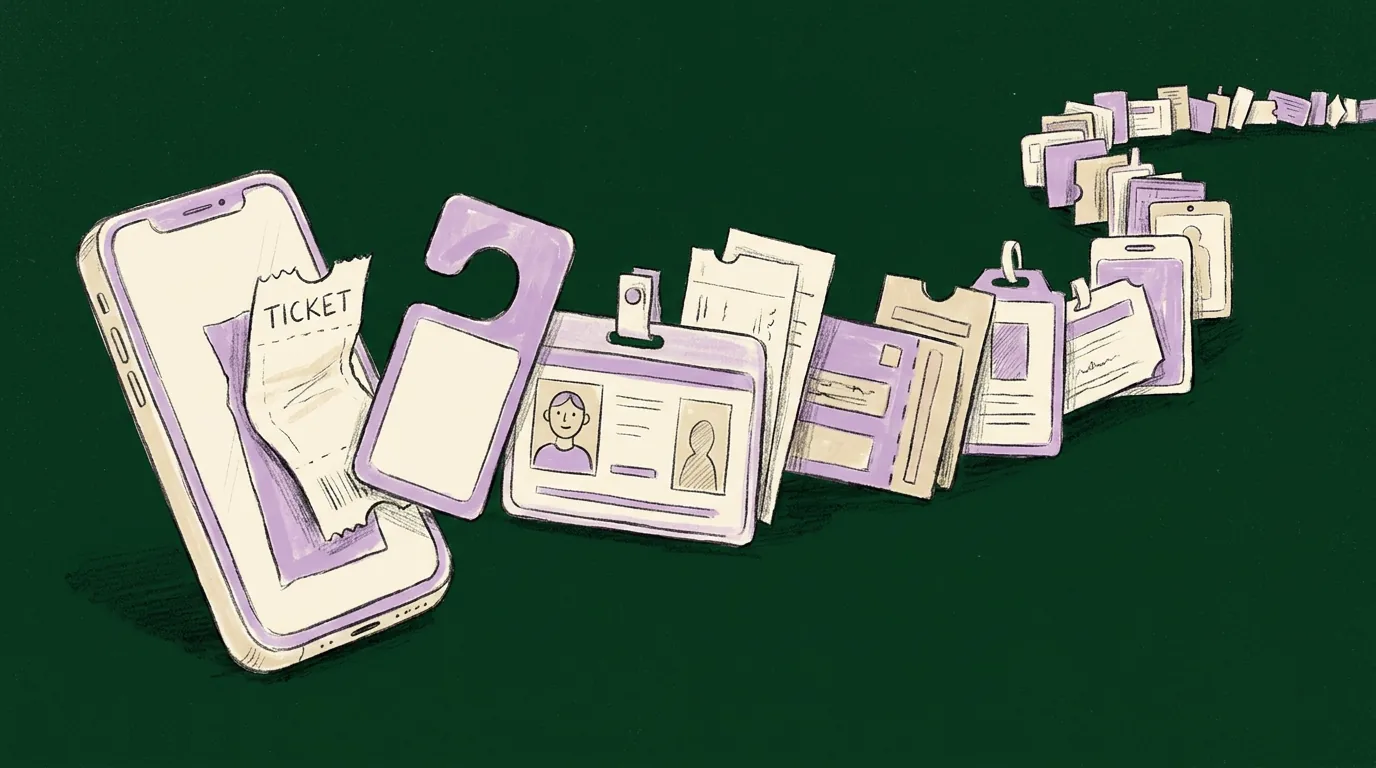
It's 10:15 on a Saturday morning in October, at a state university of about 14,000 students. A sophomore named Maya is walking her parents from a gravel overflow lot to the stadium. Her dad has a parking confirmation in his email, somewhere under 40 unread messages. Her mom has a guest ticket as a PDF that won't zoom. Maya has a screenshot of her own student ticket, which the gate may or may not accept. Her plastic ID is in her dorm room, because nobody told her she would need it.
Her school does not have a mobile student ID. It has been "looking into it" since before she applied.
Maya is invented, but you probably recognise the morning. Four different campus offices each issued her family something, and not one of them landed in the place her phone already keeps tickets and cards. The registrar is waiting on the ID project. Everyone else is waiting on the registrar.
They don't have to. This piece is about the passes a university can issue while the ID committee is still meeting: which ones, who already does it, and what order you should build them in.
Everyone started with the hardest pass on campus
When Apple brought student IDs to Wallet in 2018, it began with three schools: Duke, Alabama and Oklahoma. A year later, trade publication Digital Transactions reported that a dozen more colleges with over 100,000 students between them were joining, and that students at the early schools had already bought 1.25 million meals and opened more than 4 million doors with a phone or a watch.
That was eight years ago. The list has kept growing, and it is still short.
Look at the largest vendor in the space. Transact and CBORD, the two card system companies most campuses run on, merged under Roper Technologies in August 2024 and rebranded as Illumia in early 2026. Illumia's site says more than 1,111 colleges and universities run on its systems, serving 12 million students a year. Transact's own mobile credential pages, before the rebrand, put the number of campuses live with a wallet ID at roughly 125.
That is about one in nine of the vendor's own customers. Against the 5,819 institutions the National Center for Education Statistics counted for 2023-24, including 2,691 four-year and 1,496 two-year schools, it is about 2 percent.
The reason is not a lack of interest. The student ID is the most demanding credential a campus owns, and we covered why in an earlier piece on campus ID programs. It opens doors, so it has to work over NFC with the phone locked. It spends money, so it touches every register. Apple's own support page says a student needs a participating school and the latest version of the school's app before the ID can be added at all.
Every one of those requirements is a dependency on somebody else's calendar.
Eight years in Austin
The clearest case study is the University of Texas at Austin, because the university published its own timeline.
On March 23, 2026, UT announced that university IDs are coming to Apple Wallet and Android wallets. The announcement credits Student Government, whose president and vice president passed the legislation that pushed it over the line. It also says something candid: students have sought digital IDs since 2019.
The launch date in that announcement is the 2027-28 academic year.
Do the arithmetic. A flagship with more than 55,000 students, a serious technology department and visible student demand needs about eight years from the first ask to the first tap. UT's release says the digital ID will handle building entry, campus dining and retail, event entry and library services, and that students will no longer pay fees for lost IDs. It will run in tandem with physical cards during the transition.
None of that is slow by the standards of the category. It is what the category costs. The ID has to be right on day one, at every door, because a credential that fails at a dorm entrance at 2am is a safety problem and a headline.
Even in Austin, a student who enrolled in fall 2023 will graduate before that ID ships. For four years, everything else she carries from the university still arrives as plastic, paper, email or a screenshot.
That "everything else" is where you have room to move.
Meanwhile, the ticket office already moved
Athletics did not wait for the card office. It could not afford to.
Penn State went first. In August 2019, Ticketmaster announced that Penn State would be the first college to use its SafeTix technology for football, and that student tickets were moving to a fully digital platform. Local outlet Onward State spelled out what that replaced: swiping a student ID at Gate A of Beaver Stadium. Each ticket was tied to the student's account, carried a barcode that changed continuously, and could be saved to a mobile wallet for a tap at the gate.
The student ID had been the ticket, and the ticket office took it out of the flow.
Ohio University did the same in August 2021 for a very different budget. Its announcement says full-time students claim free tickets to football, basketball and volleyball online, download them to Apple Wallet or Google Wallet, and present them from the wallet at the gate "instead of student IDs". The tickets are non-transferable. Texas tells fans plainly that screenshots do not work with its NFC tickets, so the ticket has to be in a wallet to scan.
Why did athletics move so fast? Because it has a problem a pass is good at. The Wall Street Journal's 2018 analysis of ticket scans from 96 football programs found that scanned attendance in the 2017 season averaged about 71 percent of the announced crowd. The Oregon Journalism Project ran a similar exercise in October 2026, drawing on scan records a reporter had gathered from 55 public universities, and found roughly one in five Oregon ticket holders, and 37 percent at Oregon State, never came through the gate.
Students are the worst of it. ESPN reported after the 2013 season that close to half of Arizona's student season ticket holders skipped an average game, and about 26 percent of Michigan's did. Those numbers are old, and each school counts differently, so treat them as a direction and not a benchmark.
A ticket in the wallet gives you two things a card swipe never did. You know who claimed a seat before kickoff, and you have a channel to reach them. A pass can change on the phone on Friday to say the gates open early, or that a claimed seat will be released if it is not scanned by the end of the first quarter.
Commencement is the biggest guest list you run
If athletics is the weekly event, commencement is the annual one, and it has quietly become a ticketing operation.
Boston University is a good marker. In April 2025, BU Today explained that the university was moving its main ceremony from open attendance to ticketed entry. Each graduate received four digital tickets through a platform called Tassel, could request more while capacity allowed, and forwarded them to family. Each ticket carried a QR code that scanned once.
Other schools go a step further and put the ticket in the wallet. Cornell told its 2025 graduates that guest tickets could be added to Apple Wallet or Google Wallet. USC has told guests that printed copies of a mobile ticket would not be accepted. Buffalo's commencement tickets are mobile only.
Think about who holds those tickets. A grandparent who flew in. An uncle who has never opened your portal and never will. A guest list is the hardest audience you have, because none of them have an account with you.
That is the case for a pass over a portal. Your graduate forwards a link. The guest taps once, and the ticket sits beside their boarding pass. It shows the gate, the time and the seat with no signal, which matters when 20,000 people share one cell tower. If the ceremony moves indoors for rain, you change the pass and every phone gets the new venue.
The permit, the library card and the front desk
Three more offices have the same opening, and each one already owns a scanner or a database that makes it easy.
Parking. Many campuses have already killed the hangtag. UConn moved to license plate recognition in August 2021, and its announcement says virtual permits removed the need for decals and hang tags. The plate is the permit. What the driver lost in that trade is any proof they can hold. A permit pass gives it back: the lot, the plate on file and the expiry, all in one place. It also covers the people a plate reader handles badly, like game day visitors and a parent in a rental car. We went through the details in the parking permit piece.
The library. A library card is a number and a barcode. The circulation desk already has a handheld scanner. A pass that carries the same barcode works the day you issue it, as long as you match the symbology the scanner expects. That last clause has teeth, and the Codabar story explains why.
Recreation and guests. The rec center sells guest passes and summer memberships to people who are not students and never get an ID. Housing checks in overnight guests. Admissions runs campus tours for 17-year-olds and their parents. All of these are visitors with a date range and a name, which is exactly what a pass holds.
Notice what these have in common. A staff member or a camera reads the pass. Nothing has to respond to a phone held near a door, so none of them needs the approval the ID does.
One pass or five?
Your first instinct may be to build one "campus pass" that does everything short of opening doors. Resist it.
A wallet pass that taps a reader is a controlled capability. Apple grants NFC pass certificates to approved partners, and Google runs an equivalent program called Smart Tap. A barcode pass needs neither. That line decides what you can ship without asking anyone.
| Pass | Who reads it | Needs NFC approval | Owner |
|---|---|---|---|
| Student ID for doors and dining | Door and register readers | Yes | Card office |
| Student game ticket | Gate scanner | No, unless you want tap entry | Athletics |
| Commencement guest ticket | Handheld scanner | No | Events |
| Parking permit | Plate camera, or an officer | No | Parking |
| Library card | Circulation scanner | No | Library |
| Rec or housing guest pass | Front desk tablet | No | Rec, housing |
Five offices, five expiry dates, five systems of record. Fold them into one pass and you have made five teams agree on a release schedule, which is the same committee that delayed the ID.
Issue one pass per job instead. Tie them together behind the scenes with the identifier your systems already share, and keep that identifier out of the barcode where you can. A random token that your back end resolves is safer than a student number printed in a scannable code. Student records in the US are covered by FERPA, and your counsel will have a view on what belongs on a lock screen.
Two rules keep this from turning into clutter. A pass should expire and say so, because a stale permit in the wallet is worse than none. And a pass should never pretend to be the ID. If it does not open the dorm, do not make it look like the card that does.
A representative campus, and where it goes wrong
Consider a regional public university of about 9,000 students, based on an anonymized, invented example. It has no mobile ID and no budget line for one. It does have a ticket office with handheld scanners, a parking office on plate recognition, and a commencement that fills a 6,000-seat arena twice each May.
It starts with commencement, because the deadline is fixed and the pain is fresh. Each graduate gets a link to claim five guest tickets as passes. The events team watches the claim count rise through April and stops guessing how many chairs to set.
Next is parking. Permit holders get a pass that shows their lot and plate. The office changes nothing about enforcement. It only stops answering the email that asks "is my permit active?"
Then it goes wrong, in a small and typical way. Athletics issues student tickets as passes, but the gate staff were trained on a ticketing app with a rotating code. A student arrives with a screenshot of her friend's pass. The static barcode scans, and so does the friend's real one ten minutes later.
The fix is in the scanner, not the pass. Mark a ticket used on the first scan and reject the second, which is what a single-use scan policy is for. Decide that rule before the first home game, not after it.
Whether any of this saves money is something you should measure on your own campus. The honest claim is narrower: three offices shipped in two semesters, and nobody waited for a reader upgrade.
Start with the office that already owns a scanner
If you run technology, auxiliary services or events at a college, here is an order that tends to hold up.
- List what you issue. Count every card, tag, PDF and confirmation email a student or guest receives in a year. The list is longer than you expect.
- Pick the one with a deadline. Commencement and the first home game are fixed dates. A date ends debates.
- Match the reader first. Check what your scanners can read before you design anything. The pass follows the hardware.
- Ship both wallets. Your students carry both iPhones and Android phones, and a guest list is whatever phones your families own.
- Use the update. Put the thing that changes on the pass: the gate, the lot, the rain plan, the expiry.
- Leave the doors alone. Keep the NFC ID as its own project, with its own budget and its own calendar.
When the mobile ID does arrive, none of this is wasted. Your students will already have the habit of looking in the wallet for anything the university gives them, and your offices will already know how to issue and revoke a pass.
Maya's school will get its ID eventually. Until then, her dad could have had the parking pass on his lock screen as he turned into the lot, and her mom could have had a ticket that zoomed.
Passmint issues passes for Apple Wallet and Google Wallet from a single API call, and updates them after they are installed. If you want to try a guest ticket or a permit on your own phone, the quickstart gets you to a first pass in a few minutes.
Primary sources
Common questions
Technical content writer, Passmint
Julio is a technical content writer at Passmint. He writes about Apple PassKit, the Google Wallet API, and what breaks when wallet passes meet production traffic.
More from Julio Song →